

 English

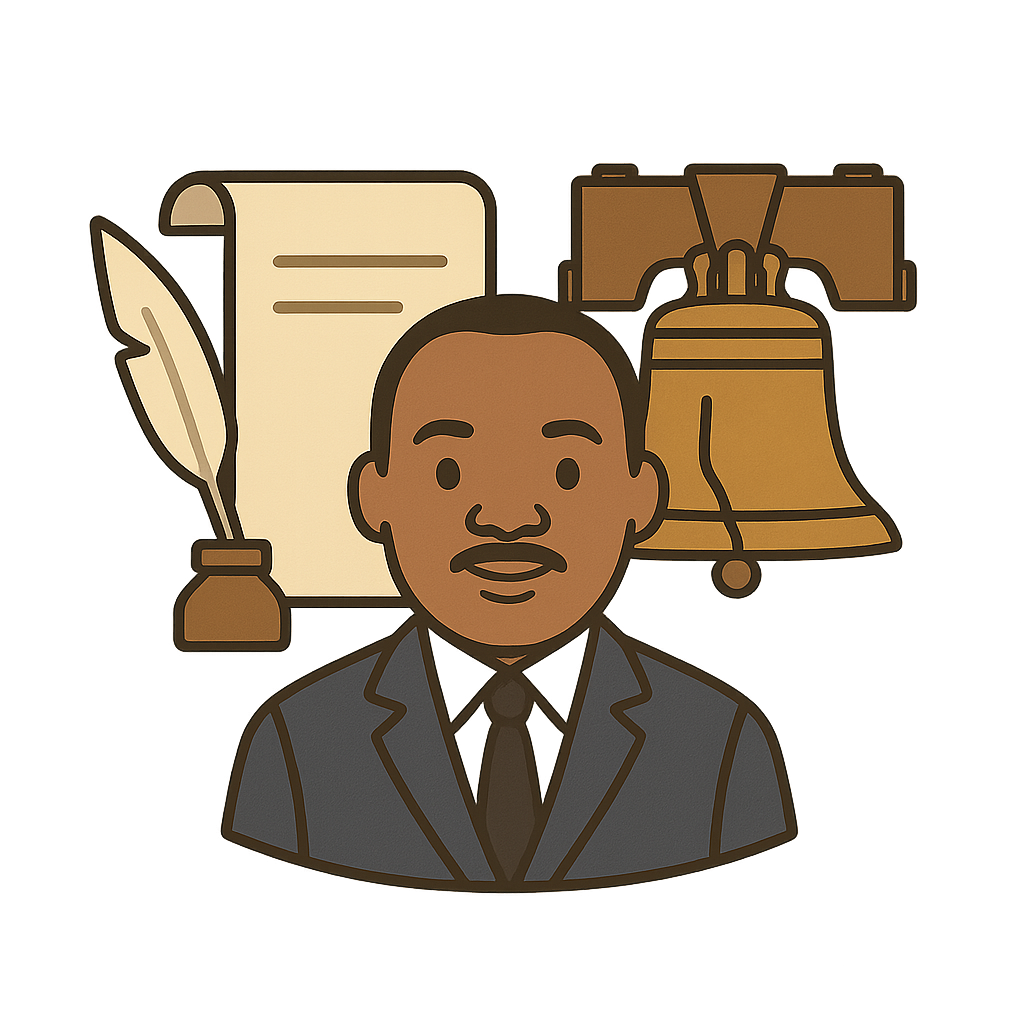
A Drum Major for Justice
Hello there. My name is Martin Luther King Jr. I grew up in a busy, sunny city called Atlanta, Georgia, in a home filled with love. My father was a pastor and my mother was a teacher, and they taught my sister, my brother, and me that we were special and loved. But outside our home, the world had some very unfair rules. These rules were called segregation. It meant that because of the color of our skin, which was Black, we were not allowed to go to the same schools, drink from the same water fountains, or even sit in the same parts of a bus as white people. It felt confusing and hurtful, and it didn't seem right that people were treated differently just because they looked different. My parents always told me, 'Martin, you are just as good as anyone.' They taught me that everyone, no matter their skin color, is somebody and deserves to be treated with respect. Those words became a little seed planted in my heart. That seed grew into a big dream—a dream of a world where people would be judged not by the color of their skin, but by the goodness in their hearts.
When I grew up, I became a pastor, just like my father. I knew I had to use my voice to help that dream grow. I became a leader in what we called the Civil Rights Movement, a large group of people working together to change those unfair laws. Our first big test of strength came in Montgomery, Alabama. On December 1st, 1955, a very brave woman named Rosa Parks was told to give up her seat on a bus to a white person. She quietly and firmly said, 'No.' Her courage inspired thousands of us. We decided to stop riding the buses until the rules were changed. For 381 long days, we walked everywhere—to work, to school, to the store. It was called the Montgomery Bus Boycott. Our feet got tired, but our spirits never did. During this time, I taught people about a powerful idea: nonviolent protest. It meant we would fight for our rights not with our fists, but with our words, our peaceful marches, and our love. Even when people were angry and unkind to us, we met them with peace because we believed that love was the only way to drive out hate. Our movement grew stronger, and on a hot summer day, August 28th, 1963, something amazing happened. More than 250,000 people—Black and white, young and old—gathered together in Washington, D.C. I stood on the steps of the Lincoln Memorial and looked out at a sea of hopeful faces. The air buzzed with excitement and unity. It was there that I shared my dream with the world. I told them, 'I have a dream that my four little children will one day live in a nation where they will not be judged by the color of their skin but by the content of their character.' It felt like the whole world was listening that day.
That march, and all our peaceful protests, made a big difference. The government listened. New laws, like the Civil Rights Act of 1964, were passed to end segregation and make our country fairer for everyone. The path was not easy, and many people faced difficult and dangerous times. But we knew we were fighting for what was right, and that gave us the strength to carry on and never give up. Today, there is a special day in January to remember our work. You might know it as Martin Luther King Jr. Day. But I hope you don't think of it as just a day off from school. I like to think of it as a 'day on'—a day for you to help others, to serve your community, and to spread kindness. It's a day to ask yourself, 'What am I doing for others?'. My dream is not finished. It lives on in each of you. I once said I wanted to be a 'drum major for justice'—someone who leads the band of goodness and fairness. You can be a drum major for justice, too. You can do it by standing up for what's right, by being a friend to someone who feels left out, and by treating every single person with kindness and respect. Keep the dream alive.
Activities
Take a Quiz
Test what you learned with a fun quiz!
Get creative with colors!
Print a coloring book page of this topic.











 Free for Educators