

 English

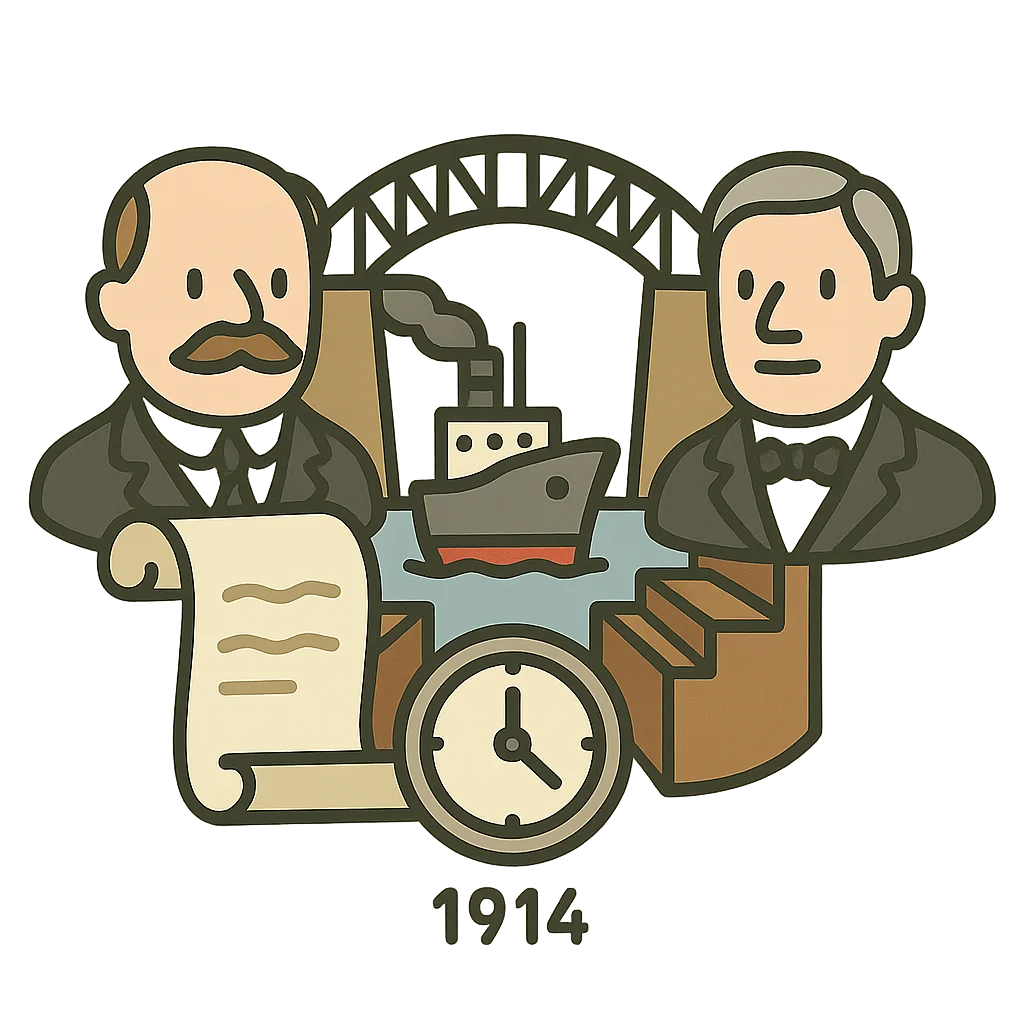
George Goethals and the Great Canal
My name is George Washington Goethals, and I am an engineer. In 1907, President Theodore Roosevelt gave me a task that many believed to be impossible. He asked me to go to the Isthmus of Panama, a narrow strip of land connecting North and South America, and finish building a canal. This wasn't just any ditch; this was to be a waterway that would connect the mighty Atlantic and Pacific Oceans. For centuries, ships wanting to travel from one ocean to the other had to make a treacherous, 8,000-mile journey all the way around the tip of South America. A canal would cut that journey down to just 50 miles, changing world trade forever. The challenge was immense. The French had tried years before, starting in 1881, but the jungle had defeated them. They left behind rusted machinery and a tragic story of failure. The land itself was a formidable enemy. It was a place of suffocating heat, torrential rains, and dense jungle teeming with unseen dangers. I knew this would be the greatest engineering challenge of our time, but I also knew that with American ingenuity and determination, we could succeed where others had failed. I accepted the position of chief engineer, ready to face whatever Panama threw at us.
When I arrived, the first battle wasn't with rock or mud, but with something much smaller and deadlier: the mosquito. The French had lost thousands of men to yellow fever and malaria, diseases carried by these tiny insects. We could not make the same mistake. Our success depended entirely on the work of a brilliant man, Dr. William Gorgas. He understood that to win the war against the canal, we first had to win the war against the mosquito. Dr. Gorgas organized a massive sanitation campaign. His teams drained swamps, fumigated buildings, and installed screens on windows. It was a slow, painstaking process, but it worked. By 1906, yellow fever was eliminated from the Canal Zone. Dr. Gorgas's victory made our work possible and saved countless lives. With the threat of disease under control, we could turn our attention to the land itself. Our greatest physical obstacle was the Culebra Cut, a nine-mile stretch where we had to carve a path directly through the mountains of the Continental Divide. The work was relentless. The sound of dynamite blasts echoed through the valleys daily as we blasted away rock. Afterward, massive steam shovels, some weighing over 95 tons, would roar to life, their giant steel jaws scooping up tons of earth and rock with each bite. We loaded the debris onto trains that ran on a complex system of tracks, hauling it away day and night. But the mountain fought back. The rainy season, which lasted for eight months of the year, turned the ground into a sea of thick, sticky mud. Worse were the landslides. We would spend months digging, only to have a wall of earth and rock come crashing down, burying the tracks and undoing all our progress in an instant. It was heartbreaking, but we never gave up. Thousands of men from all over the world, especially from the Caribbean islands of Barbados and Jamaica, worked tirelessly in the blistering heat and pouring rain. Their courage and perseverance were the true force that carved a path through that stubborn mountain.
Digging through the mountains was only half the problem. Panama is not flat, so we couldn't just dig a simple trench from one ocean to the other. We had to figure out a way to lift ships up and over the land. The solution was one of the most incredible engineering feats of the project: a system of locks. I like to think of them as a great water staircase. A ship would sail into a massive concrete chamber called a lock, and giant steel gates would close behind it. Then, water would be fed into the chamber from a lake above, and just like a bathtub filling up, the water would lift the giant ship. Once it was raised to the level of the next chamber, the gates in front would open, and the ship would sail forward. We repeated this process until the ship was 85 feet above sea level. To supply all the water for these locks, we built a dam across the Chagres River. This created Gatun Lake, which at the time was the largest man-made lake in the world. Building the locks was a monumental task. We mixed and poured millions of cubic yards of concrete to form the chambers, which had walls as thick as 50 feet at their base. The steel gates were just as impressive, some standing seven stories high and weighing over 700 tons, yet they were so perfectly balanced that a small motor could swing them open and shut. It was a system of brute strength and delicate precision, all working together to conquer gravity.
After a decade of relentless effort, the day finally arrived. On August 15th, 1914, the world watched as the steamship SS Ancon prepared to make the first official transit through the canal. A quiet excitement filled the air. For ten years, this place had been filled with the sounds of explosions, machinery, and shouting men. But on that day, there was a sense of peaceful accomplishment. I stood watching as the Ancon entered the first lock, rose gracefully on the water, and began its journey across Gatun Lake and through the Culebra Cut, the very place that had challenged us so fiercely. When it finally sailed out into the Pacific Ocean less than ten hours later, a wave of pride and relief washed over me. It wasn't a victory for me alone; it was a victory for the tens of thousands of workers who had poured their sweat and strength into this project. We had faced landslides, disease, and immense engineering puzzles, and we had triumphed. We had cut a continent in two to unite the world. My hope was that this canal would stand as a lasting monument to what human beings can achieve when they work together with courage and perseverance. We had built a path between the seas, proving that no obstacle is too great to overcome.
Activities
Take a Quiz
Test what you learned with a fun quiz!
Get creative with colors!
Print a coloring book page of this topic.










 Free for Educators