

 English

My Journey Around the World
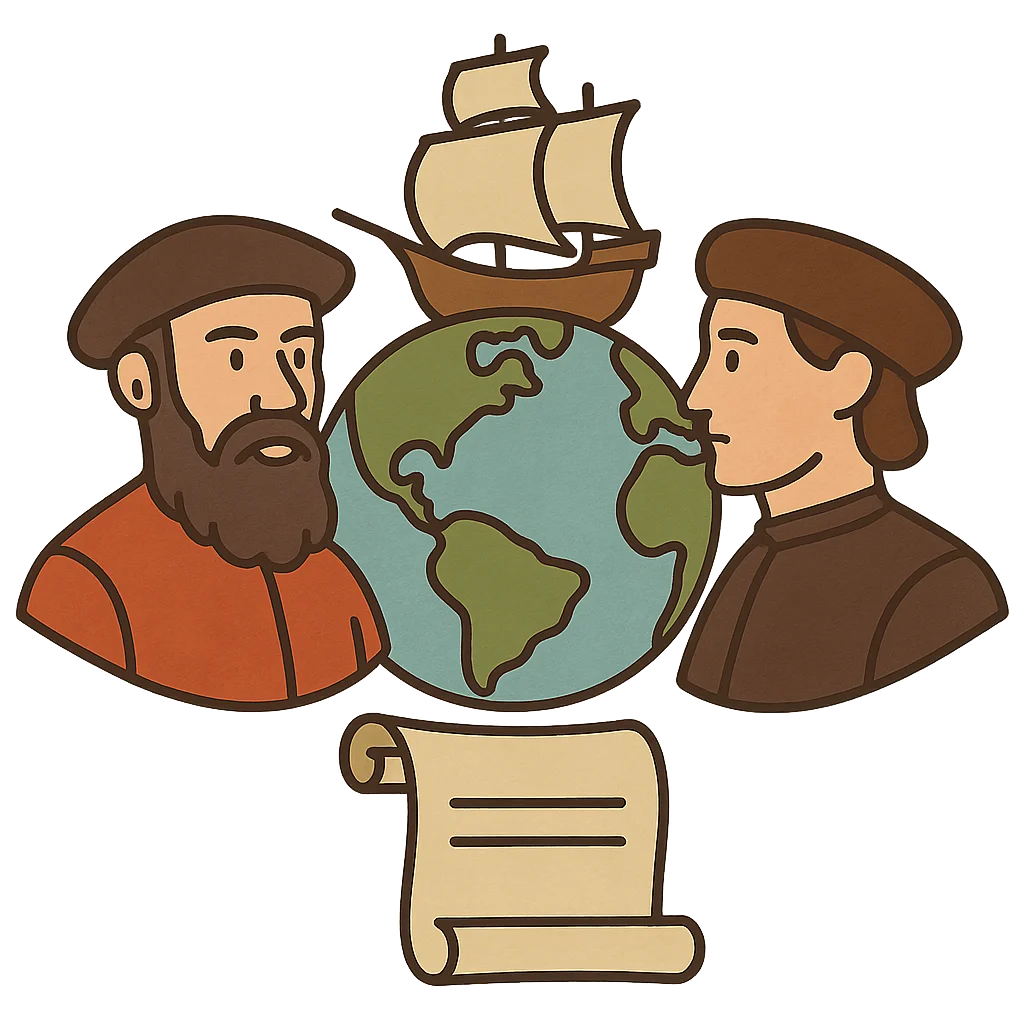
Hello there. My name is Juan Sebastián Elcano, and I was a master sailor from the Basque country in Spain. I want to tell you about the greatest adventure of my life, a journey that changed the maps of the world forever. It all began back in 1519. At that time, everyone in Europe was excited about spices like cinnamon and cloves. They came from faraway lands called the Spice Islands, and they were worth more than gold. The problem was, getting there was a long and dangerous trip sailing east. But a brilliant and brave Portuguese explorer named Ferdinand Magellan had a daring idea. He believed we could reach the Spice Islands by sailing west, right across the great unknown ocean. King Charles I of Spain loved the plan and gave us five ships: the Trinidad, San Antonio, Concepción, Victoria, and Santiago. On August 10th, 1519, we said goodbye to our families in Seville. A feeling of thrilling adventure filled the air as our sails caught the wind. We were heading into the sunset, on a mission to sail around the entire world, though we didn't fully know it just yet.
The first part of our journey was crossing the enormous Atlantic Ocean. The waves were sometimes as tall as mountains, and the wind howled. After many weeks, we reached the shores of what is now South America. Our captain-general, Magellan, was determined to find a secret passage, a waterway that would cut through this huge continent and lead us to the other side. We sailed south for months, our wooden ships creaking and groaning in the cold winds. The weather grew colder and colder. Finally, in late 1520, we found it. A narrow, twisting channel of icy water. It was incredibly dangerous, with sharp rocks and unpredictable currents. The journey through this strait was terrifying. We lost the Santiago to a powerful storm, and the crew of the San Antonio decided to turn back for Spain. But we pushed on. After more than a month of careful sailing, we emerged into a new ocean. It was so big, so calm and peaceful after the stormy strait, that Magellan named it the 'Pacifico,' which means peaceful. We felt a great sense of relief, but our hardest challenge was just beginning. For ninety-nine days, we saw nothing but water. Our food ran out, our water turned foul, and many of my friends became terribly sick from a disease called scurvy. It was a time of great sadness and struggle, but we kept our eyes on the horizon, praying for the sight of land.
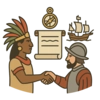
After what felt like a lifetime, in March of 1521, we finally spotted land. We had reached a group of beautiful islands, which today are called the Philippines. The people there were friendly at first, and we were so grateful for fresh food and water. We thought the worst was over. But then, something terrible happened. Our brave leader, Ferdinand Magellan, got involved in a local conflict. On April 27th, 1521, he led a small group of our men into a battle on Mactan Island, and he was killed. We were heartbroken. Our captain-general, the man with the brilliant vision, was gone. The entire crew felt lost and defeated. Our numbers were small, and two more of our ships were no longer fit to sail. We had to burn the Concepción. Only the Trinidad and my ship, the Victoria, were left. Eventually, the remaining crewmen had to make a choice. They looked to me, Juan Sebastián Elcano, to lead them. I knew we couldn't give up. We had to honor Captain Magellan and all the sailors we had lost. Our mission changed. It wasn't just about finding spices anymore. It was about finishing what we started and becoming the first people to ever sail all the way around the world.
With our ship, the Victoria, loaded with precious spices, we began the final, dangerous leg of our journey home. We sailed across the vast Indian Ocean and faced powerful storms as we navigated around the southern tip of Africa. It was a lonely and grueling voyage. We avoided stopping at ports because we feared being captured by the Portuguese, who saw us as rivals. Our food supplies dwindled again, and we were exhausted, but the thought of seeing Spain kept us going. Then, one day, after three long years away from home, we saw it. The coastline of Spain. I cannot describe the feeling of joy and relief that washed over us. On September 6th, 1522, our little ship, the Victoria, limped into the harbor. Of the 270 men who had left on five ships, only 18 of us had returned. We were thin and tired, but we were heroes. We had done the impossible. We had proved that the world was a sphere and that all its great oceans were connected. Our long, hard journey showed everyone that with courage and perseverance, you can sail beyond the edge of the map and discover a whole new world.
Activities
Take a Quiz
Test what you learned with a fun quiz!
Get creative with colors!
Print a coloring book page of this topic.







 Free for Educators