

 English

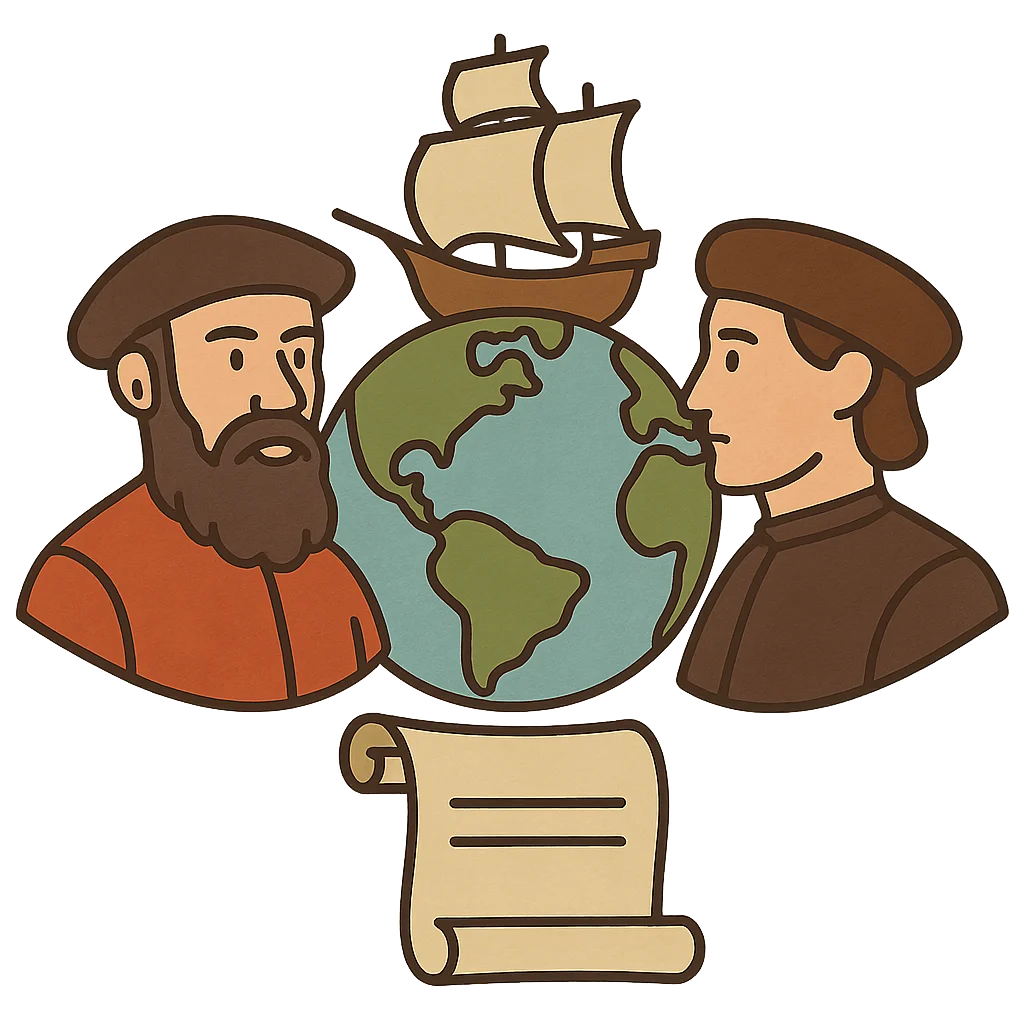
My Voyage Around the World
My name is Juan Sebastián Elcano, and I am a mariner from the Basque country in Spain. In the year 1519, the port of Seville was buzzing with a special kind of energy, a mix of grand ambition and nervous excitement. It was there that I joined an expedition that would change not only my life but the world’s understanding of itself. The leader of our venture was a Portuguese captain named Ferdinand Magellan. He was a man of incredible determination, with an idea that many thought was brilliant, while others called it impossible. At that time, the Spice Islands, what are now the Maluku Islands in Indonesia, were the source of incredible wealth. Cloves, nutmeg, and pepper were worth more than gold, but the eastward journey around Africa was long and controlled by the Portuguese. Magellan presented a daring plan to King Charles I of Spain: he would sail west, across the great Atlantic Ocean, find a passage through the unknown American continent, and reach the Spice Islands from the other side. It was a route no one had ever completed. The King agreed, and soon we had a fleet of five ships: the Trinidad, San Antonio, Concepción, Victoria, and Santiago. Our crew was a mix of over 270 men from all across Europe, each one dreaming of adventure and riches. I was assigned as the master of the Concepción. On August 10th, 1519, with our sails full and our hearts fuller, we left the harbor. Watching the familiar coast of Spain disappear behind us, I felt a powerful mix of thrill and fear. We were sailing off the edge of the known map, into a vast, mysterious sea.
Our journey into the unknown was more challenging than any of us could have ever imagined. The Atlantic crossing was long, but it was the search for a passage through South America that truly tested our resolve. We sailed for months down a cold, desolate coastline, battling fierce storms and dwindling hope. Some men grew restless and angry, even attempting to take over the ships in a mutiny, but Magellan’s firm leadership held us together. Finally, on October 21st, 1520, our perseverance paid off. We found a winding, treacherous waterway that cut through the continent. We had found the passage. Today, you know it as the Strait of Magellan. Emerging from the strait, we entered an ocean so vast and calm that Magellan named it the Pacific, for it seemed so peaceful. But that peace was deceptive. For 99 long days, we saw no land but two small, uninhabited islands. Our food turned to dust, our water became foul, and a terrible sickness called scurvy began to claim my shipmates. It was a period of unimaginable suffering. We finally reached land, first Guam and then the islands that would become known as the Philippines. It was there, on April 27th, 1521, that our journey faced its greatest tragedy. Our brave captain, Ferdinand Magellan, was killed in a battle with local islanders. His loss left us devastated and without a leader. With only three ships left and our numbers greatly reduced, we had to make a choice. After we finally reached the Spice Islands and loaded one ship with valuable cloves, it became clear only one vessel was seaworthy enough for the long voyage home: the Victoria. The remaining crew elected me to be its captain. My mission was no longer about glory or riches; it was about honoring the fallen and completing the circle. It was about getting my men home.
Captaining the Victoria on the final leg of our journey was the greatest challenge of my life. We had to sail across the vast Indian Ocean and around Africa, a route dominated by the Portuguese, who would see us as enemies. We had to be like ghosts on the water, avoiding their ports and patrols. The voyage was grueling. We faced more storms, and our supplies once again ran dangerously low. Rounding the treacherous Cape of Good Hope at the southern tip of Africa felt like a monumental victory, but the final push up the coast of Africa was agonizing. My men were weak, but their spirit was unbreakable. We all shared one dream: to see Spain again. Then, one day, it happened. A faint line appeared on the horizon. Land. It was the coast of Spain. On September 6th, 1522, nearly three years to the day after we had departed, we sailed the battered Victoria back into the port of Sanlúcar de Barrameda. Of the more than 270 men who had set out, only 18 of us returned on that ship. We were starving and exhausted, but we were alive. We had done the impossible. We had become the first humans to circumnavigate the globe. Our journey proved, once and for all, that the world was a single, connected sphere. It was a difficult and often tragic voyage, but it taught me about the incredible power of perseverance and the limitless potential of human courage. It showed that even when you face the greatest of unknowns, you must keep sailing forward.
Activities
Take a Quiz
Test what you learned with a fun quiz!
Get creative with colors!
Print a coloring book page of this topic.











 Free for Educators