

 English

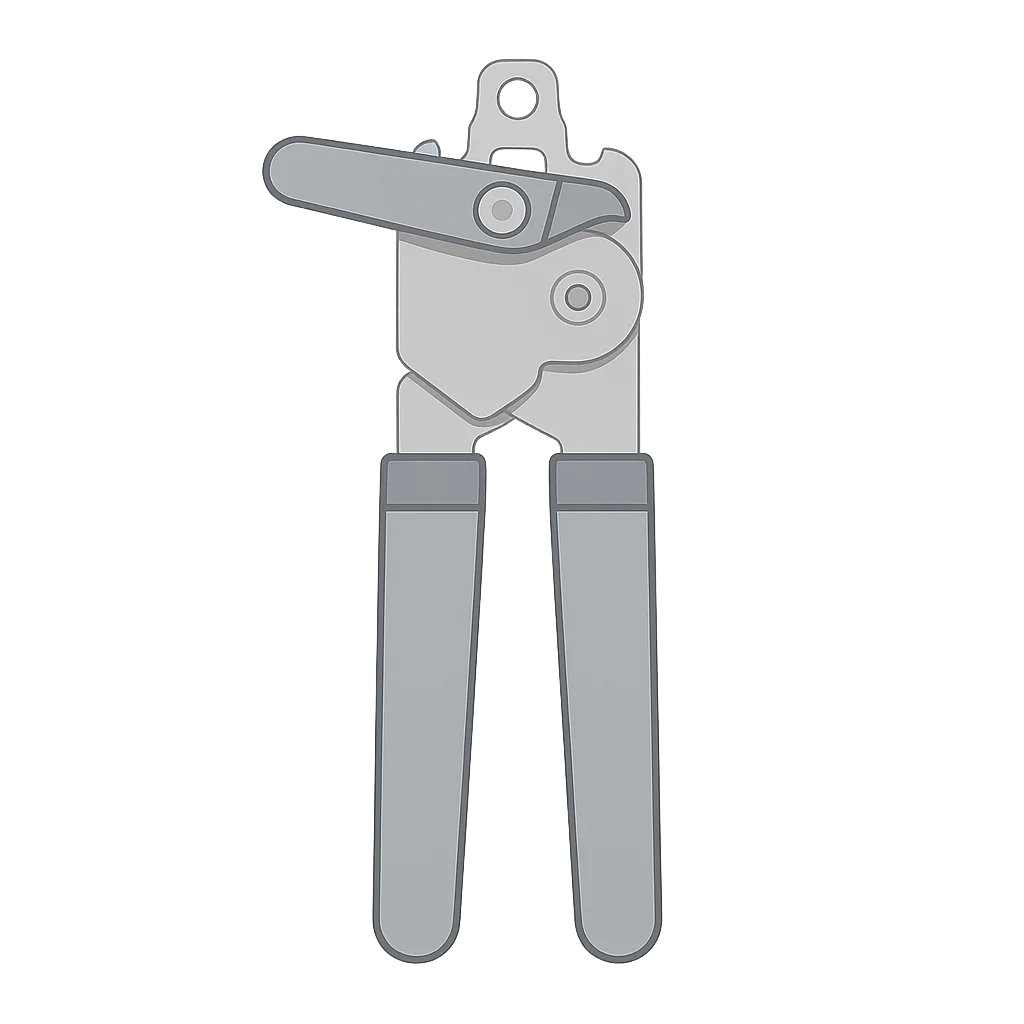
A Tale of Teeth and Tin
Hello there. You probably see me in your kitchen drawer, waiting patiently to help. I am the can opener, and my story is one of sharp points, clever wheels, and a long journey to become the simple, helpful tool you know today. Before I came along, my older cousin, the tin can, was causing a lot of trouble. The can was invented way back in 1810, full of preserved meats, vegetables, and soups that could last for ages. It was a wonderful idea, but there was one giant problem. No one had invented me yet. For nearly fifty years, people would stare at these sturdy metal cans, smelling the delicious food trapped inside, but they had no easy way to get to it. Imagine your family trying to open a can of beans for dinner with a hammer and a chisel. Bang. Clang. Scrape. It was a noisy, messy, and sometimes dangerous job. People tried everything. Soldiers in armies would use their bayonets, and explorers would use whatever sharp rocks they could find. It was a real struggle, and it meant that the amazing convenience of canned food was locked away behind a wall of tin. The world was desperately waiting for a key, and that key was me.
My story truly begins with a clever man from Waterbury, Connecticut, named Ezra Warner. He saw the frustration and knew there had to be a better way. After much thinking and tinkering, he brought me to life. On January 5th, 1858, I was officially born. I must admit, I wasn't very handsome back then. I was a big, clunky thing, a strange combination of a sharp, curved blade like a sickle and a sturdy lever. Some said I looked like a bent bayonet. Using me wasn't exactly easy, either. You had to force my sharp tooth through the top of the can and then saw your way around the edge. It took a lot of muscle, and you had to be careful not to slip. But I was a start. I was the first tool made just for this one important job. My big moment came during the American Civil War. Soldiers in the field needed their rations, which often came in my cousin, the tin can. They carried me in their packs, and I helped them open tins of beef and peaches by the campfire. I felt so proud, even if I was a bit awkward. I was finally fulfilling my purpose, helping hungry people get the food they needed, no hammer required. I proved that a dedicated tool was far better than just hitting a can and hoping for the best.
Even though I was helping soldiers, I knew I could be better. I was still a bit too difficult for everyday use in a home kitchen. That's when another inventor, William Lyman, had a brilliant idea. In 1870, he gave me a major upgrade. He designed a version of me with a wheel that could roll around the rim of the can, cutting as it went. This was a game-changer. Suddenly, opening a can was no longer about brute force; it was about a smooth, steady journey around the lid. I was safer, easier to control, and much more pleasant to use. But my evolution wasn't over. In 1925, I was improved again with the addition of a second, serrated wheel. This new wheel acted like a set of teeth, gripping the edge of the can tightly so my cutting wheel wouldn't slip. Now I was truly reliable. From there, my family grew. Soon, my electric cousins were invented, who could do the job with just the press of a button. Looking back, I see how I changed from a clunky tool for soldiers into a trusted friend in kitchens all over the world. By making it simple to get into a can, I helped make food safer, more convenient, and accessible to everyone. And even today, I’m still here, ready to pop open a can of soup or a tin of fruit, playing my small but important part in your next delicious meal.
Activities
Take a Quiz
Test what you learned with a fun quiz!
Get creative with colors!
Print a coloring book page of this topic.













 Free for Educators