

 English

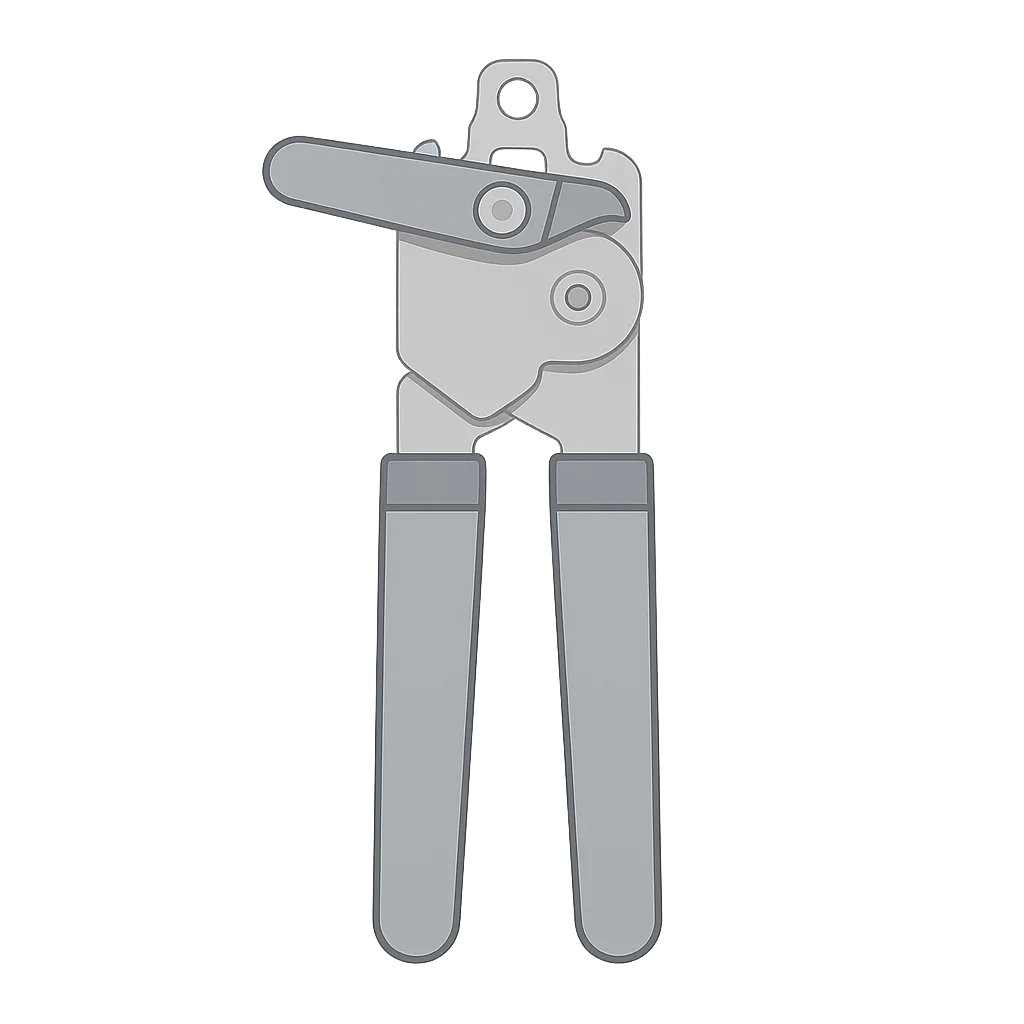
The Can Opener's Tale
Hello there. You might not recognize me at first, because I’ve changed so much over the years, but I am the Can Opener. Before I came along, the world was full of delicious, sealed treasures that were nearly impossible to reach. My good friend, the Tin Can, was invented almost fifty years before me. He was a marvel, preserving food for sailors on long voyages and soldiers far from home. But he was also a fortress. He was made of thick, heavy iron, and opening him was a battle. People would take hammers and chisels to his lid, desperately trying to pry him open. Soldiers in the field would resort to using their bayonets, a dangerous and messy business. It was clear that while the can was a brilliant idea for keeping food fresh, people needed a key to unlock its contents safely and easily. They needed a hero to break the siege, and that’s where my story begins. The world was waiting for a simple, clever tool to solve a very tough problem, even if my first attempt wasn't exactly graceful.
My story truly started on January 5th, 1858, thanks to a man from Connecticut named Ezra Warner. He was the one who first gave me life, patenting the very first version of me. To be honest, I was a bit of a monster back then. I was a large, clunky contraption made of two parts: a sharp, sickle-shaped blade designed to pierce the can’s lid, and a lever that acted as a guard to stop the blade from plunging too deep. I wasn't the sleek, friendly gadget you might have in your kitchen drawer today. I was built for strength, not convenience. My first jobs were in grocery stores and with the U.S. Army, where strong hands were needed to operate me. A grocer had to wrestle me onto the can, jab my point into the metal, and then saw his way around the edge. It worked, but it was hard, left a jagged and dangerous edge, and certainly wasn't something you’d want to try at home. I knew I was helpful, but I also felt clumsy and unfinished. I had a purpose, but I hadn't yet found my grace. My journey was far from over.
My first major glow-up, the moment I truly began to transform, came in 1870. A brilliant inventor named William Lyman saw my potential but knew I could be so much better. He must have thought, “Why brute force your way through the metal when you can simply roll?”. And with that idea, he gave me the greatest gift I had ever received: a sharp, rolling wheel. This single innovation changed everything. Instead of jabbing and tearing, I could now be centered on the can, my wheel would pierce the lid, and then I could travel smoothly and cleanly around the entire rim. It was like learning to dance instead of just stomping. The cut was neater, the process was far safer, and it required much less strength. This was the breakthrough that allowed me to leave the army barracks and enter the home. I started to appear in kitchens across the country, a reliable helper that families could count on. I was no longer a clunky tool for specialists; I was becoming a friend to the everyday cook, and I was proud to finally be the handy helper I was always meant to be.
As the 20th century dawned, my evolution continued. Inventors kept seeing new ways to make me even better. In 1925, a company added a brilliant feature: a second, serrated wheel, which you might call a feed wheel. This little, toothy gear was a game-changer. It allowed me to grip the side of the can’s rim, giving me a firm handshake. Now, instead of the person having to guide me around the can, I could hold on and turn the can myself as the user turned a key or handle. This made the process almost effortless. Then, my world got a jolt of pure energy. On December 2nd, 1931, I was fitted with an electric motor. Suddenly, I was a countertop superstar. With just the press of a button, I could open any can in seconds. This final step made me accessible to absolutely everyone, from young children helping in the kitchen to elderly people who might not have the hand strength for a manual model. I was buzzing with excitement, knowing I could now help more people than ever before.
Looking back, my journey has been incredible. I started as a crude, oversized tool that was more intimidating than helpful. But through the imagination and perseverance of clever people, I was refined again and again. I learned to roll, to grip, and to use electricity. Today, you can find me in so many forms. I am the simple, trusted manual opener in a kitchen drawer, the sleek electric model on the counter, and even a tiny, foldable version on a camper’s multi-tool. My story is a reminder that even the most complex problems often have simple solutions waiting to be discovered. It shows that a good idea rarely starts out perfect, but with patience and creativity, it can evolve to make life just a little bit easier for millions of people, one opened can at a time.
Activities
Take a Quiz
Test what you learned with a fun quiz!
Get creative with colors!
Print a coloring book page of this topic.














 Free for Educators