

 English

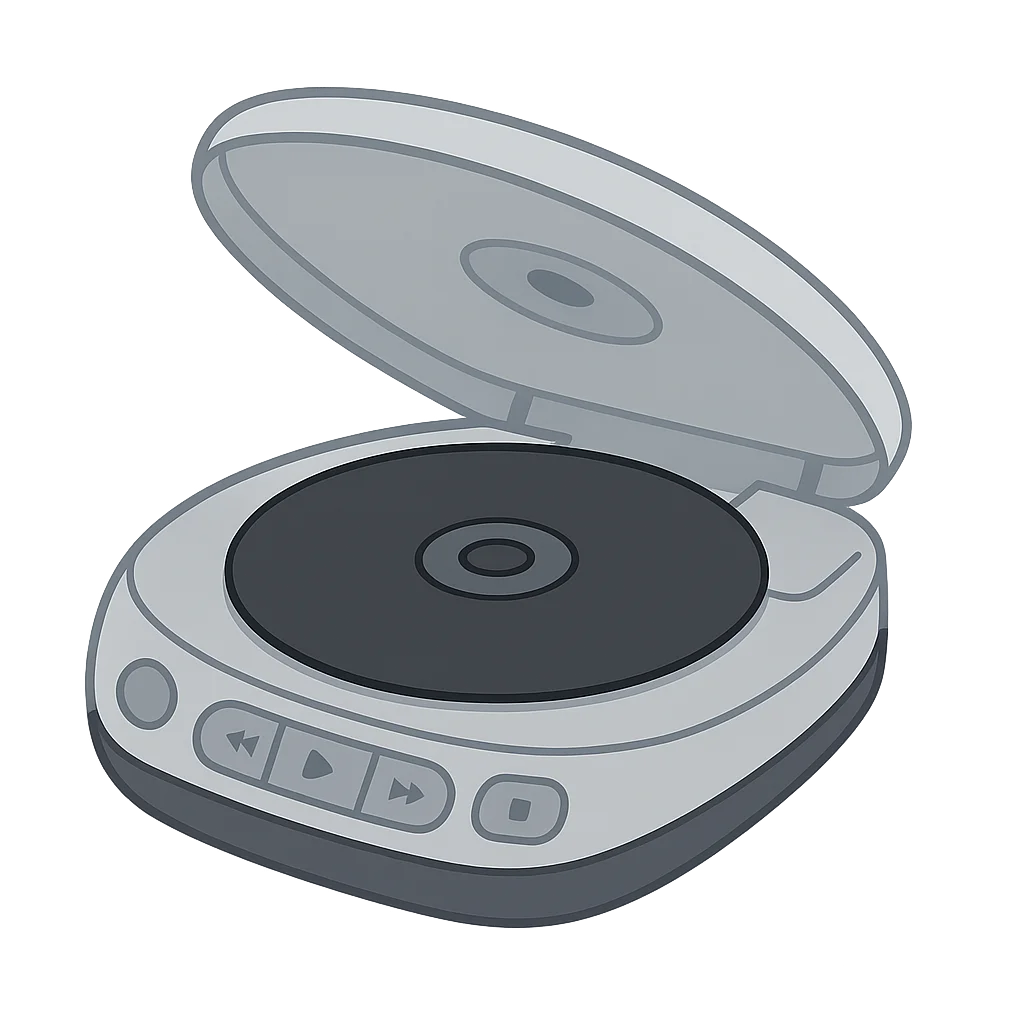
The CD Player's Song
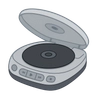
Hello there. You might have seen one of my relatives in an old movie or maybe tucked away on a shelf in your grandparents' house. I am a CD Player, and my story is about how I taught the world a new way to listen to music, using a secret language of light. Before I arrived, the world of sound was a very different place. Music lived on large, black vinyl records and in small, plastic cassette tapes. They were magical in their own way, but they had their troubles. Imagine putting your favorite vinyl album on a turntable. You’d carefully lower the needle, and then… hiss… pop… crackle. A tiny speck of dust or a small scratch could make the song skip and jump, interrupting the magic. Over time, the grooves in the record would wear down, and the beautiful, rich sound would start to fade, like a photograph left in the sun. Then there were the cassette tapes. Oh, the frustration of a cassette tape. You’d press play, only to hear a warbled, stretched-out version of a beloved song. Sometimes, the thin magnetic ribbon inside would get tangled in the player, and you’d have to carefully try to wind it back in with a pencil, hoping you hadn’t ruined it forever. And finding a specific song was a game of patience, pressing fast-forward and rewind, guessing and checking until you landed somewhere close. People loved their music, but they deserved better. They needed a way to listen that was crisp, clear, and dependable. They needed a way to hear the music exactly as the artist intended it, without the crackles, hisses, and tangles. That is why I was born. I was the answer to a question the world was asking: how can we capture perfect sound and keep it that way forever?.
My creation wasn't the work of a single inventor in a dusty workshop. It was a grand symphony of collaboration between brilliant minds from opposite ends of the globe. My story truly began in 1979, when two giant companies, Philips from the Netherlands and Sony from Japan, decided to do something remarkable. They were rivals, competing for the world's attention, but they recognized that to build the future of sound, they needed to work together. They put aside their differences and combined their research, their engineers sharing ideas and solving problems as a single, powerful team. Their shared dream was to store music not in physical grooves or on magnetic tape, but as a digital code. And the key to unlocking that code was something straight out of science fiction: a laser. You see, the shiny, rainbow-colored discs I play aren't just for show. If you could look at their surface with a super-powerful microscope, you would see a landscape of billions of tiny bumps and flat areas, known as pits and lands. This landscape forms a spiral track that is over three miles long, all on a disc that fits in your hand. This is the secret code of the music. My job is to read it. Inside me, a tiny, focused beam of red light—my laser—shines onto the spinning disc. I never actually touch it. The laser reflects off the pits and lands in different ways, and a sensor inside me reads this flickering pattern of light. It translates the code of ones and zeros back into electrical signals, which then become the pure, perfect sound that fills your ears. It is like reading a book with a magical flashlight, where the words are a language of light itself. To make sure every single one of my kind could read every single disc, my creators established a set of rules. In 1980, they published what they called the 'Red Book'. This wasn't a storybook, but an instruction manual that standardized everything, from the exact size of the disc to the precise way the digital information was arranged. One legend says they chose my disc to be 12 centimeters wide specifically so it could hold a complete performance of Beethoven's Ninth Symphony, about 74 minutes, without any interruption. This 'Red Book' meant that a disc made in Germany would play perfectly in a player made in Japan. It was a promise of universal harmony. Finally, after years of tireless work, my big day arrived. On October 1st, 1982, the first-ever commercial CD player, the Sony CDP-101, was released in Japan. Alongside it was the first album ever pressed onto a Compact Disc: Billy Joel's "52nd Street." For the first time, people at home could listen to music with a clarity and purity that had previously only been possible in a professional recording studio. There was no background noise, no wear and tear, just the song. My laser sang its first song for the world, and the digital music revolution had begun.
My arrival changed everything about how people experienced music. The most exciting new power I gave them was control. Remember the tedious task of finding a song on a cassette? I replaced it with the magic of the "skip" button. In less than a second, you could jump from the first track to the last, instantly creating your own listening order. I offered freedom. My greatest pride, however, was the quality of my sound. My creators called it "perfect sound forever," and it wasn't just a marketing slogan. Because my laser read the disc without ever physically touching it, the disc didn't wear out. The thousandth time you played a song, it sounded just as crisp, clear, and breathtaking as the very first time. I preserved the music exactly as the artists dreamed it would be heard. Soon, I evolved. I didn't just play music; I gave people the power to create their own collections. The birth of the recordable CD, the CD-R, turned everyone into a music curator. You could burn your own "mix CD," a carefully chosen soundtrack for a road trip, a gift for a friend, or a collection of songs for a party. I helped people share their passion for music in a brand new way. But the language I spoke—the digital code of ones and zeros read by light—was far too powerful to be used only for songs. My core technology became the foundation for a whole new digital family. My sibling, the CD-ROM, brought computers to life. Suddenly, entire encyclopedias, with articles, pictures, and even videos, could fit on a single disc. Amazing video games with complex worlds and graphics became possible. I helped make learning and playing on a computer a rich, multimedia experience. After that came the DVD, which used a more advanced version of my laser technology to store entire movies, changing home entertainment forever. Today, the world has continued to move forward. Many people now stream music directly from the internet, and my shiny discs are not as common as they once were. But I am not sad. I look at the modern world and see my legacy everywhere. The fundamental idea I introduced—of storing vast amounts of information in a digital format and reading it with light—is still the heartbeat of technology. It lives on in Blu-ray discs, in the fiber-optic cables that deliver high-speed internet across the globe, and in the very concept of digital data. I taught the world a new, powerful language. And even though you might not press my "play" button every day, the echo of my laser's song continues to power the stories, ideas, and music of your world.
Activities
Take a Quiz
Test what you learned with a fun quiz!
Get creative with colors!
Print a coloring book page of this topic.












 Free for Educators