

 English

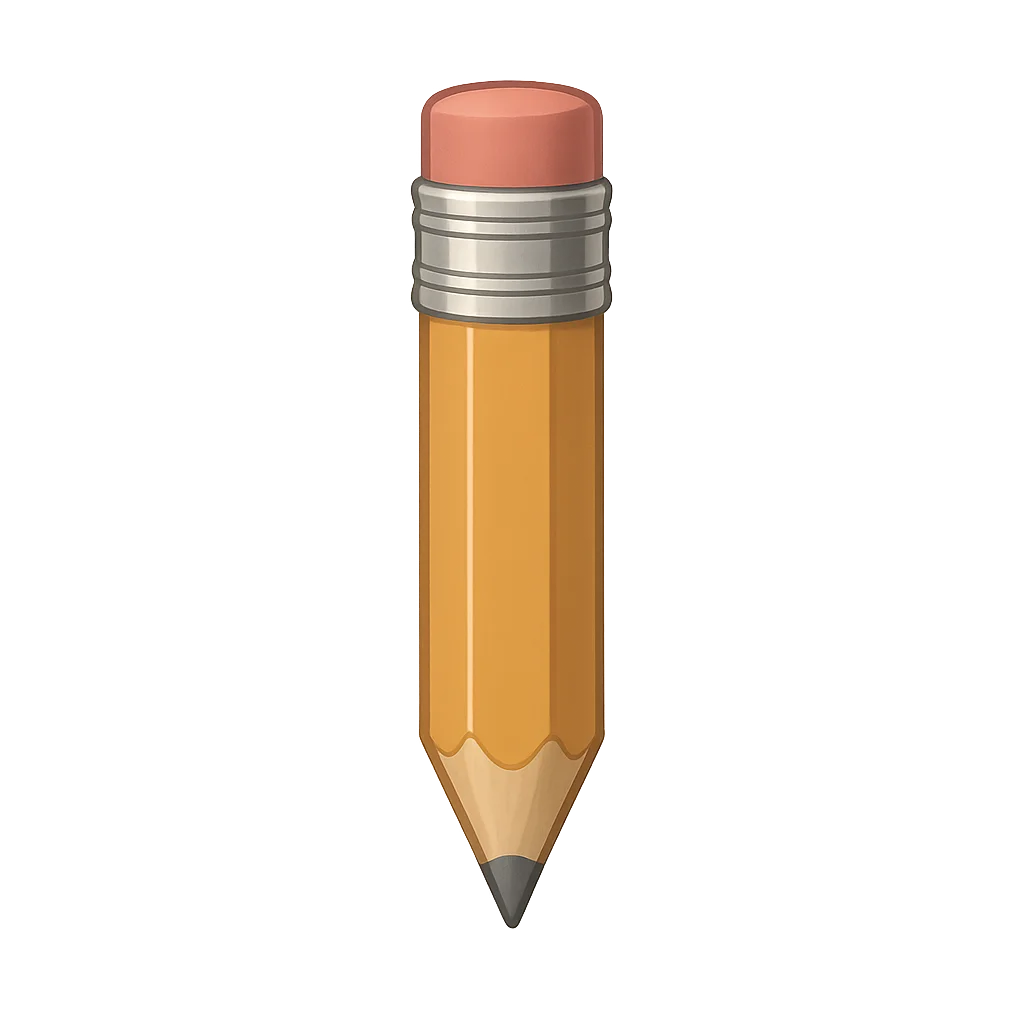
My Life as a Pencil
My story doesn't begin in a factory or an inventor's workshop, but in a field in Borrowdale, England, after a great storm around the year 1565. An old tree was torn from the ground, and beneath its roots lay something the world had never seen before: a huge deposit of a dark, greasy, and shimmering substance. People called it “plumbago,” thinking it was a type of lead. Local shepherds were the first to find a use for me, or rather, for my ancestor. They broke off chunks of the strange material and used it to mark their sheep. It left a beautifully dark line, much darker than charcoal, but it had its problems. This raw graphite was incredibly messy, staining fingers and clothes with a silvery-black smudge. Worse, it was soft and brittle, snapping with the slightest pressure. I was a brilliant idea, but I was far too fragile and messy for the world.
For many years, people tried to give me a proper suit of clothes to make me more respectable and easier to handle. At first, they simply wrapped my raw graphite core in string, winding it tighter as the tip wore down. Others tried wrapping me in soft sheepskin, which was a little better but still clumsy. The first real breakthrough came from Italy around 1560, thanks to a clever couple named Simonio and Lyndiana Bernacotti. They had the ingenious idea of carving out a space inside a stick of juniper wood and fitting a piece of solid graphite inside. This was my first real body, a wooden casing that protected me from breaking and kept my user’s hands clean. It was a magnificent step forward. For the first time, I felt sturdy and useful. However, the heart of the problem remained. My core was still a single, solid piece of pure Borrowdale graphite, which was becoming rarer and more expensive every day. And I was still prone to snapping right in the middle of a brilliant idea or a beautiful drawing.
My true transformation, the moment I became the pencil you know today, was born from a crisis. By the late 18th century, France was at war with Great Britain. This conflict had an unusual consequence: it cut off France's access to the world's only supply of high-quality, solid graphite from the English mine in Borrowdale. Suddenly, there was a pencil shortage. Artists couldn't sketch, architects couldn't draft plans, and government officials couldn't write their documents. The French government knew it needed a solution. In 1795, they turned to a brilliant scientist, inventor, and officer in Napoleon Bonaparte’s army named Nicolas-Jacques Conté. He was given a direct order: invent a pencil that did not depend on the enemy’s graphite. The challenge seemed impossible. How could he create something as good as the English pencils without the one ingredient that made them work? The fate of French creativity and industry rested on his shoulders.
Nicolas-Jacques Conté was a genius of perseverance. He refused to believe that pure, solid graphite was the only way. He started experimenting with what he had: low-grade graphite powder, which was considered useless waste. His laboratory must have been a dusty, gray place as he tried recipe after recipe. Finally, he discovered the perfect formula. He ground the impure graphite into a fine dust, mixed it with clay and water to form a thick, dark paste, and then carefully shaped this paste into long, thin rods. The final, crucial step was to fire these rods in a kiln at an incredibly high temperature. The result was miraculous. The fragile paste transformed into a writing core that was strong, smooth, and perfectly consistent. I was reborn. But Conté’s brilliance didn’t stop there. He realized that by changing the ratio of clay to graphite, he could control my character. More clay made me harder and my lines lighter (like an H pencil), while less clay made me softer and my lines darker (like a B pencil). This was the birth of the pencil grading system, a revolutionary invention that gave artists and writers precise control over their work for the first time.
With my new, reliable core, I was ready to see the world. My design traveled across the Atlantic Ocean to America, where innovators like Joseph Dixon began to mass-produce me, making me available to everyone. But there was one final touch that would make me the perfect tool. I could help people make their mark, but I couldn't help them fix their mistakes. That changed on March 30th, 1858, when a man from Philadelphia named Hymen Lipman had a simple but brilliant idea. He patented a method for attaching a small piece of rubber—an eraser—to my end. He held it in place with a little metal band, which we call a ferrule. Suddenly, I wasn't just a tool for creation; I was also a tool for correction. I came with my own solution for second thoughts and happy accidents. This little eraser on my end, like a hat, completed me. I was now the perfect companion for students learning their letters, scientists solving complex equations, and poets revising their verses.
From a messy lump of rock used to mark sheep to the dependable tool in your hand, my journey has been a long one. I have traveled across centuries and continents, powered by human ingenuity and the desire to make a mark. I don’t have a battery that runs out or need software updates to work. I am simple, quiet, and always ready. I have been used to write love poems, draft blueprints for towering skyscrapers, sketch masterpieces, and solve the mysteries of the universe. My greatest purpose is to be a bridge between your mind and the page. I am your partner in creation, waiting patiently to help you capture your thoughts, dreams, and discoveries. So the next time you pick me up, remember the journey I took to get to you, and know that together, we can make your unique mark on the world.
Activities
Take a Quiz
Test what you learned with a fun quiz!
Get creative with colors!
Print a coloring book page of this topic.














 Free for Educators