

 English

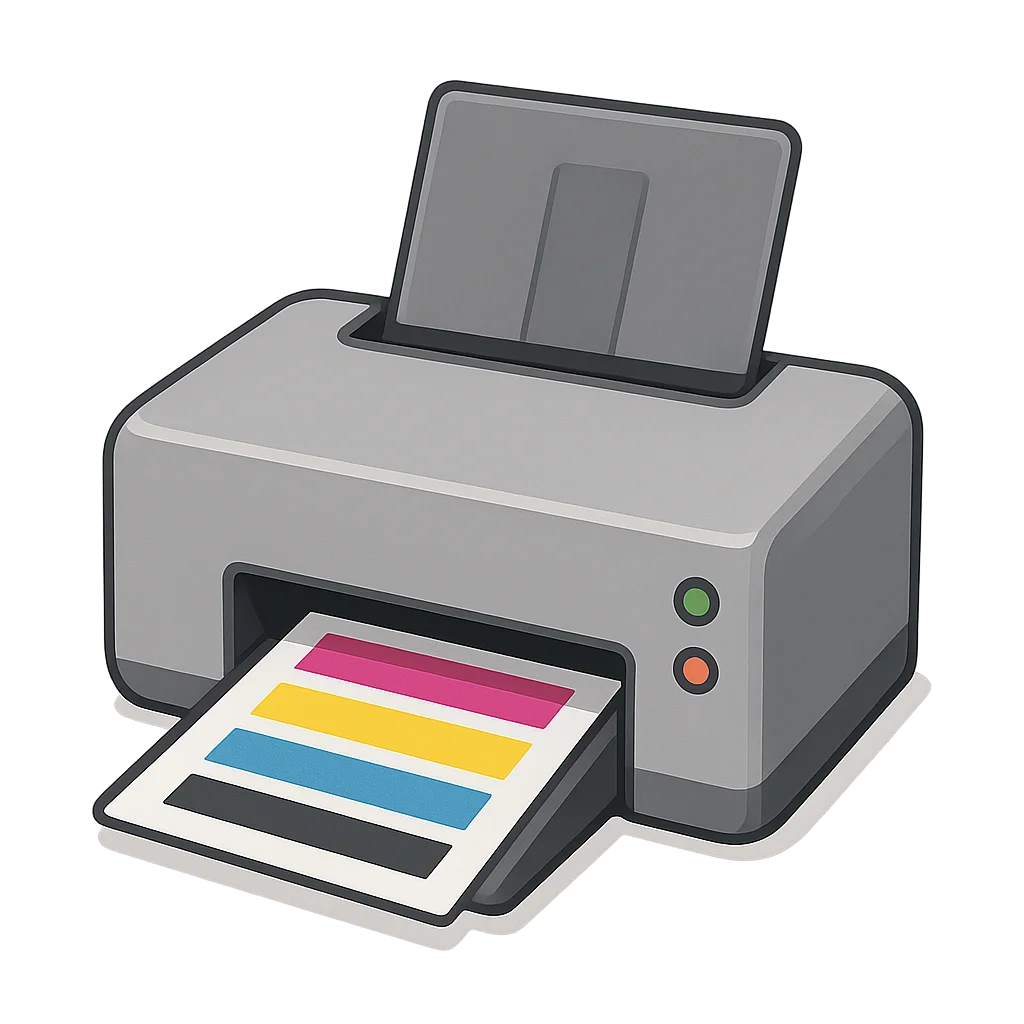
The Inkjet Printer's Story
You probably see me sitting on a desk, quiet and unassuming until you need me. I am an inkjet printer, and I hold the power to bring your digital world to life on paper. But before I could paint your photos and print your school reports in vibrant color, the world of printing was a very different place. It was a loud, gray world dominated by my ancestors, the dot matrix printers. Imagine a machine hammering away like a tiny, angry woodpecker, pressing pins through an ink ribbon to form jagged, blocky letters. Bzzzzt-clack-clack. That was the sound of progress back then. Printing was slow, noisy, and mostly confined to big, serious offices. The idea of having a machine at home that could quietly and perfectly reproduce a colorful sunset or a detailed drawing was pure science fiction. The world was waiting for a quieter, more colorful way to share its ideas.
My true beginning wasn't in one big flash of inspiration, but in two separate, brilliant sparks of genius happening continents apart. It was in 1977 in Japan, where a clever engineer at Canon named Ichiro Endo was working in his lab. He was experimenting with a syringe filled with ink when he accidentally touched its fine needle with a hot soldering iron. In an instant, a tiny drop of ink shot out from the tip. It was a complete accident, but in that moment, he saw the future. He realized that heat, when applied just right, could be used to propel a minuscule droplet of ink with incredible precision. This discovery was the birth of what Canon would later call 'Bubble Jet' technology. Meanwhile, around 1979, an ocean away in the United States, an engineer at Hewlett-Packard named John Vaught was having his own moment of insight. As he watched his coffee percolator brew his morning cup, he noticed how steam bubbles forced the hot water up through the coffee grounds. He wondered if that same principle could be applied to ink. Could a tiny resistor heat a droplet of ink so fast that it would 'perk' right out of a nozzle and onto a piece of paper? It turned out it could. These two independent discoveries, one born from a hot iron and the other from a coffee pot, became the twin hearts of my thermal inkjet technology. Two people saw a simple scientific principle and imagined a whole new way to print.
Having a great idea is one thing, but turning it into a working machine that millions of people can use is another challenge entirely. The years that followed were filled with intense work by countless engineers. They had to design print heads with hundreds of nozzles, each one thinner than a human hair, all firing in perfect harmony. They had to develop inks that wouldn't clog those tiny openings and create computers smart enough to control every single drop to form a perfect image. My earliest commercial ancestors began to appear. In 1984, the HP ThinkJet was introduced, showing the world what my thermal technology could do. A year later, in 1985, the Canon Bubble Jet arrived, based on Ichiro Endo's discovery. But we were still mostly for businesses. The real turning point, the moment I knew I was destined for homes and schools, came on February 1st, 1988, with the arrival of the HP DeskJet. It was the first model that was affordable enough for families. I was no longer just an office tool; I was becoming a part of everyday life, ready to help with homework, creative projects, and family photos.
At first, I could only speak in black and white. But the world is not black and white, and my inventors knew I needed to learn how to paint. The next great leap was figuring out how to mix colors. This is where the magic of CMYK comes in. Think of me as an artist with a very specific palette: Cyan (a bright blue), Magenta (a vibrant pinkish-red), Yellow, and a key color, Black. By firing microscopic dots of these four colors in different patterns and combinations, I can trick your eyes into seeing millions of different shades. A dot of yellow next to a dot of cyan looks green. A little magenta with a little yellow creates orange. It's a precise and beautiful dance of tiny droplets. The first time someone printed a family vacation photo at home in the 1990s, seeing the blue of the ocean and the green of the trees appear on paper, it felt like a miracle. School reports were no longer just walls of text; they came alive with colorful graphs and images. I was helping people express themselves in a whole new, vibrant way, bridging the gap between the colorful images on their computer screens and the physical world in their hands.
My journey has been about making creativity more accessible. I helped take the power of publishing out of the hands of huge companies and put it onto the desks of students, artists, and families. My impact, however, didn't stop with paper. The fundamental technology that powers me—the precise jetting of tiny droplets of liquid—was an idea that grew far beyond what my creators first imagined. It became the seed for incredible new inventions. Scientists and engineers realized that if you can jet ink, you can jet other things, too. This led to innovations like 3D printing, which jets layers of melted plastic or other materials to build solid objects from the ground up. My legacy is in every colorful report, every printed photograph, and in the spirit of innovation that continues to ask, 'What else can we create, one tiny drop at a time?'. The simple idea that started with a hot iron and a coffee pot continues to help the world share its brilliant ideas.
Activities
Take a Quiz
Test what you learned with a fun quiz!
Get creative with colors!
Print a coloring book page of this topic.













 Free for Educators