

 English

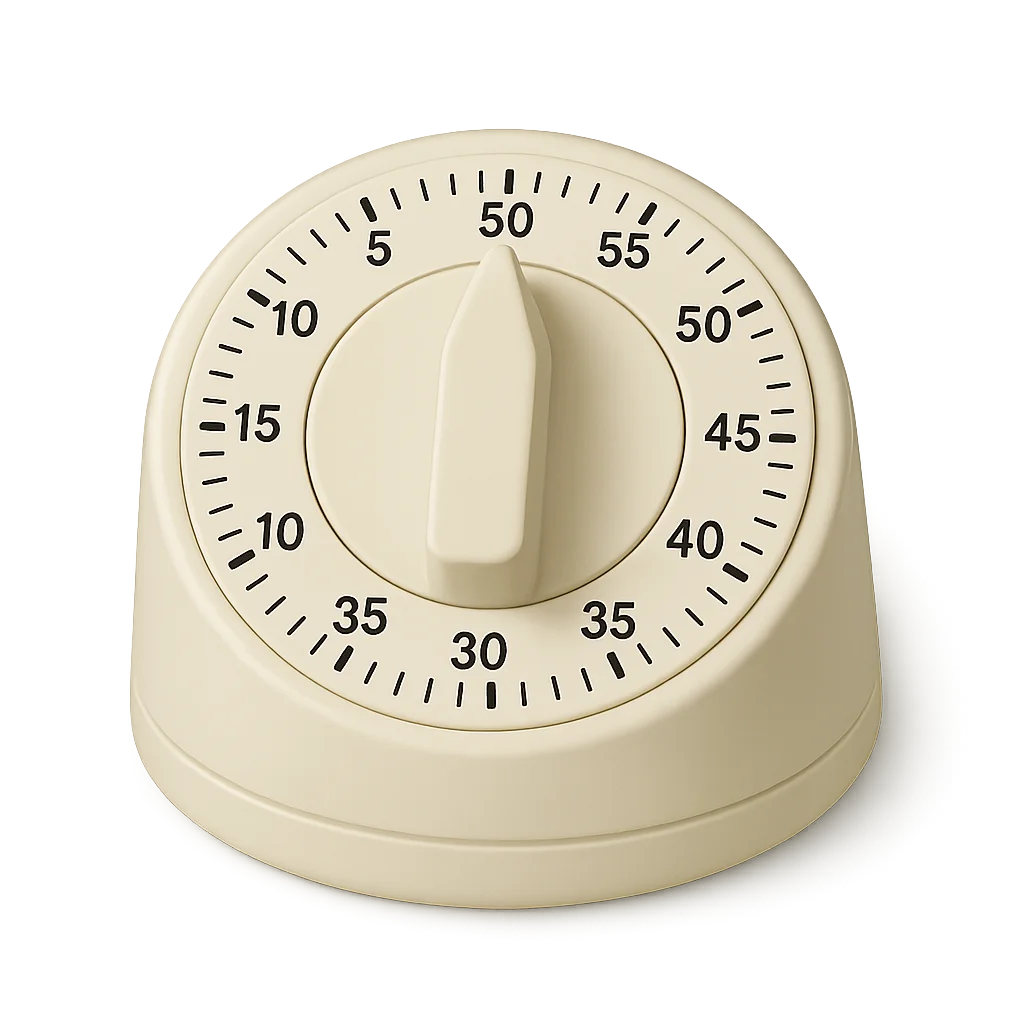
The Kitchen Timer's Tale
Hello there. You might know my voice. It’s the steady tick-tock-tick-tock that builds anticipation, followed by the cheerful DING that announces a triumph. I am the Kitchen Timer, a small but mighty guardian of culinary creations. But before I found my place on countertops around the world, the kitchen was a very different place, a realm of delicious hopes and frequent smoky disasters. Imagine a world without me. It was a world of guesswork and anxiety. A baker would mix the perfect cake batter, slide it into the hot oven, and then… what? They’d rely on the long shadows stretching across the floorboards, or listen for the distant chime of a grandfather clock in the hall, its voice too faint to be a reliable guide. A cook roasting a chicken for a special Sunday dinner would have to judge its doneness by instinct alone, a skill that took years to master and often ended in disappointment. The air was thick not just with the scent of cooking food, but with the stress of uncertainty. Was it done? Was it burnt? The simple joy of creating a meal was often overshadowed by the fear of ruining it. I imagine the countless sighs of frustration, the cakes that fell flat, the roasts that were tough and dry, and the cookies that turned to charcoal. In those kitchens of the early 20th century, there was a silent, desperate need for a hero. Not a hero with a cape, but one with a clockwork heart and a clear, commanding voice. They needed a dedicated, personal timekeeper right there in the heart of the home, a friend who could stand watch and declare, with perfect accuracy, when the moment was just right. They needed me.
My story truly begins in a bustling factory in Waterbury, Connecticut, the home of the Lux Clock Manufacturing Company. It was there that a brilliant and practical man named Thomas Norman Hicks saw the chaos in the kitchen and envisioned a solution. For years, his company had been making grand, intricate clocks, but Mr. Hicks had a revolutionary idea. What if he could take the soul of a large clock—its precise, time-keeping mechanism—and distill it into a small, affordable device made for a single, vital purpose? The year was 1926, and the world was changing rapidly. Homes were filling with new conveniences, and Mr. Hicks was determined to add one more. He filed the patent for me on October 2nd, 1926, officially beginning my journey from an idea into a reality. He called me the 'Minute Minder,' a name that perfectly described my mission. My creation was a marvel of engineering. Mr. Hicks and his team didn't just shrink a clock; they re-imagined it. When you twist my dial, you aren't just setting a time; you are winding a coiled metal spring, feeding me the energy I need to do my work. This stored energy is then released with incredible control by a special part called an escapement. It’s the escapement that creates my familiar ‘tick-tock’ sound, as it allows a series of tiny gears to turn one small step at a time, marking the slow, steady march of seconds. It was a delicate balancing act. The spring had to be strong enough to run for an hour but not so powerful that it would wear out the delicate gears. The bell needed a hammer that would strike with enough force to be heard over the sizzle of a frying pan. Every component, from the tiniest screw to my sturdy metal casing, was designed with care. I remember the feeling of being assembled, piece by piece. The gears meshed perfectly, my spring was coiled and ready, and my bell was polished to a shine. When the first production models rolled off the line in early 1927, I felt a sense of profound purpose. I was no longer just a collection of parts. I had a clockwork heart, a clear voice, and a job to do: to bring order, precision, and a little bit of peace to every kitchen.
From that factory in Connecticut, I traveled into homes across the country, and then the world. I became a silent, watchful companion on countless kitchen counters. I stood guard through the baking of thousands of birthday cakes, my final DING signaling the moment of celebration. I timed holiday turkeys to golden-brown perfection, ensuring family feasts were memorable for all the right reasons. I ticked away quietly during the making of simple weekday dinners, my presence a small comfort, a promise that everything was under control. I was a trusted friend, a small machine that helped create moments of joy and connection. As the decades passed, the world of technology surged forward, and I evolved right along with it. My mechanical, spring-wound body was joined by electric cousins who plugged into the wall, their gentle hum replacing my tick-tock. Then came the digital age. My very essence—my ability to count down time—was captured in lines of code. I found new homes inside the sleek panels of microwaves and ovens. I became an app on smartphones and a feature on computers, able to travel in a pocket anywhere in the world. Some might see this as me becoming obsolete, but I see it as my spirit becoming immortal. My form has changed, but my fundamental purpose remains the same. Whether I am a metal dial on a countertop or a set of pixels on a screen, my job is to give people the gift of perfectly managed time. From a batch of cookies to a complex chemistry experiment in a lab, I ensure that things happen exactly when they are meant to. My journey from a simple mechanical minder to a universal digital tool is a reminder that a great idea never truly disappears; it just finds new ways to be useful, continuing to serve the timeless human need for order, precision, and that perfect, triumphant DING.
Activities
Take a Quiz
Test what you learned with a fun quiz!
Get creative with colors!
Print a coloring book page of this topic.















 Free for Educators