

 English

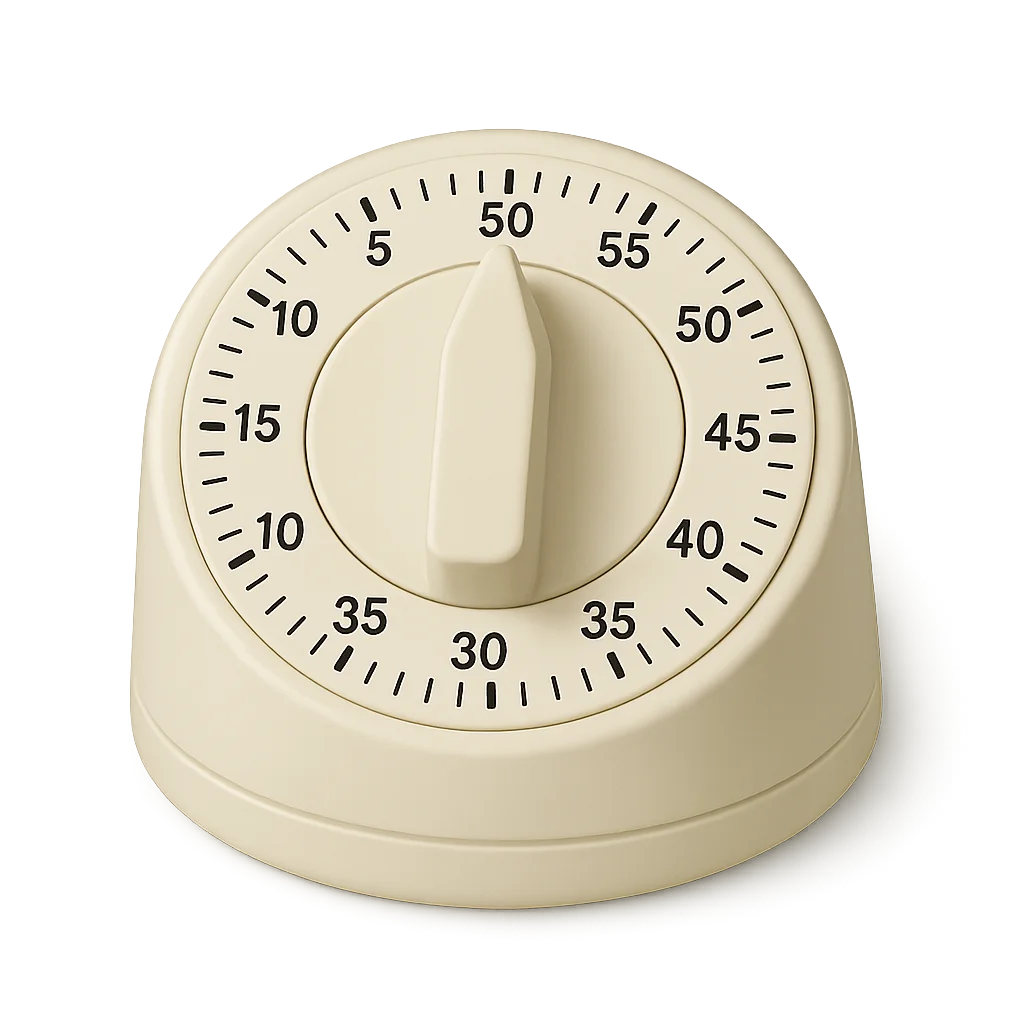
The Little Timer with a Big Job
Hello. My name is Kitchen Timer, and I’m the one who makes sure your cookies are perfectly golden and your pizza doesn't turn into a black crisp. Before I came along, kitchens could be chaotic places. A forgotten pot on the stove meant a smoky room, and a cake left in the oven too long was a sad, burnt surprise. My big cousin, the wall clock, was good at telling you what time it was, but it couldn't shout, “Hey, check the roast.”. That was the problem I was born to solve. I was created to be a cook’s special helper, a little friend with a loud voice who could keep track of minutes so people didn’t have to. With a simple twist and a tick-tock-tick, I promised to bring order and perfect timing to kitchens everywhere.
My story really begins in the busy 1920s with a clever man named Thomas Norman Hicks. He saw cooks juggling many tasks at once and thought there had to be a better way than just guessing. He imagined a small, simple device that could count down time all by itself. So, he got to work designing me. Inside my first body, he placed a tightly wound spring and a series of tiny gears. When you twisted my dial, the spring would slowly unwind, causing the gears to turn with a satisfying ticking sound. Each tick was a second marching by. He designed me so that when the last gear clicked into place, it would strike a little bell, making my signature “DING.”. It was a sound of victory, a sound that meant “Time’s up.”. On April 20th, 1926, my inventor was granted a patent, and I was officially born, ready to start my job.
After my invention, my cheerful “DING.” began to be heard in kitchens all over the world. I became a trusted friend to bakers and chefs. With my help, cooking became less of a guessing game and more of a science. People could follow recipes exactly, knowing their bread would rise for precisely 45 minutes or their eggs would be perfectly soft-boiled in three. I helped people feel more confident and successful. I also started to appear in all sorts of fun shapes. My most famous form was a bright red tomato. A university student in Italy named Francesco Cirillo used one of my tomato-shaped cousins to help him study. He would set me for 25 minutes and focus completely until I dinged. He called his method the Pomodoro Technique, after the Italian word for tomato, and students still use it today to get their homework done.
As the years ticked by, I began to change. I went through an evolution, just like other inventions. My mechanical, spring-powered insides were eventually replaced by batteries and tiny computer chips. My ticking sound often became a silent digital countdown on a little screen, and my friendly “DING.” transformed into a series of loud, insistent beeps. You might not see me sitting on the counter as often anymore, because I’ve found new homes. I live inside microwaves, ovens, and even on your family’s phones and tablets. Though I look and sound different, my heart is the same. I am still here to count the minutes and help you get things done right on time. My job is just too important to disappear.
Looking back, I’m so proud that my purpose has grown far beyond the kitchen. I don’t just time cakes anymore. I help you remember to brush your teeth for two whole minutes. I count down your 30 minutes of screen time. I’m even used for board games to make sure everyone gets a fair turn. My job started with a simple need to prevent burnt food, but it has become so much more. I am a small and simple tool, but I have a very important job: helping people everywhere manage their time, one countdown at a time. And I wouldn't trade it for anything.
Activities
Take a Quiz
Test what you learned with a fun quiz!
Get creative with colors!
Print a coloring book page of this topic.















 Free for Educators