

 English

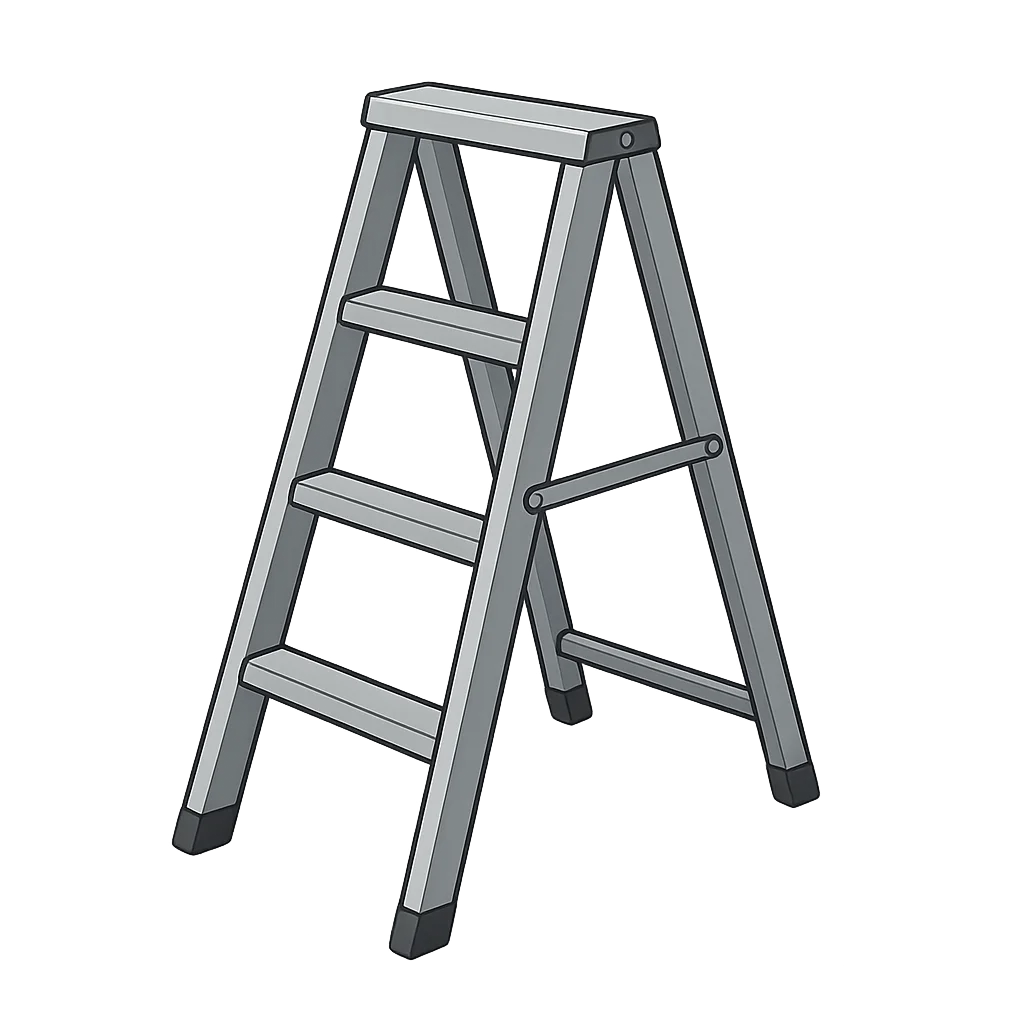
A Step Through Time: The Ladder's Story
Before there were skyscrapers or spaceships, before even the great pyramids touched the sky, there was me. I am the Ladder, and my story is as old as humanity's desire to reach for something just beyond its grasp. You might not think of me as a grand invention, but I am an idea, a simple solution that has been helping people for millennia. My earliest portrait was painted not on a canvas, but on a cave wall in Valencia, Spain, nearly 10,000 years ago. In the faint, earthy pigments of the Cuevas de la Araña, you can see a brave soul climbing up my rungs, reaching into a high crevice to gather precious honey from a wild beehive. That ancient artist captured my very essence. I was not just a tool. I was a bridge between the ground and a sweet reward, a way to overcome a challenge. Even then, my purpose was clear: to help humans ascend, to elevate them, one step at a time. My form was basic, perhaps just a sturdy tree trunk with notches cut into it, but my function was profound.
Throughout history, I have been a quiet but essential partner in progress. As civilizations rose, so did I, built from the materials of the earth. The ancient Egyptians knew me well. They fashioned me from reeds and wood, and I stood beside them as they raised the magnificent pyramids at Giza, stone by massive stone. I was the silent scaffold that allowed workers to place each block with precision, helping them build tombs fit for pharaohs. Thousands of years later, the Romans relied on my strength to construct their incredible empire. I leaned against the towering arches of their aqueducts, which carried life-giving water across vast distances. I stood firm as they built the Colosseum, a wonder of engineering. In every great construction project, from ancient temples to medieval castles, I was there. I was fashioned from rope, from bamboo, and from hand-hewn timber. My design was simple, but my contribution was immeasurable. I was the humble helper that made the monumental possible, a constant presence in the story of human ingenuity.
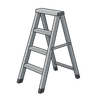
For most of my long life, I had one significant limitation: I always needed something to lean on. A wall, a cliff, or a sturdy tree was my necessary companion. This made me strong, but not always practical, especially indoors or in open spaces where there was nothing to support me. This all changed thanks to the cleverness of a man named John H. Balsley. He was a master carpenter from Dayton, Ohio, who understood my shortcomings. He saw the need for a ladder that could stand on its own two feet, so to speak. On January 7th, 1862, he was granted a patent for an invention that gave me a newfound independence: the folding stepladder. His design was a work of simple genius. He created me with two separate legs connected by a hinge at the top and a spreader to hold my legs apart, forming a stable A-frame. Suddenly, I was no longer dependent. I could be set up in the middle of a room, providing a safe, secure platform for painters, librarians, and homeowners. This improvement made me safer, preventing the slips and falls that sometimes happened with my lean-to ancestors. I became more versatile than ever, a reliable tool that could go anywhere.
My evolution didn't stop in the 19th century. As human ambition grew, so did I. My basic design was adapted, stretched, and strengthened to meet incredible new challenges. I became the extension ladder, a marvel of sliding sections that can reach the highest windows of a burning building. In the hands of a firefighter, I am not just a tool. I am a lifeline, a pathway to safety for people trapped by smoke and flames. My rungs have felt the heavy boots of heroes rushing toward danger, and I have held steady against walls while lives were saved. But my reach extends even beyond our world. In the sterile, high-tech environment of space exploration, specialized versions of me are essential. Astronauts have used me to perform repairs on the outside of the International Space Station, their hands gripping my rungs while floating in the weightlessness of orbit. From a simple notched log used to get honey to a sophisticated device used among the stars, I have been a constant companion on humanity's greatest adventures. I have proven that a simple concept can be adapted to achieve the most extraordinary things.
In an age of computers and robotics, you might think a simple tool like me would be obsolete. Yet, I am more useful than ever. You will find me in almost every garage, workshop, and storeroom across the globe. I am still the first thing people reach for when they need to change a lightbulb, paint a ceiling, or retrieve something from a high shelf. My story is a reminder that some of the most powerful ideas are the simplest ones. I represent the belief that no goal is truly out of reach if you are willing to take the first step. I am a symbol of progress, of overcoming obstacles, and of the enduring human spirit that always wants to see what's at the top. And I will always be here to help you climb higher, one steady rung at a time.
Activities
Take a Quiz
Test what you learned with a fun quiz!
Get creative with colors!
Print a coloring book page of this topic.









 Free for Educators