

 English

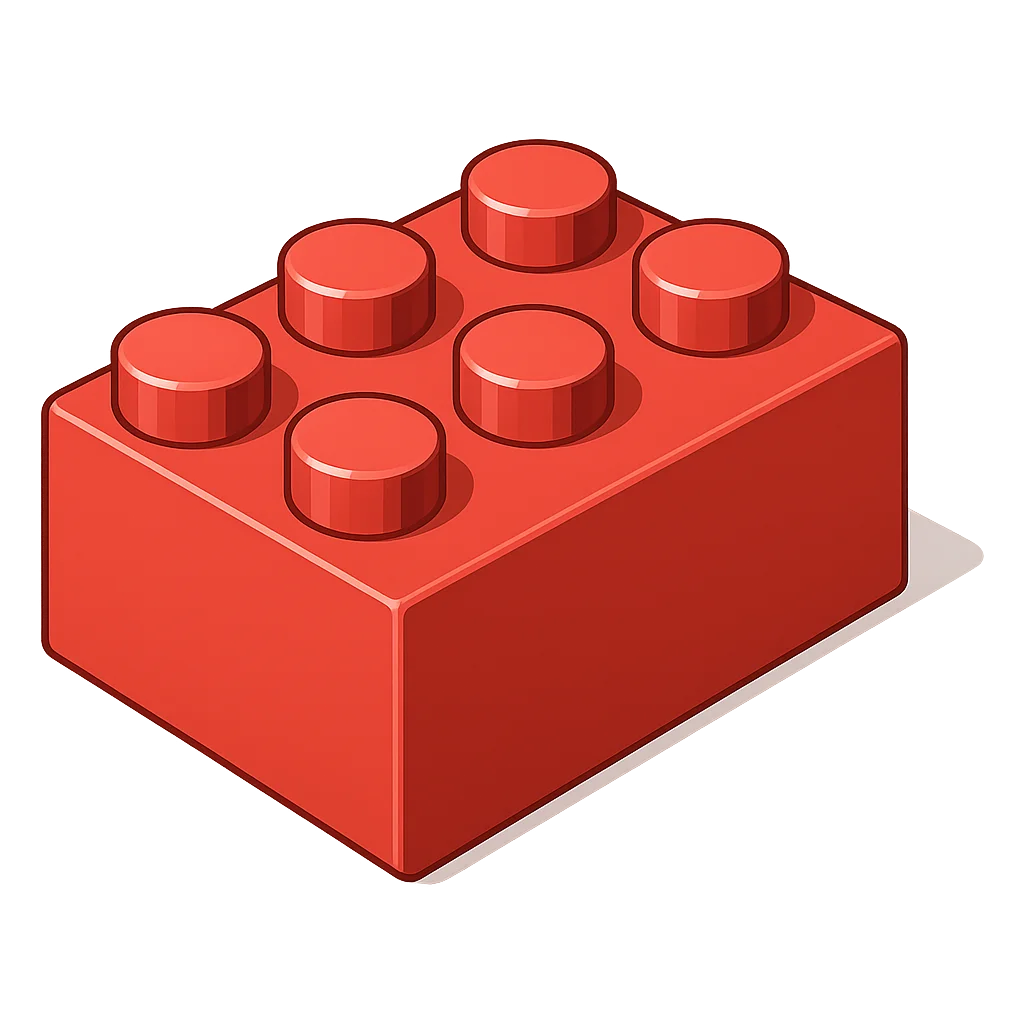
The Story of the LEGO Brick
I wasn't always the colorful, clicking plastic brick you hold in your hands today. My story began not with a snap, but with the gentle rasp of a saw against wood. I was born from an idea in a small carpentry workshop in Billund, Denmark, a place filled with the rich scent of sawdust and fresh paint. It was the year 1932, and my first creator, a thoughtful and resilient man named Ole Kirk Christiansen, was navigating a world of economic hardship. Yet, through it all, he never lost his profound belief in the importance of quality craftsmanship and the pure, simple joy of play. He poured his heart into making beautiful wooden toys that would last for generations. I remember being a cheerful duck with wheels, pulled by a string, my wooden body painted in bright, happy colors. I was also a sturdy little car and a perfectly balanced yo-yo. Ole's motto was 'det bedste er ikke for godt,' meaning 'only the best is good enough,' and he lived by it. In 1934, he decided his company needed a name that captured this spirit. He chose 'LEGO,' a clever combination of the Danish words 'leg godt,' which means 'play well.' This name became my soul, my purpose. For many years, I was carved from beechwood, a sturdy and reliable form. But even as children enjoyed my wooden brothers and sisters, a new, more versatile future was quietly waiting to be discovered, one that would be molded from a completely different material. A spark of an idea was about to transform me forever into something much more connected.
The world was changing, and I was destined to change with it. A new material, plastic, was becoming more common, and it held a world of possibilities. In 1947, my creator, Ole Kirk Christiansen, made a bold decision. He saw a plastic molding machine at a trade fair and was immediately captivated by its precision and the potential it held for toy making. Despite the high cost, he purchased one for his workshop in Billund, signaling a major shift in his vision. He had been inspired by a British toy he’d seen, the 'Kiddicraft Self-Locking Building Brick,' which was designed by an inventor named Hilary Fisher Page. The concept of interlocking blocks that could be used to build anything sparked a fire in Ole's imagination. He took that concept and adapted it, creating his own version. In 1949, I was born from that machine, my first plastic form. My official name was the 'Automatic Binding Brick.' I had the familiar rows of studs on my top surface, a promise of connection. But I had a secret weakness: I was completely hollow on the inside. This meant that while you could stack me to build walls and towers, there was nothing to make me grip the brick below. A gentle breeze or a clumsy hand could send a magnificent creation tumbling down into a disappointing pile. I felt incomplete, like a handshake without a grip. I was an exciting new idea, but my true potential was still locked away.
The person who would finally unlock my true potential was Ole’s son, Godtfred Kirk Christiansen. He grew up surrounded by my wooden and early plastic forms, and he shared his father’s deep passion for quality play. But Godtfred also had a brilliant mind for systems and engineering. He saw me not just as a single toy, but as the core component of an entire universe of creativity. He called his vision a 'System of Play.' For this system to work, I had to be perfect. For years, he wrestled with my fundamental flaw: my weak connection. He knew that for children to build their dreams without frustration, I needed what he called 'clutch power.' The connection had to be strong enough to hold a model together when it was picked up and played with, yet gentle enough for a child’s small hands to easily pull apart. The solution, when it arrived, was an act of pure genius. After countless sketches and prototypes, he perfected a new design. On my underside, he added three small, hollow tubes, engineered with incredible precision. These tubes were designed to fit perfectly and snugly over the studs of the brick placed beneath me. When you pressed two of us together, those tubes would flex ever so slightly and grip the studs, creating a firm, reliable connection. It was a connection you could feel and hear in a deeply satisfying 'click.' This simple but revolutionary stud-and-tube design was patented on January 28th, 1958. That date is my true birthday, the moment I became the brick you know today. That single innovation transformed me from a simple stacking block into a limitless construction system, ready for any challenge.
My new clutch power was the key, but Godtfred's vision extended far beyond a single connection. He established a set of core principles for his 'System of Play,' a grand idea that would guide my evolution for decades to come. The most important principle was universal compatibility. He declared that every single element I came in had to fit together. Every brick, every plate, every specialized piece had to be compatible with all the others, no matter which set they came from or when they were manufactured. This meant a brick from 1963 had to connect perfectly with a brand-new brick made today. This promise required manufacturing with almost unheard-of precision, but it also meant that a child’s collection could grow with them indefinitely, becoming a more powerful tool for creativity with every new addition. To fulfill this promise of longevity, however, I needed to be made from a stronger, more stable material. My early plastic form could sometimes warp or lose its color over time, compromising my perfect fit. The search began for the perfect substance. Finally, in 1963, after testing many different types of plastic, my creators found the ideal material: Acrylonitrile Butadiene Styrene, or ABS. This new plastic was a miracle for a toy like me. It was incredibly durable and resilient, able to withstand years of enthusiastic building, dropping, and rebuilding. It held its vibrant colors without fading and, most importantly, it didn't shrink or warp, ensuring that my clutch power would remain just right for decades. Being made from ABS meant that the amazing starships, castles, and cities you build could become lasting keepsakes, passed down for others to enjoy and build upon. I was no longer just a toy; I was a lasting legacy.
From that humble carpentry workshop in the small town of Billund, my journey has taken me across the entire globe. I have found my way into the hands of millions of children and adults, speaking a universal language of creativity that needs no translation. I am a small piece of potential, waiting to become part of something magnificent. With me, you have built towering skyscrapers that scrape imaginary skylines, and cozy little houses for tiny figures. You have assembled spaceships to explore distant galaxies and charted courses for pirate ships on pretend seas. I have become the building block for programmable robots that can solve mazes and the medium for intricate works of art displayed in galleries. I am so much more than just a piece of plastic. I am a tool that helps you learn about engineering and physics without even realizing it. I am a canvas for your endless imagination. Every single time you snap me together with another brick, you are honoring the legacy of Ole Kirk Christiansen and his simple, powerful belief to 'play well.' His dream lives on in every creation you make. And the most wonderful part of my story is that it is never-ending. It continues with you. So, what will you build next?
Activities
Take a Quiz
Test what you learned with a fun quiz!
Get creative with colors!
Print a coloring book page of this topic.













 Free for Educators