

 English

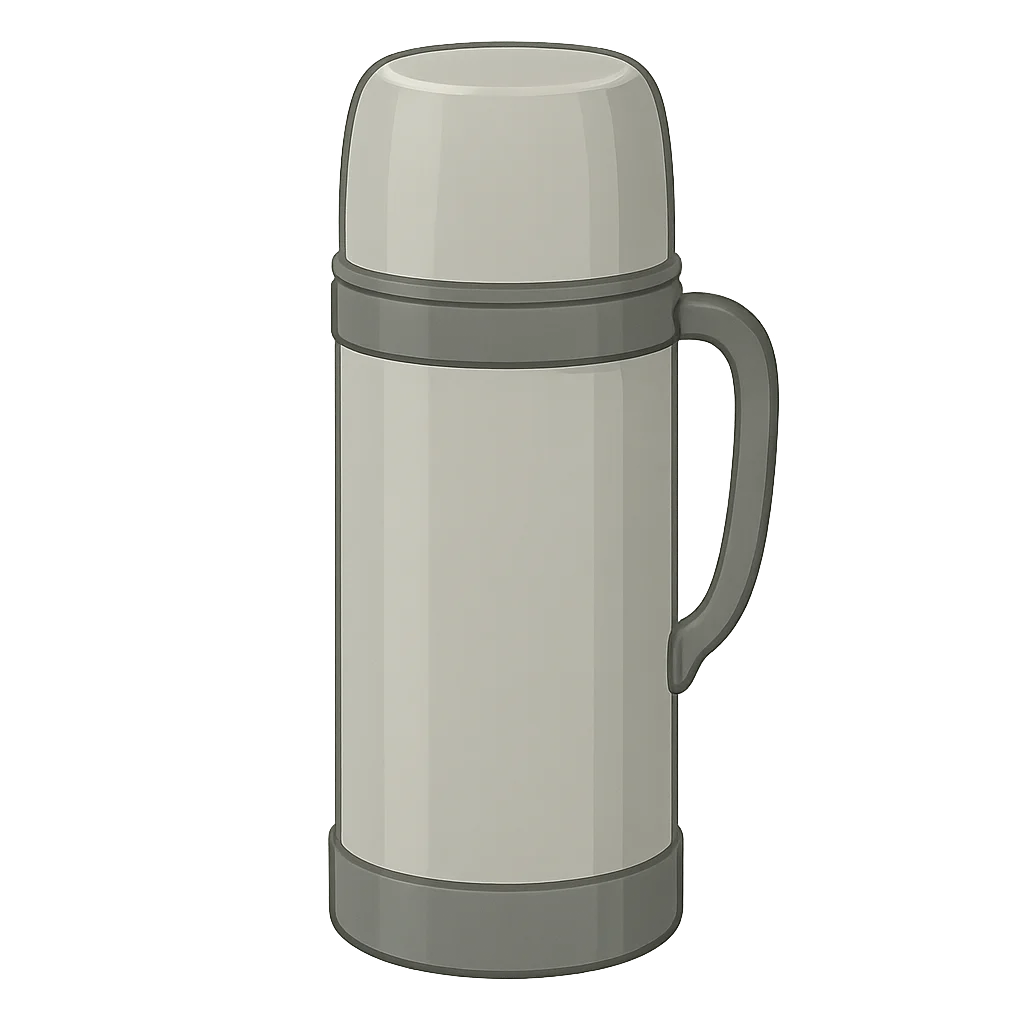
The Story of the Thermos
Hello there. You might recognize me. I am a Thermos, but my story is much bigger than just a simple container. I hold a secret power, a remarkable ability that feels like pure magic but is actually rooted in brilliant science. Imagine a frosty winter morning, the ground sparkling with ice. I can cradle your hot chocolate, keeping it steaming and rich for hours, a warm, liquid hug waiting inside your backpack long after you've left home. Now picture a blistering summer afternoon, the sun beating down relentlessly. I can guard your lemonade, keeping it so perfectly icy and refreshing that the first sip feels like diving into a cool, clear lake. This power wasn't invented for comfort, at least not at first. My creator was a thoughtful and curious scientist named Sir James Dewar. He didn't dream me up for picnics or school lunches. My life began in his London laboratory in the late 19th century, a place filled with strange bubbling liquids and the ambitious quest for temperatures colder than you can possibly imagine. I wasn't born for keeping soup warm, but for a much more serious purpose: to help unlock the secrets of the universe at temperatures that could freeze air solid. My story is one of surprising transformation, from a quiet, essential tool in a lab to a trusted companion on adventures all over the globe.
My origin story is truly a scientific surprise, born from a challenge that baffled many great minds of the late 19th century. My creator, Sir James Dewar, was a brilliant Scottish scientist working at the prestigious Royal Institution in London. The year was 1892, and he was deeply involved in the fascinating field of cryogenics, the study of what happens to materials at extremely low temperatures. Imagine a world colder than the harshest arctic winter—that was his laboratory. He was on a quest to liquefy gases, turning substances that are normally invisible, like hydrogen, into a liquid state. But he faced a persistent and frustrating problem. These liquefied gases were so intensely cold, hundreds of degrees below zero, that they would instantly boil and evaporate the moment they touched a normal container. It was like trying to carry water in a sieve. He needed a vessel that could shield these ultra-cold liquids from the warmth of the room. After much thought, he had a stroke of genius. He took two custom-blown glass flasks, one slightly smaller than the other, and nested the smaller one inside the larger one. Then, he sealed the space between them and, using an air pump, painstakingly removed as much of the air as possible from that gap. This created a near-perfect vacuum, an empty space that is an incredibly poor conductor of heat. Heat energy needs molecules to vibrate and pass it along, but in a vacuum, there are almost no molecules to do the job. This vacuum barrier became my secret. It prevented the outside warmth from reaching his cold liquids, a process known as convection and conduction. To further improve my design, he coated the glass with a layer of silver, which reflected heat radiation away, much like a mirror reflects light. And so, I was born: the 'Dewar Flask.' I was a specialist, a high-tech tool for a very specific scientific purpose, and I performed my job perfectly, protecting his precious liquid air for his vital experiments.
For over a decade, my life was confined to laboratories. I was a tool for scientists, not a comfort for the public. Sir James Dewar was a man of pure science; he was so focused on his research that he never patented me for commercial use. He saw me as a means to an end for his cryogenic studies, not something you'd pack for a day trip. But my potential was too great to stay hidden. My journey into the wider world started in Germany with two entrepreneurial glassblowers, Reinhold Burger and Albert Aschenbrenner. They had worked with Dewar and understood my design intimately. They saw what my inventor had overlooked: if I could keep liquid nitrogen from warming up, I could just as easily keep a cup of coffee from cooling down. They recognized that my scientific principle had a very practical, everyday application. In 1903, they made some critical improvements. My original form was all glass and quite delicate. They designed a strong metal casing to protect my fragile inner chambers, making me durable enough for daily use. They also added a secure stopper and a cup that doubled as a lid. I was being transformed from a piece of lab equipment into a consumer product. To complete my makeover, they needed a name. In 1904, they held a public contest to find the perfect name for me. The winning entry was 'Thermos,' derived from the Greek word 'therme,' which means 'heat.' It was perfect. The Thermos company was born, and soon, I was being manufactured not just for scientists in lab coats, but for everyone.
Once I had my new name and sturdy body, my adventures truly began. I left the quiet laboratory and went out to see the world. I became a trusted companion to some of the most daring people in history. I journeyed with explorers like Robert Peary to the bone-chilling cold of the North Pole and with Ernest Shackleton on his expeditions to the Antarctic. In those desolate, frozen landscapes, a warm sip of soup or tea wasn't just a comfort; it was a lifeline, and I was proud to provide it. I soared into the skies with pioneering aviators in their open-air cockpits, where the wind was fierce and the temperatures plummeted. I kept their coffee hot, giving them a small piece of warmth as they charted new paths across the clouds. But as thrilling as those grand expeditions were, my favorite adventures were the quiet, everyday ones. I found my way into the hands of construction workers, providing a hot meal high above the city on a steel girder. I was tucked into backpacks for family picnics in sunny parks, keeping the lemonade perfectly chilled. Most importantly, I became a staple in school lunchboxes everywhere. For millions of children, I was a small, reliable piece of home, delivering their favorite soup just the way their parents had made it that morning. I realized I wasn't just a container; I was a vessel for care, a small but significant way people could look after each other, even when they were apart. I changed daily life by granting people the freedom to break their routines and enjoy a taste of home, no matter where their day took them.
My journey has been long, and the world has changed immensely since 1892, but my core purpose remains. The fundamental principle Sir James Dewar discovered—vacuum insulation—is more important today than ever. My modern cousins, the vacuum flasks you see everywhere, are direct descendants of that first glass flask from his lab. My design has been adapted for countless critical tasks. In hospitals, specially designed versions of me are used to transport life-saving medicines and even human organs for transplants, where maintaining a precise temperature is a matter of life and death. In advanced scientific laboratories, I am still essential for storing sensitive biological samples and materials for cutting-edge research. I've even traveled to space with astronauts, helping them in the extreme environment far beyond Earth. It fills me with pride to know that the simple idea of an empty space between two walls has had such a profound impact. From a solution to a niche scientific problem, I blossomed into a global companion. My story is a testament to how creativity and problem-solving can lead to inventions that touch lives in ways the creator never could have imagined. I am proof that a little bit of science can indeed warm up the whole world.
Activities
Take a Quiz
Test what you learned with a fun quiz!
Get creative with colors!
Print a coloring book page of this topic.













 Free for Educators