

 English

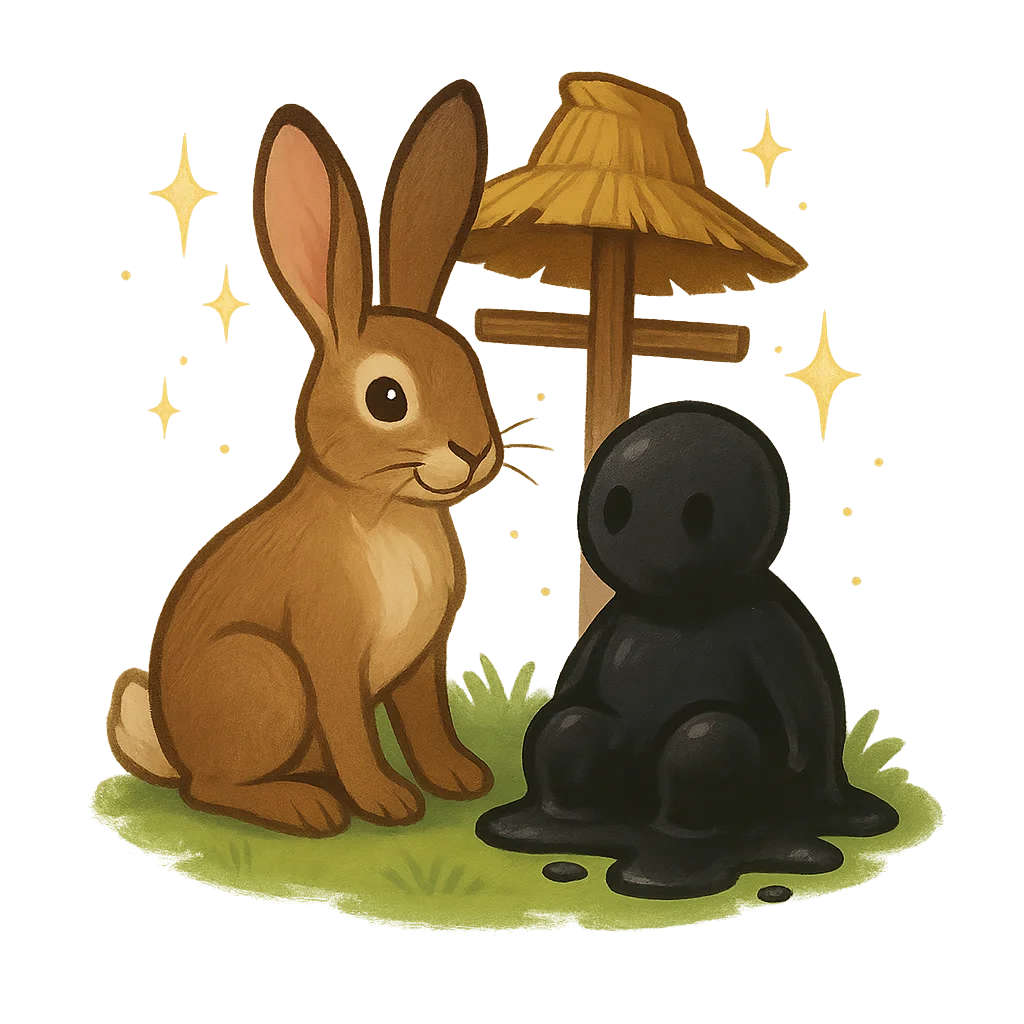
Br'er Rabbit and the Tar Baby
Well now, howdy! Folks call me Br'er Rabbit, and if there's one thing I've learned living out here in the Georgia countryside, it's that you don't need long claws or a loud roar to get by; you just need a quick mind. The sun beats down hot on these dusty roads, and the woods are full of critters bigger and stronger than me, like that sneaky Br'er Fox, who's always cooking up some scheme to put me in his stew pot. But a body's got to survive, and my way of surviving has turned into some mighty fine stories, the most famous of which folks call 'Br'er Rabbit and the Tar Baby'.
The story begins not with me, but with Br'er Fox, fuming because he could never seem to catch that clever rabbit. One morning, he had an idea so sly he grinned from ear to ear. He mixed up a batch of tar and turpentine and molded it into the shape of a little person, a 'Tar Baby,' he called it. He sat this sticky, silent figure on a log by the side of the road, a spot he knew Br'er Rabbit would pass on his morning stroll. Sure enough, along came Br'er Rabbit, hopping along, lippity-clippity, feeling mighty pleased with himself. He saw the Tar Baby and, being a polite sort of fellow, tipped his hat. 'Mornin'!' he said cheerfully. 'Nice weather we're havin'!' The Tar Baby, of course, said nothing. Br'er Rabbit tried again, a little louder, but still got no answer. Well, his pride began to bubble. 'You stuck up, are you?' he shouted. 'I'll teach you some manners!' He drew back his fist and—BAM!—punched the Tar Baby right in the head. His fist stuck fast. 'Let go!' he yelled, and swung with his other hand. Now both his fists were stuck. In a panic, he kicked with one foot, then the other, until he was completely trapped, tangled up in the gooey mess. Just then, Br'er Fox sauntered out from behind the bushes, licking his chops. 'Well, well, Br'er Rabbit,' he chuckled. 'Looks like I've got you this time. I wonder what I ought to do with you.'
Br'er Fox circled his trapped prize, thinking aloud about all the ways he could finish him off. 'I could roast you on a fire, Br'er Rabbit,' he mused. 'Or I could hang you from the highest tree.' Br'er Rabbit's heart was beating like a drum, but his mind was racing even faster. He had to think of something, and quick. As Br'er Fox listed more terrible fates, an idea sparked. Br'er Rabbit started to tremble and cry, putting on the performance of a lifetime. 'Oh, Br'er Fox!' he wailed. 'You can do anything you want with me! Roast me, drown me, skin me alive! I don't care what you do, just please, oh please, whatever you do, for mercy's sake, don't fling me into that awful briar patch!' Br'er Fox stopped and his eyes lit up. The briar patch! The thorniest, prickliest, most painful place he could imagine. To cause his rival the most suffering, that's exactly what he would do. 'So you're scared of the briar patch, are you?' he sneered. With a mighty heave, he pulled Br'er Rabbit off the Tar Baby and flung him—KERPLUNK!—right into the middle of the thickest, thorniest briar patch. For a moment, there was silence. Then, a little chuckle was heard from deep within the thorns. A moment later, Br'er Rabbit hopped out onto a log on the other side, brushing himself off. 'Thank you, Br'er Fox!' he called out cheerfully. 'I was born and bred in a briar patch! This is my home!' And with a flick of his tail, he disappeared into the woods, leaving a furious Br'er Fox to stomp his feet in frustration once again.
This story, and many others like it, were more than just fun tales about talking animals. They were born in the American South, first told by enslaved African Americans who, like me in the story, faced challenges much bigger and stronger than themselves. Br'er Rabbit became a secret hero, a symbol that wit could triumph over brute force, and that the powerless could outsmart the powerful. These stories were shared in quiet moments, passed down from one generation to the next as lessons in survival, hope, and resilience. In the years after the Civil War, a writer named Joel Chandler Harris began collecting these tales, publishing them in a book on December 8th, 1880, which introduced them to the whole world. Though his work is complicated, it saved these stories from being lost. Today, Br'er Rabbit still reminds us that your greatest strength isn't in your size, but in your mind. He lives on in cartoons, books, and theme park rides, a timeless trickster who proves that a little bit of cleverness can get you out of even the stickiest situations and that stories are one of the most powerful ways to keep hope alive.
Activities
Take a Quiz
Test what you learned with a fun quiz!
Get creative with colors!
Print a coloring book page of this topic.
















 Free for Educators