

 English

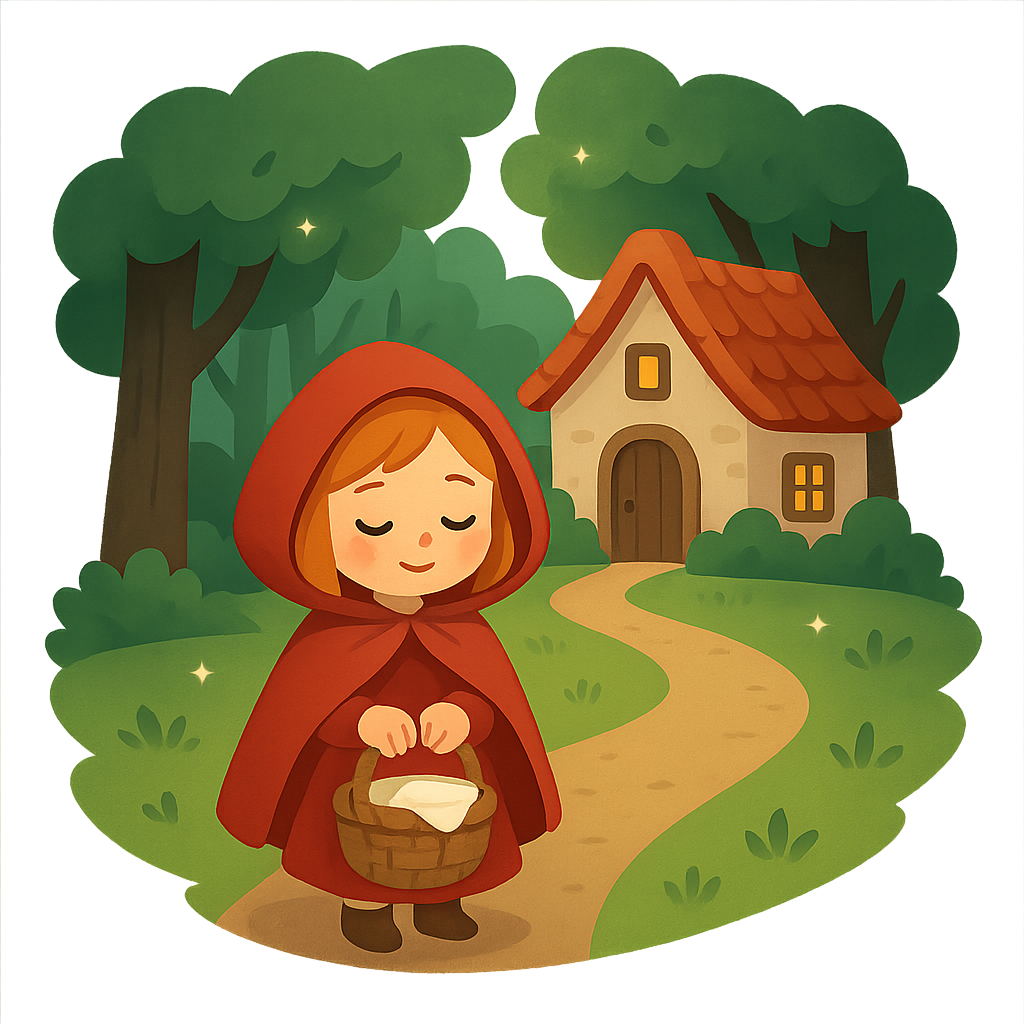
Little Red Riding Hood's Warning
My grandmother’s hands, wrinkled and kind, were the ones that stitched the beautiful scarlet cloak I wear. The moment I put it on, everyone in my little village by the forest started calling me Little Red Riding Hood. I loved the name, and I loved my grandmother even more. Her cottage was a warm, welcoming place filled with the scent of cinnamon and woodsmoke, and her hugs could chase away any chill. One sunny morning, my mother packed a basket with fresh, crusty bread, a pot of sweet butter, and a small bottle of elderflower cordial for her, as she was feeling unwell. 'Go straight to your grandmother's cottage,' she warned, her eyes serious as she tied the basket's cloth cover. 'The path is safe if you stay on it. Don't dawdle, don't stray to pick flowers, and most importantly, don't talk to strangers. The woods are deep, and not every creature in them is friendly.' I promised I would, nodding earnestly while my mind was already picturing the journey. But the forest path was just so full of wonders that day—the way the sunlight dappled through the leaves, the cheerful chirping of the robins, the rustle of unseen things in the undergrowth. My story, the one you might know as the tale of Little Red Riding Hood, is a reminder that the world can be as dangerous as it is beautiful, and that a friendly face can sometimes hide the sharpest teeth. It’s a lesson I learned firsthand, a lesson etched into my memory like the winding path through those very woods.
An Unexpected Encounter
The path to Grandmother's house was dappled with sunlight filtering through the tall, ancient trees. I knew every twist and turn, every mossy stone and gnarled root that snaked across the dirt. I hopped and skipped, humming a tune my mother taught me, feeling perfectly safe in my familiar world. But that day, a new shadow fell across the path, a shadow that didn't belong to any tree. A large wolf, with clever, shining amber eyes and a coat the color of twilight, stepped out from behind a great oak tree. He was not snarling or fearsome; instead, he was shockingly charismatic. He dipped his head in a polite bow, a gesture so unexpected it made me giggle. 'Good morning, little miss,' he said, his voice as smooth as honey and just as sweet. 'And where might you be off to so briskly on this fine day?' Forgetting my mother’s warning in an instant, I was charmed by his manners. 'I'm going to see my grandmother who lives on the other side of the woods,' I replied cheerfully. 'She is feeling unwell, and I'm bringing her bread and butter to make her feel better.' The wolf's smile widened. 'How very thoughtful of you,' he purred. He then pointed a clawed finger towards a nearby meadow, bursting with vibrant wildflowers. 'But look at those lovely flowers. Why not pick a bouquet for your dear grandmother? It would surely brighten her spirits more than any bread.' It seemed like such a kind and wonderful idea. While I was busy gathering the prettiest bluebells and daisies, completely absorbed in my task, the wolf slipped away. He took a shortcut I didn't know, racing through the woods toward my grandmother's cottage with a terrible, hungry plan forming in his cunning mind. I didn't know it then, but my small act of disobedience had sprung a dangerous trap.
At Grandmother's Cottage
When I finally arrived at the cottage, basket heavy and arms full of flowers, I noticed the door was slightly ajar. A cold sliver of unease trickled down my spine; Grandmother was always so careful to keep it shut. Inside, the cottage was strangely dark and quiet, with the shutters drawn tight against the afternoon sun. 'Grandmother?' I called out, my voice a little shaky. A weak, scratchy voice answered from the large, canopied bed. 'Come closer, my dear. I'm feeling so weak I can hardly lift my head.' I tiptoed to the bedside, but the figure in the bed, wearing Grandmother's frilly nightcap, looked peculiar. The cap was pulled down low, covering most of the face, and the room was too dim to see clearly. 'Grandmother, what big ears you have,' I said, my voice trembling now. 'All the better to hear you with, my dear,' the voice rasped back. The answer was right, but the voice was all wrong. 'And Grandmother, what big eyes you have,' I continued, my heart starting to pound like a drum. 'All the better to see you with, my dear.' My hand clutched the basket tightly. 'And Grandmother, what big hands you have.' 'All the better to hug you with, my dear.' With each strange reply, my fear grew into a cold certainty. I took a final, fearful step closer and whispered, 'But Grandmother, what big teeth you have!' In a flash, the wolf threw back the covers and roared, 'All the better to eat you with!' He leaped from the bed, revealing his true, monstrous self. Just as he lunged, the cottage door burst open with a crash. A brave woodsman, who had been passing by and was concerned by the strange silence from the cottage, rushed in with his axe raised high. He had seen the wolf lurking earlier and knew something was amiss. In that terrifying moment, I learned that a moment of carelessness can lead to disaster, and that true saviors often appear when you least expect them.
A Story That Lives On
Grandmother and I were safe, thanks to the woodsman, but I never forgot the terrifying lesson I learned that day. My experience became a cautionary tale, a story told around crackling fireplaces all over Europe for hundreds of years. Parents would share it to teach their children to be cautious, to listen to the wisdom of their elders, and to understand that danger can wear a very convincing disguise. For a long time, it was just a spoken story, changing a little with each telling. Then, a writer in France named Charles Perrault wrote it down on paper in 1697, though his version ended much more grimly to serve as a stark warning. Later, two brothers in Germany, Jacob and Wilhelm Grimm, collected folktales and published their version on December 20th, 1812. They are the ones who gave the story its famous happy ending, with the heroic woodsman saving us both. This myth isn't just about a girl and a wolf; it’s about the journey we all take as we grow up. The path through the woods is like life itself—full of beauty, wonder, and unexpected turns, but also hidden dangers. My story continues to inspire countless books, movies, and paintings, reminding every new generation to be brave, to be wise, and to always look beyond a charming smile to see what truly lies beneath. It’s a story that connects us across time, a timeless warning wrapped in a fairy tale.
Activities
Take a Quiz
Test what you learned with a fun quiz!
Get creative with colors!
Print a coloring book page of this topic.













 Free for Educators