

 English

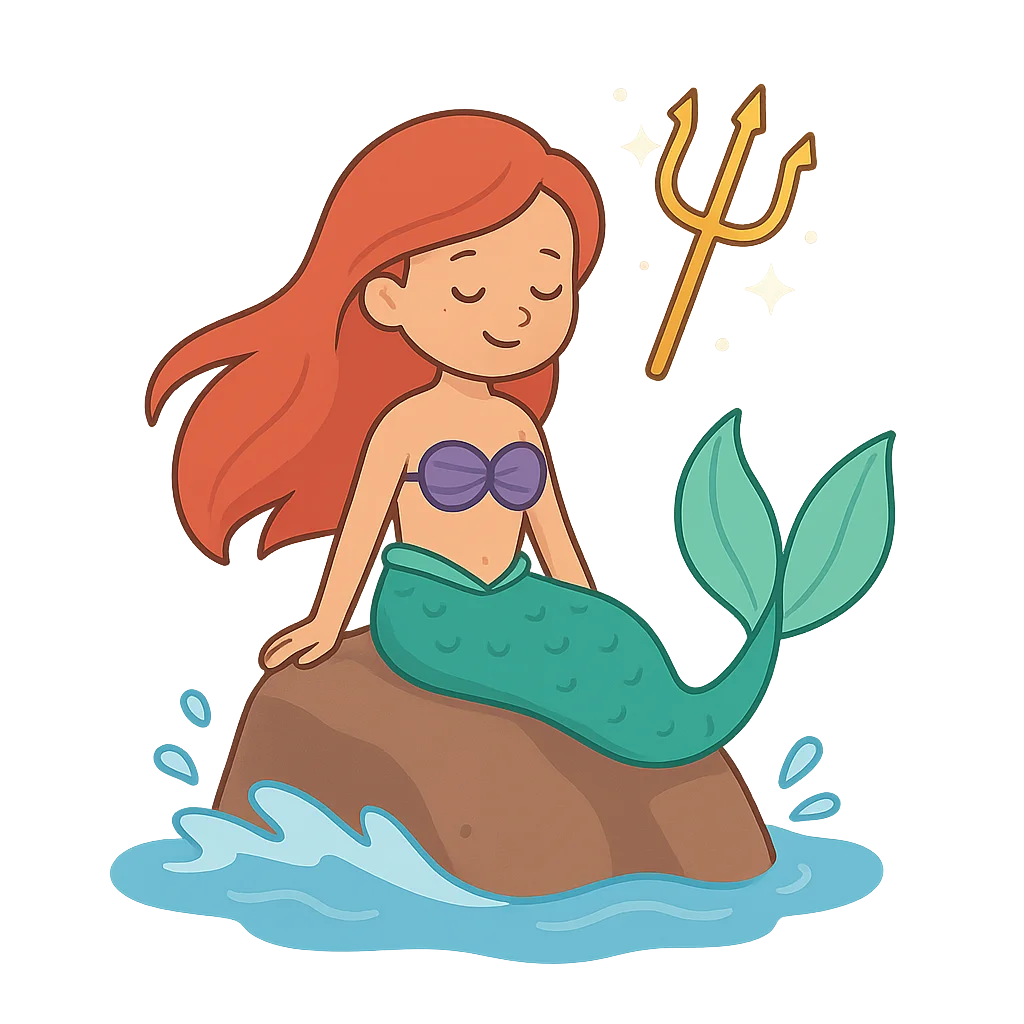
The Little Mermaid
My world is a quiet kingdom of shimmering blue and green, where sunlight dances in ribbons through the water. Down here, among the coral castles and gardens of swaying sea-anemones, I am the youngest of six sisters, a princess of the sea. My name is not known to you, for we have no names in the way humans do, but my story has been told for generations; it is the tale of The Little Mermaid. From my grandmother, I heard stories of the world above—a place of bright sun, fragrant flowers, and creatures with two strange fins they called 'legs' who walked upon the dry land. While my sisters decorated our garden with treasures from sunken ships, like broken statues and strange metal objects, my curiosity was never satisfied by these trinkets. I planted a single red flower that resembled the sun and listened intently to every tale of the surface. I longed for something more than our long, peaceful lives beneath the waves. The stories spoke of beings who possessed something we merfolk could never have: an immortal soul. This idea fascinated me. What was it like to have a life that continued beyond the three hundred years we were allotted, a consciousness that could ascend to the stars? My desire to see this world and understand its people grew into an ache that filled my heart, a constant pull toward the light shimmering on the surface of the water.
On my fifteenth birthday, the day I was finally allowed to rise to the surface, my anticipation was a current rushing through me. The world above was more staggering than I had ever imagined. I saw a magnificent three-masted ship gliding across the dark water, its lanterns glowing like fallen stars. Music and laughter drifted across the waves, and I watched a handsome young prince with kind eyes celebrating his own birthday. I felt an immediate and profound connection to him, a pull stronger than any ocean tide. But my wonder turned to terror as a sudden, violent storm descended upon the ship. The sky turned black, lightning tore across the clouds, and mountainous waves crashed over the deck, splintering the wood like a child's toy. The prince was thrown into the churning, icy waves. Without a second thought, I swam through the wreckage to his rescue. I held his head above the water, battling the storm until I could pull him to the shore of a nearby land. I waited with him until a young woman from a nearby temple found him, and then I retreated to the depths, my heart now tethered to the human world. My longing was no longer a vague curiosity; it was focused entirely on him. I had to see him again, to walk beside him, even if it meant risking everything. Desperate, I sought the dreaded Sea Witch in her dark, fearsome grotto, a place made of bones and populated by slithering polyps. "I can help you," she hissed, her voice like grinding stones. She agreed to give me legs, but the price was terrible: she would take my voice, the most beautiful in the entire ocean, by cutting out my tongue. Worse, every step I took on my new legs would feel like walking on the sharpest knives. And the final condition was the cruelest of all: if the prince married another, my heart would break, and I would dissolve into sea foam at dawn on the morning after his wedding. Driven by a love that felt as vast as the sea itself, I agreed. I drank the fiery potion, felt a searing pain as if a sword were passing through me, and awoke on the shore with human legs, where I was found by the very prince I had saved.
The prince was kind, captivated by my silent beauty and mysterious eyes. He brought me to his palace, dressed me in silks, and I danced for him, each graceful movement concealing the excruciating pain that shot through my feet. He grew deeply fond of me, calling me his little foundling, but without my voice, I could never tell him that I was the one who saved his life from the storm. He saw me as a dear child, a sweet and mysterious creature to be protected and admired, but not as the woman he could love and marry. He would often confide in me, telling me, "You are the most devoted to me, but I can only truly love the young woman from the temple, for I believe she is the one who rescued me." My heart ached with the truth I could not speak. When it was announced that he must marry a princess from a neighboring kingdom, his spirits were low until he met her and discovered she was the very same woman from the temple. His joy was my devastation. When their wedding was announced, my despair was as deep as the ocean I had left behind. On the wedding ship, as they celebrated, my sisters rose from the waves one last time. Their beautiful, long hair was gone, shorn off. "We traded it to the Sea Witch for this," they cried, holding up an enchanted dagger. "If you end the prince's life and let his blood touch your feet, you will become a mermaid again and live out your days with us." I took the dagger, my hand trembling.
I crept into the tent where the prince slept beside his new bride. The moonlight illuminated his face, and I saw the man I had saved, the man I loved more than my own life. I saw his happiness, his peace, and I knew I could not destroy it. My love for him was too great to cause him such harm, even to save myself. My sacrifice had to be complete. Instead of ending his life, I threw the dagger into the sea where it sizzled in the water. As the first pale ray of sun touched the sky, I cast myself into the waves, ready to become the foam my sisters had foretold. But I did not dissolve into the cold water. I felt myself rising, my body becoming lighter than air, translucent and ethereal. I had become a spirit, a daughter of the air. Other shimmering spirits welcomed me, their voices like soft music. They explained that because I had strived with all my heart for an immortal soul and had chosen selfless love over my own life, I had earned the chance to gain one through three hundred years of good deeds. My story, written down by a Danish storyteller named Hans Christian Andersen on November 7th, 1837, is not just about unrequited love. It is about sacrifice, hope, and the profound desire to connect with a world beyond our own. It inspires people to think about the nature of the soul and the pain that sometimes comes with deep love, living on in ballets, films, and the famous statue in Copenhagen's harbor that gazes out to sea, forever reminding us of the mermaid who gave everything for a chance to be human.
Activities
Take a Quiz
Test what you learned with a fun quiz!
Get creative with colors!
Print a coloring book page of this topic.
















 Free for Educators