

 English

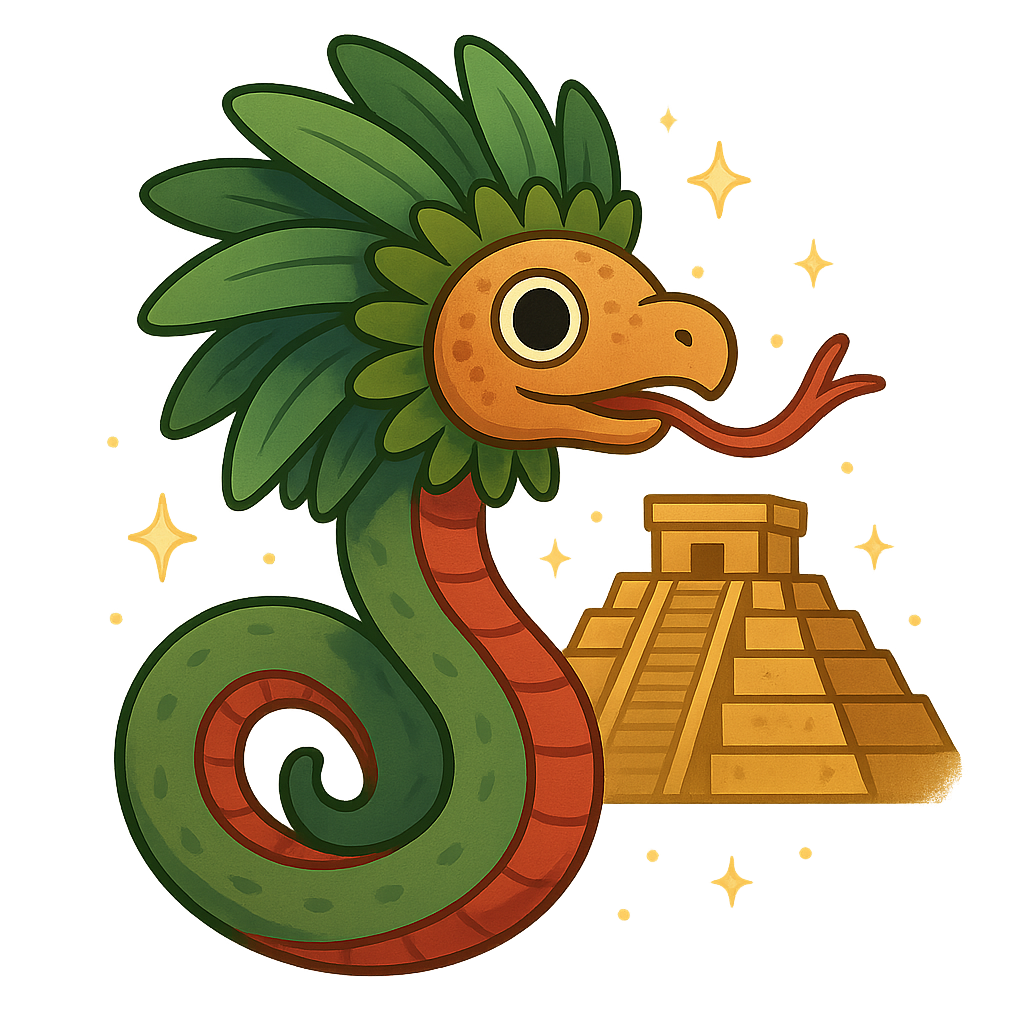
The Feathered Serpent's Gift
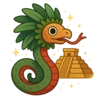
My scales shimmer with the green of jungle leaves, and my feathers catch the first light of the morning star. I am the wind that rustles through the corn stalks and the breath that gives life to clay. Long before your cities of glass and steel, my spirit soared over a world of volcanoes, lakes, and sky. My name is Quetzalcoatl, and I want to tell you a story the Aztec people used to share around their fires, a story about how your world came to be filled with people and the golden corn you eat. This is the myth of the Feathered Serpent's Gift. Before humanity, the world was silent. The gods and I looked down upon the earth after the Fourth Sun had been destroyed, and we saw it was empty. We knew it needed people to honor the sun and tend to the land. But the bones of the past generations were locked away in the deepest part of the underworld, Mictlan, a place of shadow and dread. Someone had to be brave enough to go and retrieve them. I knew it had to be me. I gathered my courage, took a deep breath of the mountain air, and began my journey into the darkness to bring forth a new dawn for humanity.
The journey to Mictlan was not for the faint of heart. The air grew cold, and the path was guarded by snapping skeletons and winds as sharp as obsidian knives. I finally stood before Mictlantecuhtli, the grim lord of the dead, and his queen. They would not give up the bones easily. They gave me a challenge: I had to circle their kingdom four times while blowing a conch shell. But the shell they gave me had no holes. It was a trick. I did not despair. I called upon my friends, the worms, to burrow holes into the shell, and I asked the bees to fly inside and make it hum with their buzzing. The sound echoed through the underworld, and Mictlantecuhtli, though annoyed, had to let me take the bones. I gathered the precious bundle and fled. In my haste, I tripped and fell, and the ancient bones scattered and broke upon the ground. I was heartbroken, but I gathered every last piece. I brought them back to the world of light, where the gods were waiting. We ground the bones into a fine powder, and I, along with the other gods, let drops of our own blood fall upon them. From this mixture, the first men and women of the Fifth Sun—your ancestors—were born. But my work was not done. These new people were hungry. I saw tiny red ants carrying kernels of maize, a food they kept hidden inside a mountain. I knew I had to get it for my children. So, I changed myself into a small black ant and followed them through a tiny crack in the stone. I returned with a single, perfect grain of corn and taught humanity how to plant it. It was my gift to them, the food that would let them build great cities and live strong lives.
For many years, I lived among the people I had created, especially in the magnificent city of Tollan. I taught them how to read the stars, to write books, to polish jade, and to create beautiful art from feathers. We lived in an age of peace and wisdom. But not all the gods were pleased. My own brother, Tezcatlipoca, the lord of the night sky, grew jealous. His domain was darkness and trickery, and he couldn't stand the light and order I brought to the world. One day, he came to me disguised as an old man, holding a mirror made of polished, black obsidian that swirled with smoke. He told me to look at my reflection. I had never seen myself before, and when I looked, he used his magic to show me a twisted, monstrous version of myself. He told me I was old and ugly and offered me a 'medicine' to make me feel young and strong again. It was not medicine; it was pulque, a strong drink made from the agave plant. As a priest, I had vowed never to drink it. But in my confusion and sadness from the vision in the mirror, I drank. The pulque clouded my mind. I forgot my sacred duties and broke my vows. When the morning came and the haze lifted, I was filled with a shame so deep it felt like a stone in my heart. I knew I was no longer worthy to lead my people. My golden age in Tollan was over.
With great sorrow, I left Tollan. The people wept as I departed, and it is said that the trees along my path wept with me. I traveled east, all the way to the great sea. There, I built a raft made of serpents and set it upon the waves. Before I disappeared into the horizon, I made a promise to my people. I told them that one day, I would return from the east, just as the morning star rises each day. For centuries, the Aztec people held onto that promise. My story was more than a tale; it explained where they came from, gave them their most precious food, and taught them about the endless struggle between light and darkness, wisdom and trickery. It reminded them that even the greatest can fall, but that hope for a new beginning is never truly lost. Today, you can still see me, the Feathered Serpent, carved into the stones of ancient temples like Chichen Itza and Teotihuacan. My story is painted in books and murals and lives on in the vibrant culture of Mexico. The myth of Quetzalcoatl is a reminder that knowledge and kindness are great gifts, and that the promise of a new dawn is always waiting, just over the horizon. It inspires us to learn, to create, and to imagine a better world.
Activities
Take a Quiz
Test what you learned with a fun quiz!
Get creative with colors!
Print a coloring book page of this topic.








 Free for Educators