

 English

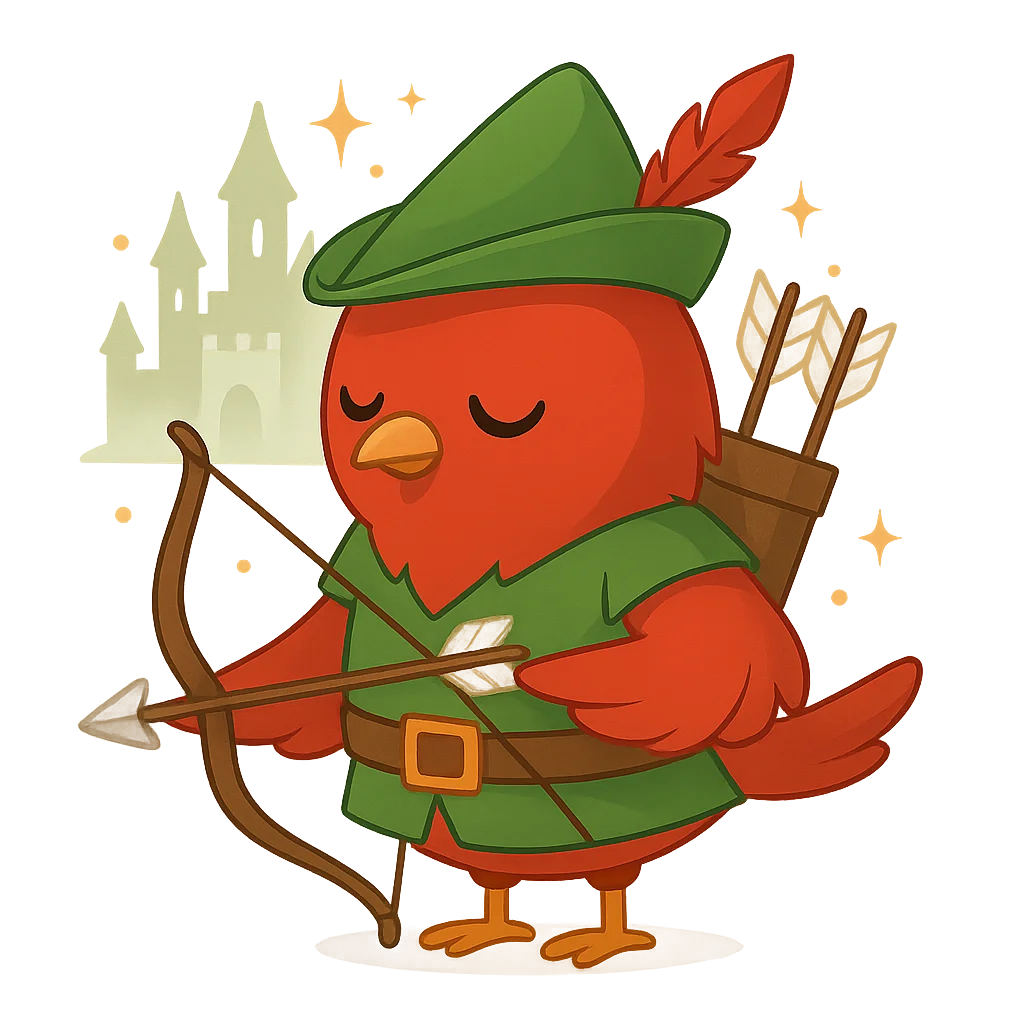
The Legend of Robin Hood
My home is not made of cold stone but of living wood and rustling leaves. Here in the heart of Sherwood Forest, among ancient oaks whose branches twist like old men’s fingers, I find my freedom. The air smells of damp earth and wildflowers, and the only law we follow is that of the seasons. My name is Robin Hood, and though some call me an outlaw, I am simply a man who chose the greenwood over the gilded cage of a nobleman’s life. I could not stand by while the common people of England suffered under the thumb of the greedy Prince John and his cruel enforcer, the Sheriff of Nottingham. Their taxes bleed the villages dry and their laws serve only to fill their own coffers. And so, my name began to be whispered in taverns and by hearthfires, a spark of defiance in a dark time. This is the story of how that whisper became a roar—the legend of Robin Hood.
Our band of Merry Men was not forged in a day, but grew one by one, like the forest itself. I’ll never forget my first encounter with the man you now know as Little John. He was a giant, seven feet tall if he was an inch, and we met on a narrow log bridge spanning a babbling stream. Neither of us would give way. “Make way, you scoundrel!” he boomed, brandishing a mighty quarterstaff. I grinned and raised my own. Our duel was a clatter of wood and a spray of water, ending when he knocked me square into the cold stream. I came up sputtering and laughing, not with anger, but with respect for his skill. From that day on, the enormous John Little became my most loyal friend, and in jest, we called him Little John. Soon after, we met the jovial Friar Tuck, a man as round as a barrel and as skilled with a sword as he was with a prayer. He believed that serving God also meant serving the poor, and he joined our cause with a hearty laugh. With them came others, like the loyal Will Scarlet, and of course, the brilliant Maid Marian. She was no damsel waiting in a tower; she was our sharpest mind, a vital partner and strategist whose clever plans often saved us from the Sheriff’s traps. We spent our days honing our skills, especially our archery. An arrow from one of my men could hit a running deer at two hundred paces. We used this skill to ambush the Sheriff’s tax collectors and arrogant nobles, relieving them of the gold they had stolen from the people. We then returned this wealth to the struggling families who needed it most. The Sheriff’s fury grew with every successful raid, so he devised a grand trap: a great archery tournament in Nottingham, with a single golden arrow as the prize. He knew I couldn't resist. I arrived disguised as a grizzled old man with one eye patched. One by one, I outshot every challenger until only the Sheriff’s champion remained. He shot true, his arrow landing dead center in the target. The crowd gasped. The Sheriff smirked, certain of his victory. “Can you beat that, old man?” he sneered. I drew my bow, took a steadying breath, and let my arrow fly. It soared through the air and, with a sharp crack, split his arrow right down the middle, embedding itself in the very same spot. Before the Sheriff could overcome his shock, I snatched the golden arrow, threw off my disguise, and with a signal, my Merry Men created a diversion, allowing me to melt back into the welcoming arms of Sherwood Forest.
That victory at the tournament did more than just embarrass the Sheriff; it ignited a fire of hope across the land. We weren't just thieves taking gold; we were a symbol that the powerful were not invincible. With every purse we redistributed, we were delivering a message that someone was fighting for the common folk. The Sheriff of Nottingham’s fury became a dangerous, mounting obsession. He set elaborate traps, filled the woods with spies, and placed an enormous bounty on my head. But he could never catch us. We knew every secret path, every hollow log, and every hidden clearing in Sherwood. We used our wits and the forest itself as our greatest allies, turning his own plans against him time and again. We were always one step ahead, a frustrating and infuriating ghost he could never grasp. This struggle raised an important question: what is true justice? The Sheriff enforced the law, but his laws were cruel and unfair. We were outlaws, yet our 'crimes' were acts of righteousness in the eyes of the people we helped. Our deeds soon left the forest and found new life in the songs of traveling minstrels. In taverns and at village fairs, singers would tell tales of our daring raids and our clever escapes. They sang of Little John’s strength, Friar Tuck’s good humor, and my skill with a bow. These ballads spread our legend far and wide, turning a band of outlaws into folk heroes and ensuring our story became a permanent part of England’s heart.
A legend, I have learned, is more powerful than any man. My time in Sherwood Forest is now part of England’s distant past, a story told in books and around campfires. But the idea I stood for is timeless. Our fight was never just about gold or defying a particular Sheriff; it was about fairness. It was about the belief that the vulnerable deserve protection and that no one should suffer while others feast. The myth of Robin Hood has inspired people for centuries to question authority when it is unjust and to believe that courage and conviction can make a difference. The spirit of Sherwood lives on, not in a specific patch of woods, but in the hearts of anyone who stands up for what is right. It continues to inspire stories, films, and the dreams of all who wish for a more just world. It is proof that an arrow of hope, once fired, never truly lands.
Activities
Take a Quiz
Test what you learned with a fun quiz!
Get creative with colors!
Print a coloring book page of this topic.













 Free for Educators