

 English

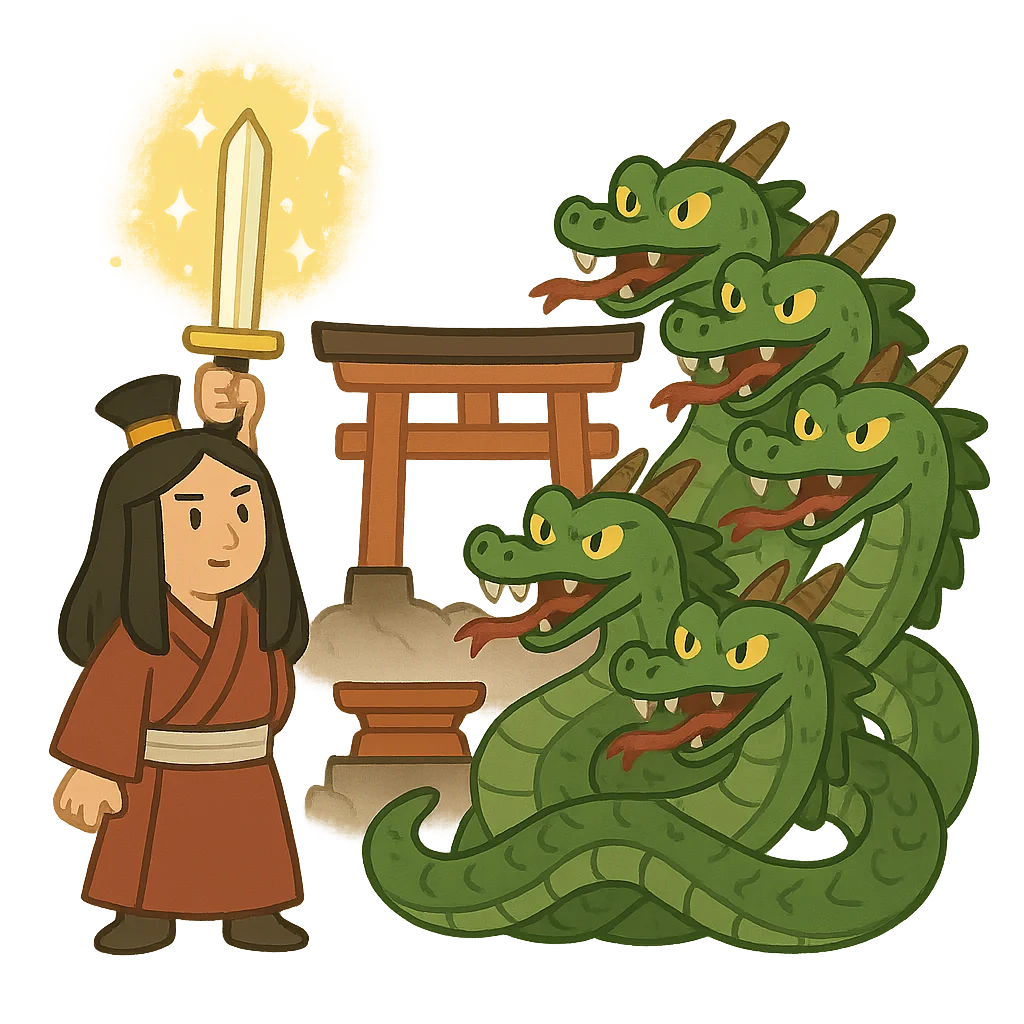
Susanoo and the Yamata no Orochi
My name is Susanoo, and though I am a god of storms and the wild sea, my story begins not with a thunderclap but with the quiet shame of exile. After a terrible argument with my sister, the sun goddess Amaterasu, I was banished from the High Plain of Heaven, my divine home. I descended to the world of mortals, landing in the lush, green land of Izumo, where rivers wound through forests like silver threads. It was there, by the Hi River, that I heard a sound more sorrowful than any storm I had ever created: the sound of weeping. This is the story of how I faced a monster of unimaginable terror, the tale of Susanoo and the Yamata no Orochi. I followed the sound to a small house where I found an old man and woman crying, with a beautiful young woman between them. They introduced themselves as Ashinazuchi and Tenazuchi, and their daughter, Kushinada-hime. They explained that their sorrow came from a monstrous serpent, the Yamata no Orochi. This beast was no ordinary snake; it had eight heads and eight tails, with eyes as red as winter cherries, and its body was long enough to cover eight hills and eight valleys. For seven years, it had come and devoured one of their daughters. Now, it was time for it to claim its eighth and final victim: Kushinada-hime. Their story filled my heart not with fear, but with a storm of righteous anger. I had been a troublesome god, but I could not stand by and watch such cruelty. I saw a chance for redemption, a way to use my power for good. I looked at the grieving parents and the brave, terrified princess, and I made a promise. I would save her, and I would destroy the beast that haunted their lands.
I revealed my identity as a god and brother to the great Amaterasu. The old couple was stunned but hopeful. I made them a proposal: I would slay the serpent if they would give me their daughter Kushinada-hime's hand in marriage. They agreed immediately, their faces filled with relief. My plan was not one of simple brute force; the Yamata no Orochi was too immense for that. It required cleverness. First, to protect Kushinada-hime, I used my divine power to transform her into a beautiful, multi-toothed comb, which I tucked safely into my hair. Next, I instructed her parents to brew eight enormous vats of the strongest, most potent sake they could make. We then built a tall, sturdy fence around their home, and in this fence, we cut eight gates. Just inside each gate, we placed one of the vats of sake, filled to the brim. With our trap set, all we could do was wait. The air grew heavy and still. The birds stopped singing, and the wind died down. Soon, the ground began to tremble, and a terrible wind, smelling of iron and decay, swept through the trees. The Yamata no Orochi had arrived. It was more horrifying than I had imagined. Its eight heads swayed on long necks, forked tongues flicking out to taste the air. Its massive body scraped against the earth, and its glowing red eyes scanned the landscape. The monster slithered toward the fence and, just as I had hoped, it smelled the irresistible aroma of the strong sake. One by one, each of its eight heads plunged into one of the eight vats, and the creature began to drink greedily. The sound of its gulping echoed like a waterfall. It drank and drank until every last drop was gone. The potent drink quickly took effect, and the great serpent grew drowsy. Its massive heads drooped, and a thunderous snoring filled the air. The monster had fallen into a deep, drunken sleep.
This was the moment I had been waiting for. With the monster helpless before me, I drew my own formidable ten-span sword, the Totsuka-no-Tsurugi. Leaping over the fence, I began my work. The serpent's snores were my battle cry. I moved with the speed of a lightning strike, my blade flashing in the dim light. I swung my sword with all my might, severing each of the monster's eight heads. With every strike, the ground shook, but the beast was too deep in its slumber to fight back. After the heads, I moved to the tails, cutting through them one by one. As I sliced through the fourth of its eight massive tails, my sword struck something impossibly hard with a loud clang. The impact nearly jolted the weapon from my hands. Curious, I carefully cut open the tail to see what had stopped my divine blade. There, nestled within the flesh of the monster, was another sword. It was magnificent, glowing with a faint, ethereal light. This was no ordinary weapon; I knew at once it possessed immense power. I had discovered the legendary blade that would come to be known as Kusanagi-no-Tsurugi, the Grass-Cutting Sword. With the Yamata no Orochi finally defeated and its reign of terror ended, I turned Kushinada-hime back into her human form. Her parents wept with joy, and the entire land of Izumo was freed from its curse. I married the princess, and we found a peaceful place to build our home. The land was safe once more.
My victory was more than just the end of a monster; it was the beginning of my own redemption. To make peace with my sister Amaterasu, I presented the incredible sword, Kusanagi-no-Tsurugi, to her as a gift of reconciliation. She accepted it, and my exile was eventually forgiven. That sword became one of the Three Imperial Regalia of Japan, sacred treasures passed down through generations of emperors, symbolizing their divine right to rule, their courage, and their wisdom. Our story, first written down in ancient texts like the Kojiki around the year 712 CE, was shared to show that even a flawed and wild god could become a hero. It taught people that courage isn't just about strength, but also about intelligence and fighting for others. It showed that even after making great mistakes, one can find a path to do good. Today, the tale of my battle with the Yamata no Orochi continues to inspire people. You can see its echo in modern stories, from epic anime series and video games featuring heroes fighting multi-headed dragons to art that captures the fury of our battle. The myth reminds us that inside every person, there is the potential for great courage. It encourages us to face the 'monsters' in our own lives with cleverness and a brave heart, proving that a story of heroism, once told, can echo through time forever.
Activities
Take a Quiz
Test what you learned with a fun quiz!
Get creative with colors!
Print a coloring book page of this topic.














 Free for Educators