

 English

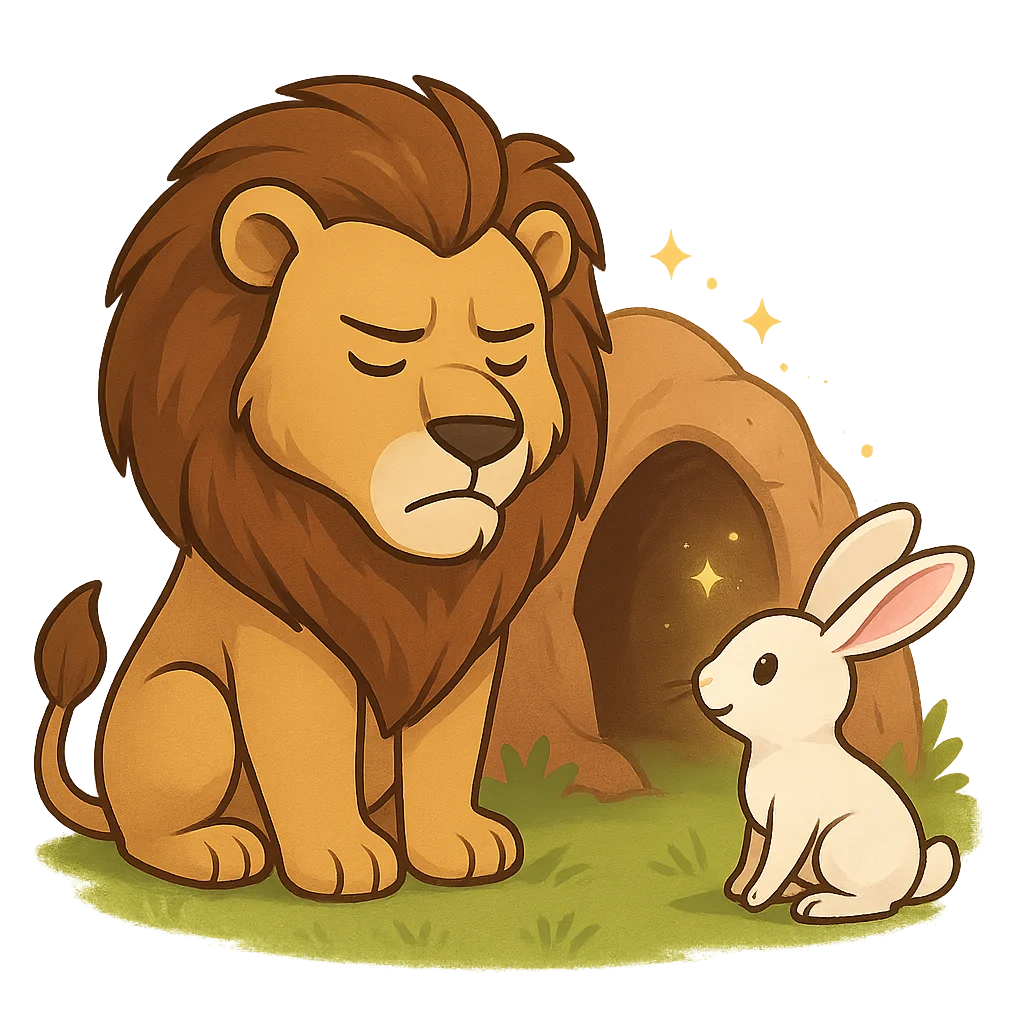
The Clever Rabbit and the Foolish Lion
My ears, long and sensitive, used to twitch at the sound of birdsong and the rustle of leaves in the wind. Now, they mostly listen for the heavy tread of paws and the earth-shaking roar that silences everything. I am just a small rabbit, with a coat the color of dried grass and a heart that beats like a drum, but I’ve always believed that what’s inside your head is far more powerful than the size of your claws. Our home, a once-vibrant jungle full of life and sound, had fallen under a shadow of fear, a shadow cast by the terrible lion, Bhasuraka. He was a tyrant, whose hunger was as vast as his pride, and his reckless hunting threatened to leave our forest a silent, empty place. We were all trapped, and it seemed there was no escape, but even in the darkest moments, a single clever thought can be a spark of light. This is the story of how that spark became a flame, a tale that has been told and retold for thousands of years, known as The Clever Rabbit and the Foolish Lion.
The animals of the forest gathered under the ancient banyan tree, their usual chatter replaced by fearful whispers. The deer, the boars, the buffaloes—all had lost family to Bhasuraka's endless appetite. He didn't just hunt for food; he hunted for sport, leaving devastation in his wake. An old, wise bear suggested they try to reason with him. With trembling hearts, a delegation of animals approached the lion’s den. They found him lounging on a rock, his golden fur gleaming in the sun, his tail twitching with impatience. They bowed low and made their offer: if he would remain in his den, they would send one animal to him each day to satisfy his hunger. This way, he would not have to exert himself, and the rest of the forest could live without the constant terror of his random attacks. Bhasuraka, whose arrogance was matched only by his laziness, found the idea appealing. He agreed to the pact, warning them that if a day was missed, he would destroy them all. And so, a somber routine began. Each morning, one animal would say its tearful goodbyes and walk the lonely path to the lion's den. A cloud of grief hung over the forest, and hope seemed to be a forgotten dream.
One day, the lot fell to me. The other animals looked at me with pity, but as I set off, my mind was racing faster than my feet ever could. I didn't run or hop in fear. Instead, I took my time, wandering through the forest, nibbling on some clover, and thinking. I formulated a plan that was bold and dangerous, a plan that relied on exploiting the lion's greatest weakness: his vanity. I arrived at the lion's den long after midday. Bhasuraka was pacing back and forth, his stomach rumbling and his temper flaring. 'You insignificant morsel!' he roared, his voice echoing through the rocks. 'How dare you make me wait? I will kill every last one of you for this insult!' I bowed so low my nose touched the dust. 'Oh, mighty king,' I squeaked, pretending to tremble. 'It is not my fault. On my way here, I was stopped by another lion. He claimed that he was the true king of this forest and that you were an imposter. He said he was going to eat me himself, but I told him I was promised to you, my one true king. He let me go only so I could deliver his challenge to you.' Bhasuraka's eyes blazed with fury. Another king? In his forest? The insult was too much for his pride to bear. 'Where is this coward?' he snarled. 'Take me to him at once! I will show him who the real king is!' Hiding a small smile, I agreed. 'Follow me, your majesty,' I said, and I led the enraged lion away from his den and toward an old, deep well in a clearing.
I led the fuming lion to the edge of the large, stone-lined well. 'He lives in this fortress, my king,' I whispered, pointing down into the dark, still water. 'He is too proud to come out.' Bhasuraka stomped to the edge and peered in. There, in the water below, he saw the reflection of a powerful lion staring back at him, its face contorted with the same rage as his own. He let out a deafening roar to challenge his rival. From the depths of the well, the echo of his roar boomed back, sounding even louder and more defiant. To the foolish lion, this was the ultimate proof. Blinded by fury and convinced he was facing a real challenger, Bhasuraka leaped with all his might into the well to attack the enemy. The great splash was followed by a desperate struggle, and then, silence. The tyrant was gone. I raced back to the other animals and announced the news. A great celebration erupted, and the forest was filled with sounds of joy for the first time in years. This story became part of the Panchatantra, a collection of tales written over two thousand years ago in India to teach princes about wisdom and justice. It shows that true power isn't about size or strength, but about cleverness and courage. Today, this ancient myth continues to inspire us, reminding us that even the smallest person can overcome the biggest challenges with a quick mind and a brave heart, sparking our imagination to find creative solutions to the world's problems.
Activities
Take a Quiz
Test what you learned with a fun quiz!
Get creative with colors!
Print a coloring book page of this topic.
















 Free for Educators