

 English

The First Strawberries
My name is not spoken often, but I am the First Woman. I remember when the world was new, and my husband, the First Man, and I walked through a world painted in brilliant greens and deep blues, where every day was filled with sunshine and easy laughter. Our life was one of perfect harmony, a seamless song sung between two hearts. But even in a perfect world, shadows can fall, and one day, a harsh word, spoken in a fleeting moment of anger, shattered our peace like a stone thrown into a still pond. The silence that followed was heavier than any mountain. This is the story of how that single argument led to a chase across the world, a moment of divine intervention, and the creation of a special fruit in the tale we call The First Strawberries.
The sting of my husband’s words was sharper than any thorn, and a cold pride welled up inside me, extinguishing the warmth we had shared just moments before. In that instant, I turned my back on him, on our home, and on the life we had so carefully built together. I decided to walk away forever, setting my face east toward the Sun Land, a place of no return. My feet moved quickly, my moccasins barely whispering against the earth as my mind churned with a storm of angry, wounded thoughts. Behind me, I could hear my husband’s footsteps, a frantic, desperate rhythm against the steady beat of my own. He called my name, his voice laced with a regret I was not yet ready to hear or accept. I hardened my heart, clenching my jaw and focusing only on the horizon ahead. With every step, I tried to put more distance between us, determined to leave our shared world and its sudden pain behind me.
My husband, watching the distance between us grow, felt his own heart crack with despair. He was suddenly, terrifyingly alone, and he knew he was losing the most important thing in his life because of a foolish, angry word. In his desperation, with his breath coming in ragged gasps, he sent a prayer up to the great Apportioner, the Sun, who sees all that happens on the earth below. The Sun, from its high throne in the sky, saw my determined flight and my husband’s sorrowful, hopeless pursuit. The Sun knew that if I reached the Sun Land, our separation would be sealed forever, a wound that could never be healed. Taking pity on the foolishness and sadness of the first people, the Sun decided to intervene, not with the force of a storm or the heat of its fire, but with gentle persuasion born from the earth itself.
As I stormed onward, the Sun first caused a patch of ripe huckleberries to spring up directly in my path. Their deep blue skins glistened under the golden light, promising a sweet and juicy taste that on any other day would have been a delight. But my anger was a shield, a fortress around my heart, and I walked past them without a second glance, my eyes fixed on the distant east. Unfazed, the Sun tried again, this time creating a thicket of tangled blackberry canes, their dark, shiny fruit hanging heavy on the vine like clusters of jewels. I saw them, of course, but my mind was too clouded with hurt to be tempted by their richness. Next, a grove of serviceberry trees appeared, their branches laden with delicate, beautiful fruit. I pushed past their leaves without pausing. My resolve to leave was a fire burning inside me, stronger than any simple, sweet fruit. The Sun understood then that it would take something truly special, something entirely new, to make me pause my furious journey.
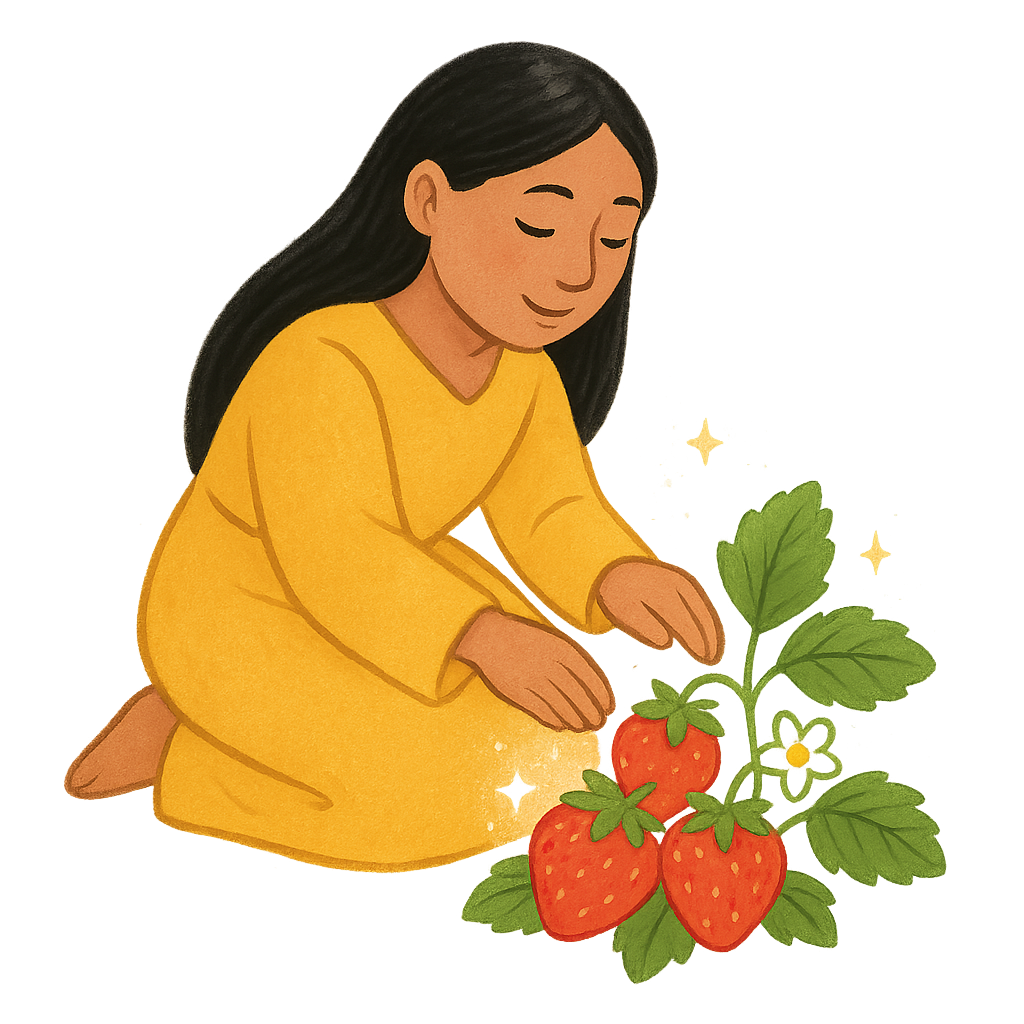
Finally, the Sun did something new, something unprecedented. Right at my feet, spreading across the path like a fragrant carpet so that I could not take another step without seeing them, grew a patch of the most wondrous berries I had ever beheld. They grew low to the ground on delicate green leaves, each one shaped like a tiny, perfect heart, and they glowed with a brilliant, luminous red. A fragrance, sweeter than any flower I had ever known, rose up to meet me, a gentle invitation. I stopped. I couldn't help it; my feet refused to move. I knelt on the soft earth and plucked one of the heart-shaped berries. As I put it in my mouth, an incredible sweetness exploded on my tongue. With that taste, a flood of memories washed over me—memories of happy days walking by the river, of shared laughter under the stars, of the deep love I shared with my husband. The bitterness in my heart began to melt away, replaced by the berry's gentle warmth.
As I knelt there, gathering the astonishing berries into my hands, their sweetness acting as a balm to my wounded spirit, I heard my husband's footsteps finally draw near. They were slow now, hesitant. He came and stood beside me, and when I looked up, I saw no anger in his eyes, only profound love and overwhelming relief. He didn't speak, and he didn't have to. I held out a handful of the berries, an unspoken offering of peace. As we shared them, the memory of our argument faded away, replaced by the sweet taste of forgiveness. We walked back home together, side by side, hand in hand. The strawberries remained, a gift from the Creator to remind all people that love and forgiveness are the sweetest fruits of all. They are a living symbol that even after the harshest words, relationships can be mended and sweetness can be found again.
For all the generations that have followed, my Cherokee people have told this story. When we gather the first strawberries each spring, we are reminded of the fundamental importance of kindness and forgiveness in our lives. The strawberry, shaped so perfectly like a heart, is a sacred fruit that represents the endurance of love and the strength of friendship. This story is more than just a charming explanation of where a berry came from; it’s a guide for how to live in harmony with one another. It teaches us that compassion can heal any argument and that taking a moment to pause and appreciate a gift of sweetness can change everything. Even today, this ancient story inspires us to cherish our relationships and to remember that forgiveness, like the first strawberry of the season, has the power to make the world feel new and whole again.
Activities
Take a Quiz
Test what you learned with a fun quiz!
Get creative with colors!
Print a coloring book page of this topic.















 Free for Educators