

 English

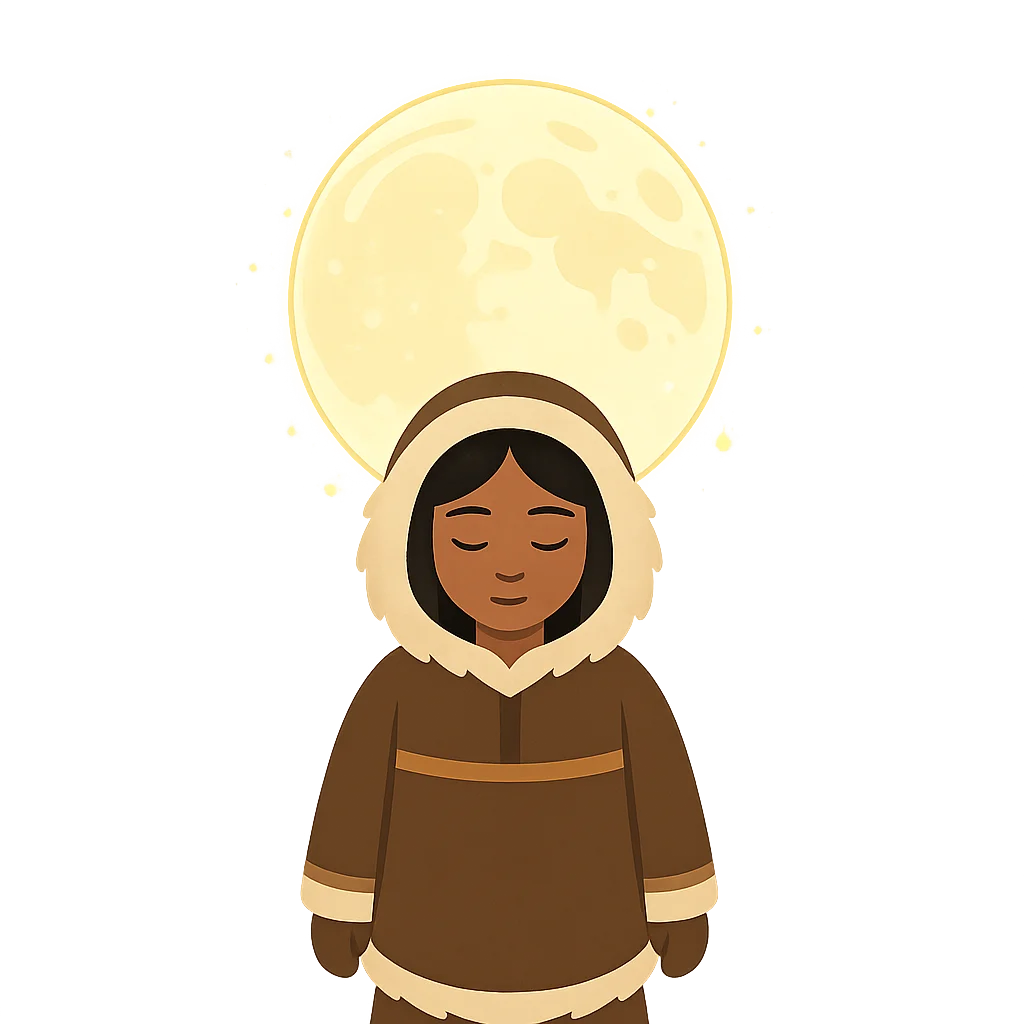
The Girl Who Married the Moon
Long ago, in a village where snow blanketed everything in a thick, silent quilt and the winter nights were long and deep, I lived with my family in our communal igloo. My name isn't important; what matters is what I became. Inside our home, the only light came from our precious seal-oil lamps, which flickered and cast colossal, dancing shadows on the walls of ice. During the brief daylight hours, our village was a hub of activity—hunters preparing their sleds with meticulous care, children’s laughter echoing in the crisp air, and elders sharing ancient stories that held the wisdom of our people. But when the polar night descended, swallowing the world in darkness, a profound loneliness would settle over me, as deep and cold as the ice that stretched to the horizon. It was during these quiet, dark hours that a secret visitor began to come to me when everyone else was asleep. I couldn't see his face in the impenetrable darkness, only feel his gentle presence and hear his soft, whispered words that warmed me against the chill. Night after night he came, and I found myself falling in love with this mysterious person who seemed to understand my solitude. I treasured his visits, a secret joy in the long winter. Still, I wondered endlessly who he could be, this kind soul who sought me out in the quiet of the polar night. Was he a great hunter, known for his bravery. A visitor from a faraway village with stories of his own. My imagination ran wild, painting a hundred different heroic faces for him in my mind. My heart ached with the need to know the truth, a desire that grew more insistent with each passing night. This is the story of how my curiosity led to an endless chase across the heavens, the story the elders call The Girl Who Married the Moon.
Night after night, my visitor came, and my desire to know his identity grew stronger than the winter winds that howled outside our igloo. I had to know who he was. The mystery was becoming unbearable, a constant question that echoed in my thoughts during the day. I decided I had to find a way to see him in the light, to finally put a face to the voice I had come to love. One evening, after much deliberation, I prepared a special mixture. I carefully scraped soot from the blackened bottom of our communal cooking pot and mixed it with a little oil from my lamp, creating a thick, dark paste that would not easily rub off. I kept the small pot of it beside my sleeping place, my heart pounding with a mixture of anticipation and fear. What if he was angry. What if he never returned. But the need to know was too powerful to ignore. When my visitor arrived that night, his presence filling the darkness as it always did, I tried to act normally. We spoke in whispers as usual, but my mind was focused on my plan. Just as he was about to leave, his form a shadow moving toward the entrance flap, I reached out with a trembling hand and smeared the dark, greasy paste across his cheek. He flinched in surprise but was gone before I could say a word. The next day, I walked through the village, my eyes scanning every face, searching for the tell-tale mark. I looked at the hunters returning with their catch, the elders mending nets, and the children playing games on the ice, but I saw nothing. My heart began to sink with disappointment. Then, my gaze fell upon my own brother, Aningaaq, as he turned to speak to me. There, staining his familiar face, was the dark, greasy smudge I had left on my secret love. A cold shock, sharper than the arctic wind, went through me. In our culture, such a bond between a brother and sister was forbidden, a truth so deeply ingrained it was never spoken of. Shame and confusion washed over him as he saw the terrible recognition in my eyes. He said nothing, but his face, marked by my own hand, told a story of deep regret and shared disgrace.
Unable to bear the weight of his shame and the look in my eyes, Aningaaq fled. He said not a single word, his silence a deafening roar in our small igloo. In a desperate, panicked movement, he grabbed a lit torch from its holder, its flame sputtering weakly, and ran from our home out into the vast, frozen landscape. The darkness swallowed him almost instantly. I couldn't let him just disappear into the unending night. I seized a torch of my own—a brighter, more fiercely burning one that I had just tended—and ran after him, my feet barely feeling the crunch of the snow. He was fast, his feet flying over the packed ice, his flickering torch a tiny, desperate star in the immense darkness. But I was fueled by a storm of emotions—love, betrayal, confusion, and a desperate need for answers. "Aningaaq!" I screamed, but the wind snatched my voice away. I pursued him relentlessly, my brighter torch cutting a brilliant path through the gloom. The chase led us away from our world, beyond the familiar hunting grounds and ice flows. We ran so fast and so far that the world itself seemed to fall away beneath us. A strange lightness filled my limbs, and I felt my feet lift from the ground. We were rising, ascending into the cold, black sky. Higher and higher we soared, our torches blazing against the velvet backdrop of distant stars, leaving the snowy world of our birth far below. As we ascended, we were transformed by the powerful spirits of the sky. My brother, Aningaaq, with his dimmer, flickering torch and the dark soot still staining his face, became the Moon. The smudges of soot, a permanent mark of his secret and his shame, are the dark spots and craters you can still see on his face today. And I, with my brilliantly burning torch that cast a powerful glow, became the Sun, forever casting a brighter, warmer light, destined to chase him for all time.
Now, we are bound to the sky in an eternal chase. I, the Sun, pursue my brother, the Moon, across the heavens, day after day, night after night. He forever flees from me, his pale light a reminder of his sorrow, and we can never be together again as we once were. This endless cycle, this cosmic pursuit, is what creates day and night for the people on the Earth below. When I rise, my light pushes his darkness away, and when I set, he returns to rule the night sky. For generations, Inuit storytellers shared our tale during the long winter nights, huddled together for warmth. It was more than just a story to explain the sun and the moon; it was a way to teach about the consequences of our actions, the complexities of love, and the sacred importance of family bonds. Our story became a map of the cosmos and a guide for living in balance with the world and with each other. Today, our myth continues to inspire. When you look up and see the brilliant sunrise, you are seeing me begin my daily pursuit, filled with an unyielding and radiant light. When you see the moon in the night sky, with its dark, shadowy patches, you are seeing my brother, Aningaaq, forever marked by a secret he could not bear. Our story is a powerful reminder that the sky above is full of ancient tales, connecting us all to the wonder and mystery of the universe and the timeless power of a story well told.
Activities
Take a Quiz
Test what you learned with a fun quiz!
Get creative with colors!
Print a coloring book page of this topic.













 Free for Educators