

 English

The Legend of King Arthur
My name is Merlin, and I have seen more winters than there are stars in the sky. I remember when the great Roman legions sailed away, leaving the island of Britain like a ship without a captain. The land became a place of mist-shrouded hills and dark forests, fractured by war and ruled by ambitious, squabbling lords who carved out their own small kingdoms with iron and fear. The people suffered, yearning for peace but finding only conflict. As a watcher and a guide, a whisperer of truths to those who would listen, I felt the land's deep, aching need for a true king, one who could unite the people not with a heavy fist, but with hope and a noble heart. I knew that such a leader could not be chosen by strength alone. So I listened to the ancient prophecies and began to weave a plan, a grand test designed to reveal a leader of great courage and even greater character. This is the beginning of the story that people would one day call The Legend of King Arthur.
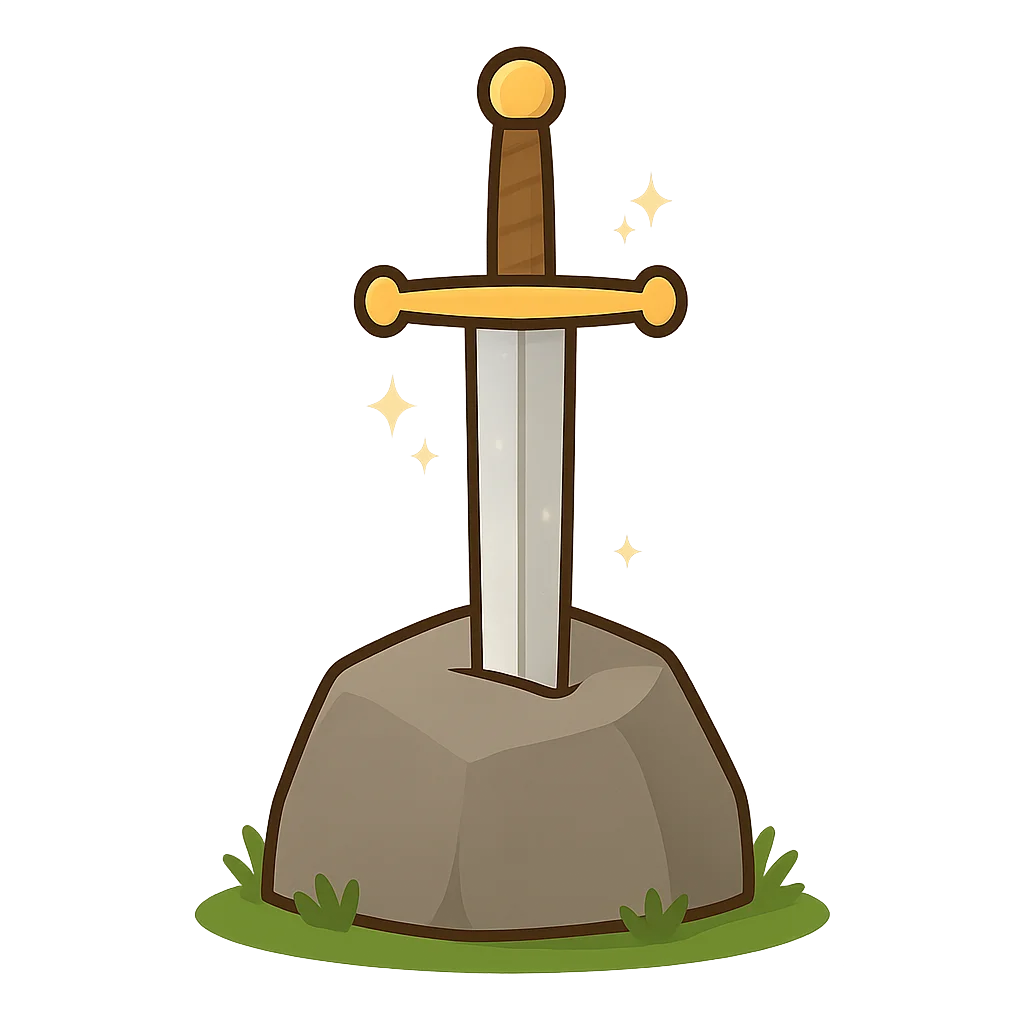
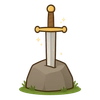
To find this king, I needed more than a simple declaration. I needed a sign that no one could dispute, a miracle born of magic and fate. One winter night, I traveled to a London churchyard. There, with words that crackled in the frosty air, I summoned a great, square stone, dark as midnight, and placed upon it a heavy blacksmith's anvil. Then, I plunged a magnificent sword deep into the anvil and the stone beneath it. Its hilt gleamed with gold and jewels, and along the blade, I etched a promise in golden letters: 'Whoso pulleth out this sword of this stone and anvil, is rightwise king born of all England.' News of the marvel spread, and a great tournament was called. Knights and nobles came from every corner of the land, each one boasting of their strength. They heaved and strained, their faces red with effort, but the sword would not budge an inch for any of them. Among the crowds was a young, overlooked boy named Arthur, serving as a squire for his arrogant foster-brother, Sir Kay. During the tournament, Kay broke his own sword and impatiently ordered Arthur, “Go, find me another.” Dutifully, Arthur ran off. Seeing the beautiful sword in the churchyard and knowing nothing of its significance, he took hold of the hilt to borrow it. To his own surprise, he pulled it free from the stone as easily as if it were set in water. When he brought it to Kay, the crowd fell silent, their disbelief turning to awe. The humble boy, not a mighty lord, was their destined king.
As Arthur’s advisor, I had the privilege of watching a boy grow into a legendary king. We founded the magnificent castle of Camelot, its white towers rising from the green hills like a promise of a new dawn. It became a beacon of light and justice in a dark world. Its heart was the great hall, and in that hall stood the Round Table, a wedding gift from Queen Guinevere’s father. I made sure Arthur understood its profound importance. It was round so that no knight who sat at it could claim to be at the head or in a place of greater honor. All were equal in their service to the realm and to each other. A fellowship of the bravest and most honorable knights gathered there. There was the peerless Sir Lancelot, whose skill in battle was matched only by his deep loyalty. There was the pure-hearted Sir Galahad, whose virtue was so great that he alone was destined to achieve the greatest of all quests. And there was the ever-loyal Sir Bedivere, who would be with Arthur until the very end. They all swore an oath to a code of chivalry: to protect the weak and the innocent, to always speak the truth, to honor women, and to put the needs of the kingdom before their own. Their quests became the stuff of legend. They battled savage beasts, overthrew cruel tyrants, and sought the Holy Grail—a quest that was not about finding a treasure of gold, but about a perilous journey to prove the strength and purity of their spirits.
Yet, I have lived long enough to know that even the brightest lights must cast shadows, and the golden age of Camelot could not last forever. The heartbreak that came to our kingdom was not delivered by a foreign enemy with an invading army, but grew from within, like a poison ivy choking a mighty oak. The seeds of jealousy and betrayal, sown by Arthur’s own treacherous nephew, Mordred, found fertile ground. Whispers turned to accusations, and the perfect fellowship of the Round Table fractured. Friend turned against friend, and the unity that had made Camelot strong was shattered into pieces. This tragedy culminated in the final, sorrowful Battle of Camlann. Arthur fought valiantly to save his kingdom, and though he defeated Mordred, he was gravely wounded in the struggle. The victory felt like a defeat, for the dream of Camelot lay broken on that field. As he lay dying, he gave his last command to Sir Bedivere: to return his magical sword, Excalibur, to the water where it was forged. After Bedivere cast the blade into the lake, a hand rose from the depths to catch it. I watched from the mists as a mysterious barge, draped in black and steered by silent queens, arrived to carry my king away to the mystical isle of Avalon. He left behind not a crown, but a promise: that King Arthur would one day return when his people needed him most.
Though I watched my friend and king depart, I knew his story was far from over. Camelot may have fallen, its towers crumbling back into the earth, but the idea of it never did. The tales of King Arthur and his noble knights were first shared by bards in firelit halls, then written down by scribes, and they have been passed down for over a thousand years in poems, books, and films. The legend endures because it is not just about magic swords, brave knights, and wizards like me. It is a story that reminds every generation of the importance of just leadership, true friendship, and the courage required to build a better, fairer world. It teaches us that even if we stumble or fail, the dream of a just and noble society is a dream worth fighting for, inspiring people today to find the hero within themselves.
Activities
Take a Quiz
Test what you learned with a fun quiz!
Get creative with colors!
Print a coloring book page of this topic.











 Free for Educators