

 English

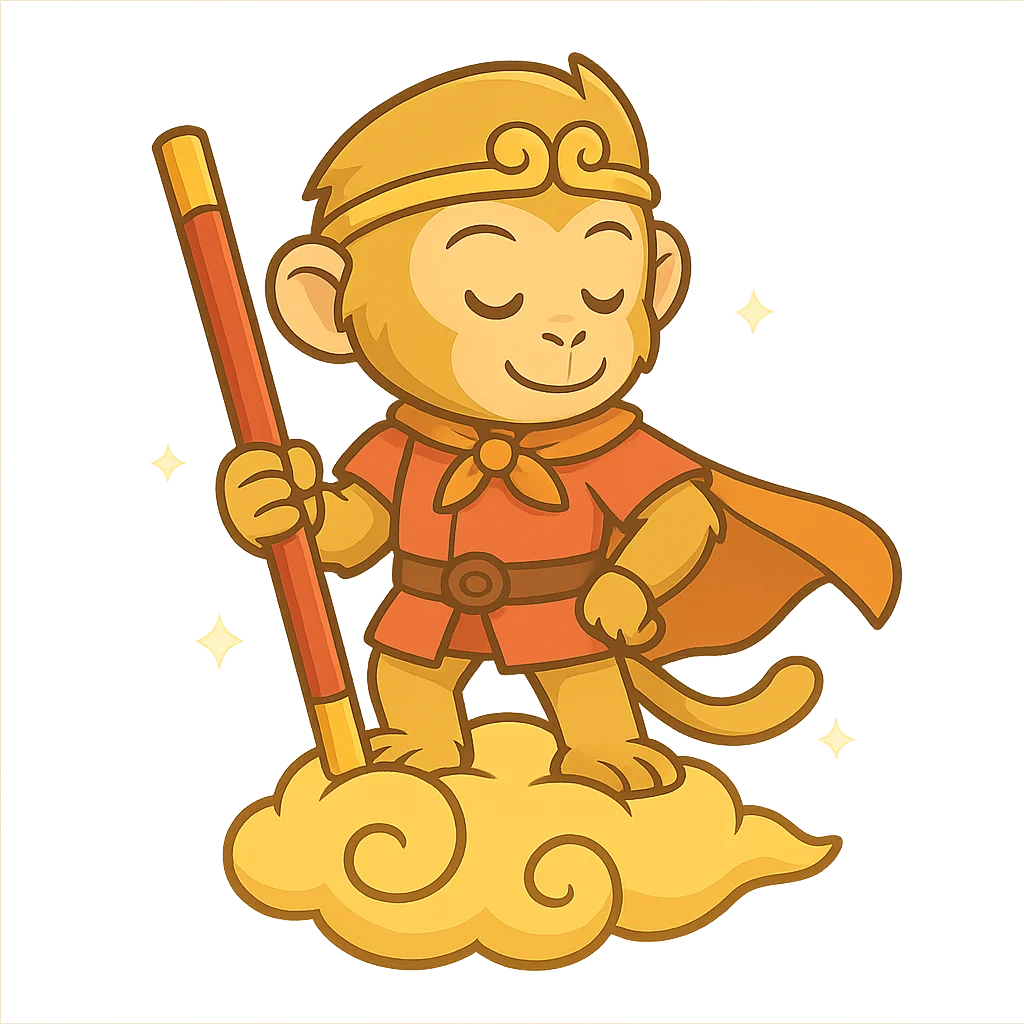
Sun Wukong: The Great Sage Equal to Heaven
From a crack of lightning upon the Flower Fruit Mountain, I, a monkey born of stone, first opened my eyes to a world bursting with green and gold. My spirit was as wild as the wind, and I yearned for power that would last forever, a desire that sparked the legendary tale of the Monkey King. They call my story Sun Wukong, the Great Sage Equal to Heaven, and it all began with a single, daring leap. Among my fellow monkeys, I was the bravest. To prove it, I jumped through a roaring waterfall that none dared approach, discovering a magnificent cave behind the watery curtain. For my courage, they crowned me their handsome Monkey King. For centuries, we feasted and played, but one day a shadow fell upon my heart. I realized that even kings grow old and fade away. This fear of mortality became a fire in my soul, driving me to seek the secret to eternal life. I said goodbye to my home and journeyed to the far corners of the world until I found the great Taoist master, Puti Zushi. He saw the spark in me, gave me my name—Sun Wukong—and taught me the secrets of the universe, unlocking powers I had never dreamed of.
With my new abilities, I felt invincible. I could transform into 72 different animals or objects, and my somersault cloud could carry me thousands of miles in a single bound. But I needed a weapon worthy of my greatness. I traveled to the bottom of the East Sea and stormed the palace of the Dragon King. I demanded a weapon, and he showed me his entire armory, but nothing was good enough. Then, I saw it: a colossal iron pillar that glowed with ancient magic. It was the Ruyi Jingu Bang, a treasure that could shrink to the size of a needle or grow to touch the heavens. I claimed it as my own. Still not satisfied, I bullied the other Dragon Kings into giving me a suit of golden armor, a phoenix-feather cap, and cloud-walking boots. My arrogance knew no bounds. I stormed the Underworld, brushed aside the Ten Kings of Hell, and with a stroke of a brush, erased my name and the names of all monkeys from the Book of Life and Death, granting us all immortality. The Jade Emperor, ruler of Heaven, heard of my antics and summoned me. He offered me a job: Keeper of the Heavenly Horses. An insult. I, the great Monkey King, a stable boy. I rebelled, smashed the gates of Heaven, and returned to my mountain, where I raised a banner declaring myself the ‘Great Sage Equal to Heaven.’ Heaven’s armies came for me, but I defeated every general, every warrior, every god they sent. I was unstoppable.
My rebellion threw Heaven into utter chaos. I crashed the Emperor’s grand peach banquet, a feast meant only for the most important deities, and devoured the peaches of immortality and the pills of longevity. With Heaven’s greatest champions defeated, the Jade Emperor had no choice but to appeal to the highest power in the universe: the Buddha himself. When the Buddha arrived, his presence was calm but immense. I boasted, “I am so fast I can leap to the very edge of the cosmos. If you can stop me, I’ll bow to your power.” The Buddha smiled and made a simple wager. “Leap out of the palm of my hand,” he said. “If you succeed, I will name you the new Jade Emperor. If you fail, you must return to Earth and learn humility.” The challenge was laughable. I gathered my strength and launched myself into the sky, soaring past stars and galaxies until I reached what I thought was the end of everything. Before me stood five colossal pillars. I chuckled, certain of my victory, and wrote ‘The Great Sage Equal to Heaven was here’ on the middle pillar to prove I’d made it. Then, I somersaulted all the way back, landing triumphantly in the Buddha’s palm. “I have returned,” I declared. “Now, make me the Emperor.” The Buddha simply looked down at his hand. “You never left,” he said. And there, on his middle finger, was my own writing. The five pillars had been nothing more than his fingers.
In that moment, my arrogance shattered. I tried to leap away, to escape my humiliation, but it was too late. The Buddha’s hand turned over, transforming into a massive mountain of five elements—metal, wood, water, fire, and earth. It slammed down upon me, trapping me beneath its immense weight. For 500 years I was a prisoner, with only my head free, forced to eat iron pellets and drink molten copper. The seasons changed, empires rose and fell, and I had nothing but time to reflect on my pride and foolishness. It was a long and humbling lesson. My redemption finally came in the form of a gentle monk named Tripitaka. He was on a sacred quest, sent by the Emperor of China to travel to India and bring back holy scriptures that would bring wisdom to his people. The goddess of mercy, Guanyin, had told him that he would need a powerful protector for his perilous journey, and she guided him to my mountain prison. Tripitaka recited a prayer, and the seal holding the mountain together dissolved. I was free. Overwhelmed with gratitude, I pledged to become his disciple and guard him with my life. But Guanyin knew my mischievous nature was not entirely tamed. She gave the monk a golden headband. The moment it was on my head, I couldn't remove it. Whenever I became disobedient or violent, Tripitaka could chant a special sutra, and the band would tighten, causing me unbearable pain. It was a necessary restraint, and it marked the true beginning of our epic Journey to the West.
The story of my journey with Tripitaka is about more than just fighting demons and crossing treacherous lands. It is a story about transformation. The mischievous, arrogant monkey who once tried to conquer Heaven learned the meaning of loyalty, compassion, and discipline. I used my 72 transformations, my all-powerful staff, and my fiery eyes that could see through any disguise not for my own glory, but to protect my master and our sacred mission. For centuries, this tale, recorded in the great novel Journey to the West, has captivated hearts in China and all over the world. It has been told in operas and plays, in movies and video games, becoming a timeless legend. I, the Monkey King, became a symbol of resilience, of cleverness, and of the courage to face impossible odds. My story teaches that true strength isn’t just about being the most powerful. It’s about learning from your mistakes, controlling your impulses, and using your gifts to serve a greater good. Even today, I continue to leap across the imaginations of new generations, a reminder that every difficult journey is a chance to become a better version of ourselves.
Activities
Take a Quiz
Test what you learned with a fun quiz!
Get creative with colors!
Print a coloring book page of this topic.












 Free for Educators