The Tortoise and the Hare
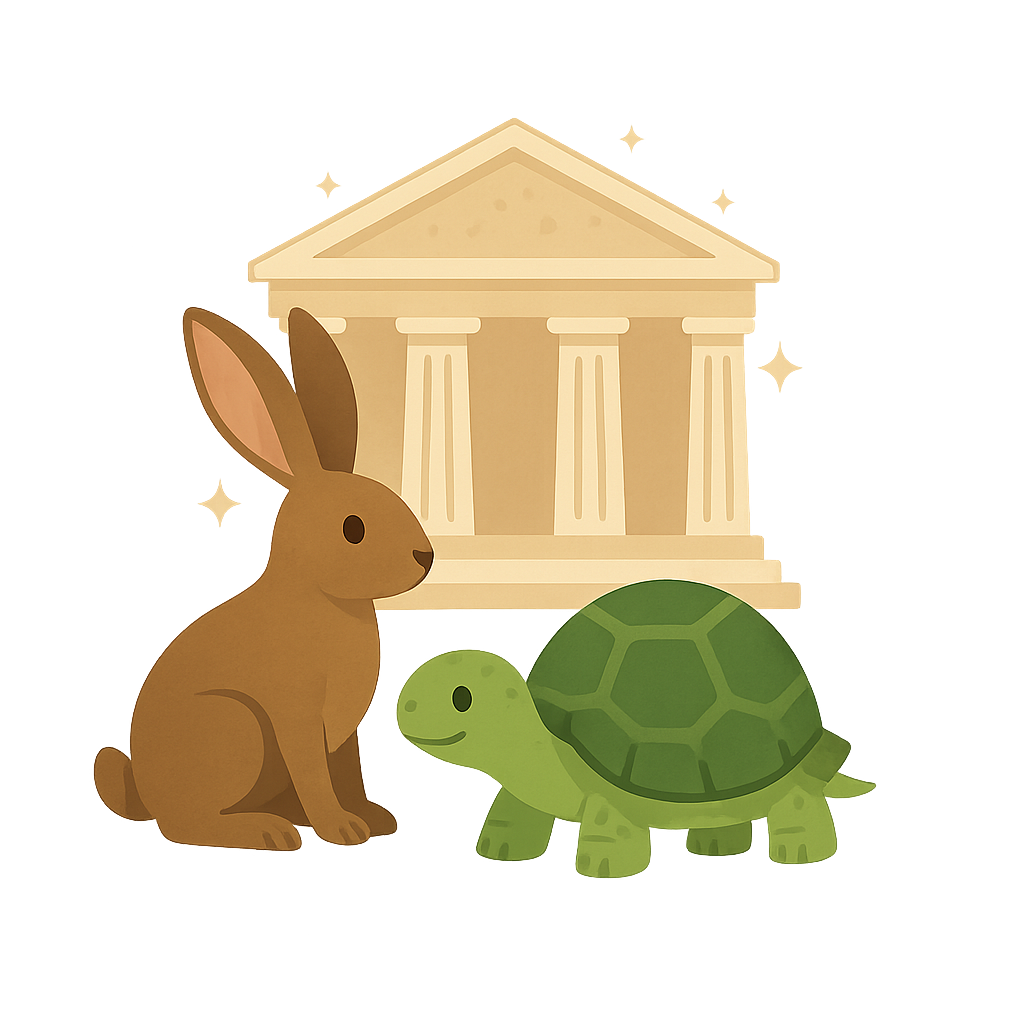
The Greek sun felt warm on my shell, just as it had for a hundred summers. I am the Tortoise, and though my legs are short and my pace is what you might call ‘deliberate,’ I have seen many things from my view close to the earth. I remember the day it all began, with the air buzzing with the sound of the Hare boasting, as usual. He would leap from one olive grove to another, a streak of brown fur against the green hills, shouting for all to hear, ‘No one is faster than me! I am the swiftest in all of Greece!’ The other animals, the foxes, the birds, and even the wise old owl, would simply roll their eyes. But his pride, as bright and hot as the midday sun, began to wear on us all. I was tired of his endless bragging, not because he was fast—that was a simple truth—but because he believed his speed made him better than everyone else. So, I did something no one expected. I cleared my throat, a slow, dusty sound, and said, ‘I will race you.’ A hush fell over the meadow. The Hare stopped mid-leap, his long ears twitching in disbelief before he burst into laughter that echoed through the valley. A race? Between him and me? The very idea was absurd. But a challenge had been made, and the story of our contest would become known for ages as the tale of The Tortoise and the Hare.
On the day of the race, the air was thick with excitement. Animals from all over the countryside gathered along the path that wound up the dusty hill and through the cypress trees. The fox, chosen for his cleverness, marked the starting line with a smooth white stone. The Hare pranced and stretched, winking at the crowd and making a show of his powerful legs. I simply took my place, my heart beating a slow, steady rhythm against the inside of my shell. When the fox barked the signal to start, the Hare shot off like an arrow from a bow. He was a blur of motion, kicking up a cloud of dust that I slowly, patiently, walked through. The crowd cheered for him, their voices fading as he disappeared over the first rise. I did not watch him go. I kept my eyes on the path just ahead of me, focusing on my next step, and the one after that. One foot, then the other. That was my plan. The sun climbed higher in the sky, beating down on the trail. I could feel its heat on my back, but I kept my rhythm, steady and unchanging. As I rounded a bend, I saw the Hare far ahead. He wasn't running. He was lounging under a large, shady plane tree, nibbling on some clover. He saw me plodding along and waved mockingly. He was so sure of his victory that he decided a little nap wouldn't hurt. He yawned, stretched out his long legs, and closed his eyes. I saw him, but I didn't stop. I didn't speed up or slow down. I just kept moving, step by steady step, my mind focused only on the finish line.
The path grew steeper, and the stones were sharp beneath my feet, but I never considered stopping. I thought about the Hare's laughter and the faces of the other animals, and it fueled my determination. The world was quiet now, except for the buzz of cicadas and the soft scuff of my feet on the dirt. I passed the sleeping Hare, his chest rising and falling in a deep, untroubled sleep. He was dreaming of victory, I was sure, while I was busy earning it. As I neared the top of the hill, I could see the finish line—a ribbon of woven vines stretched between two ancient olive trees. A murmur went through the crowd as they saw me. First, it was a whisper of surprise, then it grew into a roar of encouragement. Their cheers gave me a new burst of energy. I pushed forward, my old legs aching, my breath coming in slow, deep draws. I was just inches away when a frantic scrabbling sound erupted from down the hill. The Hare had woken up! He saw me at the finish line, and his eyes went wide with panic. He sprinted, a desperate, panicked dash, but it was too late. I crossed the line, my head held high, just as he skidded to a stop behind me. The crowd erupted. I had won. The Hare stood panting, his pride shattered, unable to believe that I, the slowest of all creatures, had beaten him. He had all the speed in the world, but I had something more important: perseverance.
Our race became more than just a local event. A wise storyteller named Aesop heard of it and shared our tale across the land. He knew it wasn't really about a tortoise and a hare; it was a fable, a story with a message. For over two thousand years, people have told it to their children to teach them that 'slow and steady wins the race.' It’s a reminder that talent and natural gifts are not enough. It is the steady effort, the refusal to give up, and the focus on your own journey that truly lead to success. The story has been painted on pottery, written in books, and even turned into cartoons and movies. It has inspired countless people who felt they were not the fastest or the smartest to keep trying. Our simple race in the Greek countryside became a timeless lesson in humility and persistence. And so, the next time you face a challenge that seems too big, remember me. Remember my slow, steady steps under the hot sun. The story of the Tortoise and the Hare lives on, not just as a myth, but as a spark of hope that reminds us all that the finish line is reached not by the swift, but by the determined.
Reading Comprehension Questions
Click to see answer