

 English

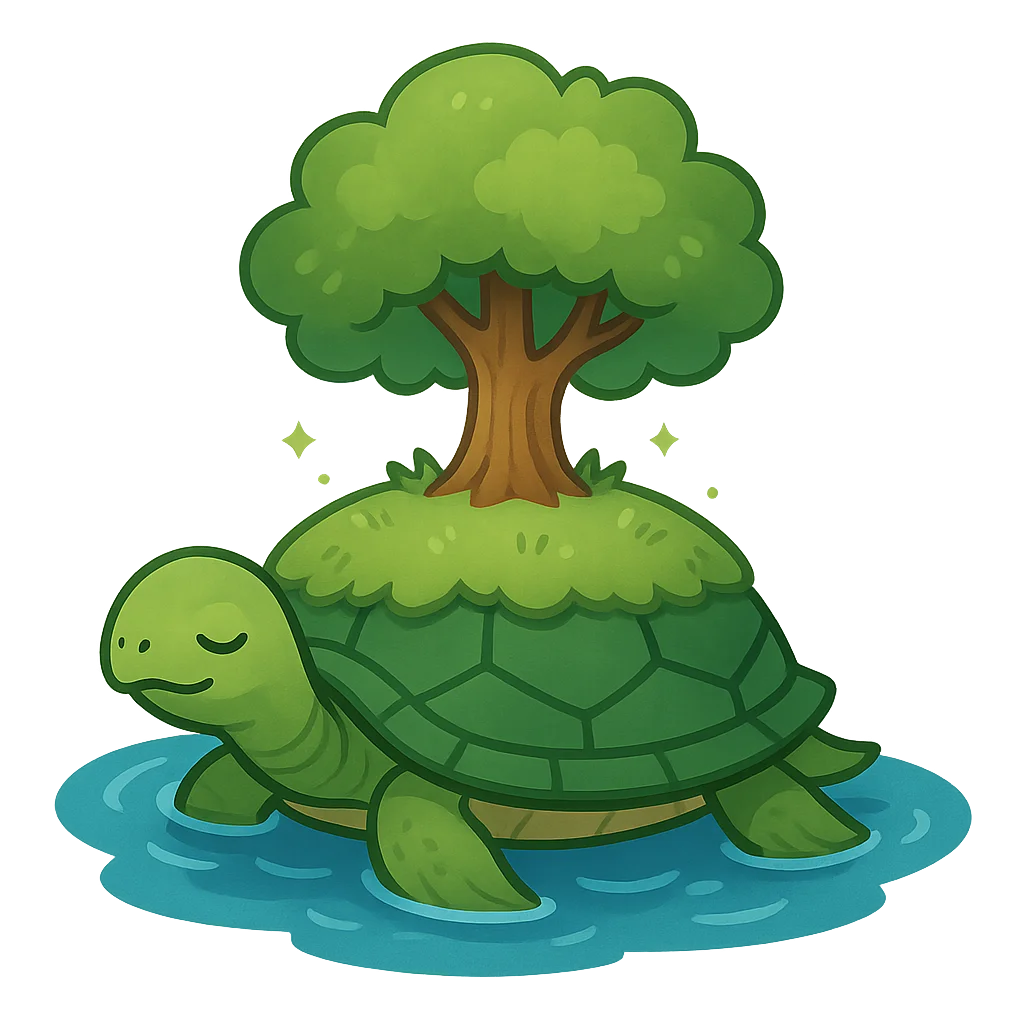
The World on a Turtle's Back
Before there was anything you might call land, there was only water. As far as any of us could see, a shimmering, endless sea stretched out in all directions, reflecting the mysterious and beautiful light of the Sky-World high above. My name is Muskrat, and in those ancient days, my world was a simple one of swimming and floating with my fellow creatures beneath the gentle glow of the great Sky-Tree that grew up there. I remember seeing its branches silhouetted against the sky, a constant, comforting presence. I was small, you see, much smaller than the others, and I knew my place. There was the sleek, strong Otter, who could twist through the water like a liquid shadow, his movements a dance of effortless power. The clever Beaver was our engineer, his teeth sharp enough to fell any log he might find floating, his mind always working on some new project. And above us, the graceful Swan and the mighty Geese commanded the air, their wings powerful enough to stir the surface of the water into tiny waves. Among these impressive beings, I was just a tiny, furry creature with a long, skinny tail, often overlooked and easily dismissed. I was not the strongest, fastest, or cleverest. My gift, if I had one, was persistence, but that was a quiet quality, not one that earned much notice. Our peaceful, predictable existence was shattered one day when a brilliant light tore through the Sky-World. It was a falling star, we thought at first, a dazzling anomaly in our calm world. But it grew larger and more distinct as it plummeted toward us. A great hole had opened in the sky where the sacred tree once stood, a wound in the fabric of our universe. From that void, a figure was falling, arms outstretched against the vast emptiness. The Great Geese called out in alarm, their cries echoing across the water, and we all watched in stunned silence as we realized it was a person, a woman, tumbling through the air, bringing with her the seeds of a new world. This is how the story of Turtle Island begins.
The Geese, without a moment's hesitation, sprang into action. With a great cry, they formed a V-shaped fleet, their powerful wings beating against the air as they soared upward to meet the falling woman. They wove a feathered net with their bodies, catching her gently and slowing her descent until they could lower her softly onto the surface of the water. She floated there, frightened and alone, a being completely alien to our watery home. The wisest among us, the Great Turtle, surfaced. His back was as wide and ancient as the sky itself, covered in moss and time. 'She cannot survive here,' his deep voice rumbled. 'She is not like us. She needs earth beneath her feet.' We all gathered around him, a council of water creatures, bobbing in the endless sea. The challenge was clear, but the solution seemed impossible. Somewhere, deep below us, lay the bottom of the world, and on it was the earth she needed. Someone had to bring it up. The Otter, sleek and confident, spoke first. 'I am the swiftest diver. I will go.' He took a deep breath and vanished, leaving only a trail of silver bubbles. We waited. The moments stretched into an eternity before he shot back to the surface, gasping for air, his mission a failure. 'The water is too deep, too dark,' he choked out. The Beaver, ever practical, slapped his broad tail on the water. 'My lungs are mighty. I can hold my breath longer than any of you. I will succeed where Otter has failed.' He too disappeared into the depths. The wait was even longer this time, and when he finally returned, he was exhausted and empty-handed. One by one, the strongest and proudest among us tried. The swift Loon, the muscular Sturgeon—they all dove with great courage but returned with nothing but the crushing pressure of the deep in their lungs. I watched, my heart pounding in my small chest. Fear was a cold knot in my stomach, but something else was stirring, too—a strange sense of duty. The others looked at me, and I could read the dismissal in their eyes. 'What can you do, little Muskrat? You are too small, too weak.' Their words echoed my own doubts. But as I looked at the Sky Woman, shivering on the water, I knew I had to try. 'You all have strength and speed,' I said, my voice barely a squeak. 'But I have determination. I will not come back until I have touched the bottom.' I took a deep breath, smaller than all the others, and plunged into the cold, silent world below.
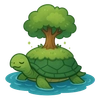
The world turned from shimmering blue to murky green, then to an inky, absolute blackness. The light from the Sky-World vanished completely, and I was alone in the crushing dark. The water, which had always been my home, now felt like a monster, its immense pressure squeezing the very air from my lungs. My ears ached, and my small muscles screamed in protest. Every instinct told me to turn back, to flee to the light and air I so desperately needed. The ghosts of the others’ failures swam around me, whispering that I was foolish, that my quest was hopeless. But then I thought of the Sky Woman, and the new world that could be born from a single act of courage. I pushed onward, deeper and deeper, driven by a hope that felt far bigger than my tiny body. Just as my vision began to blur and my strength gave out entirely, my paws felt something new. It wasn't water. It was soft, cool, and solid. It was mud. The bottom of the world. With the last ounce of my will, I clawed at the seafloor, gathering a small, precious handful of earth. Clutching it tightly in my paw, I kicked with all my remaining might, pushing myself back toward a surface I could no longer see. I remember breaking through the water's surface, gasping, my lungs on fire. The other animals gathered around, their eyes wide with disbelief as I unfurled my paw to reveal the dark, rich soil. The Great Turtle swam forward. 'Place it on my back,' he rumbled. 'I will be the foundation.' Sky Woman, her eyes filled with gratitude, took the small bit of earth and placed it gently in the center of his ancient, patterned shell. Then, she began to walk in a slow, deliberate circle around it, chanting a song of thanks and creation. It was magic. As she walked, the small patch of mud began to grow, spreading outward from the center, expanding over the turtle's back until it became an island, then a continent. She opened her hands and sprinkled the seeds she had carried from the Sky-World, and from them grew grasses, flowers, and towering trees. This is how our world, Turtle Island, was born—from a small pawful of mud, a great act of sacrifice, and the cooperation of all creatures. It’s a story we still tell, passed down through generations, to remind us that everyone, no matter how small, has a gift to offer. It teaches that the greatest things are created when we work together, and it inspires us to remember that this land is not just a place on a map, but the sacred, living back of the Great Turtle.
Activities
Take a Quiz
Test what you learned with a fun quiz!
Get creative with colors!
Print a coloring book page of this topic.






 Free for Educators