

 English

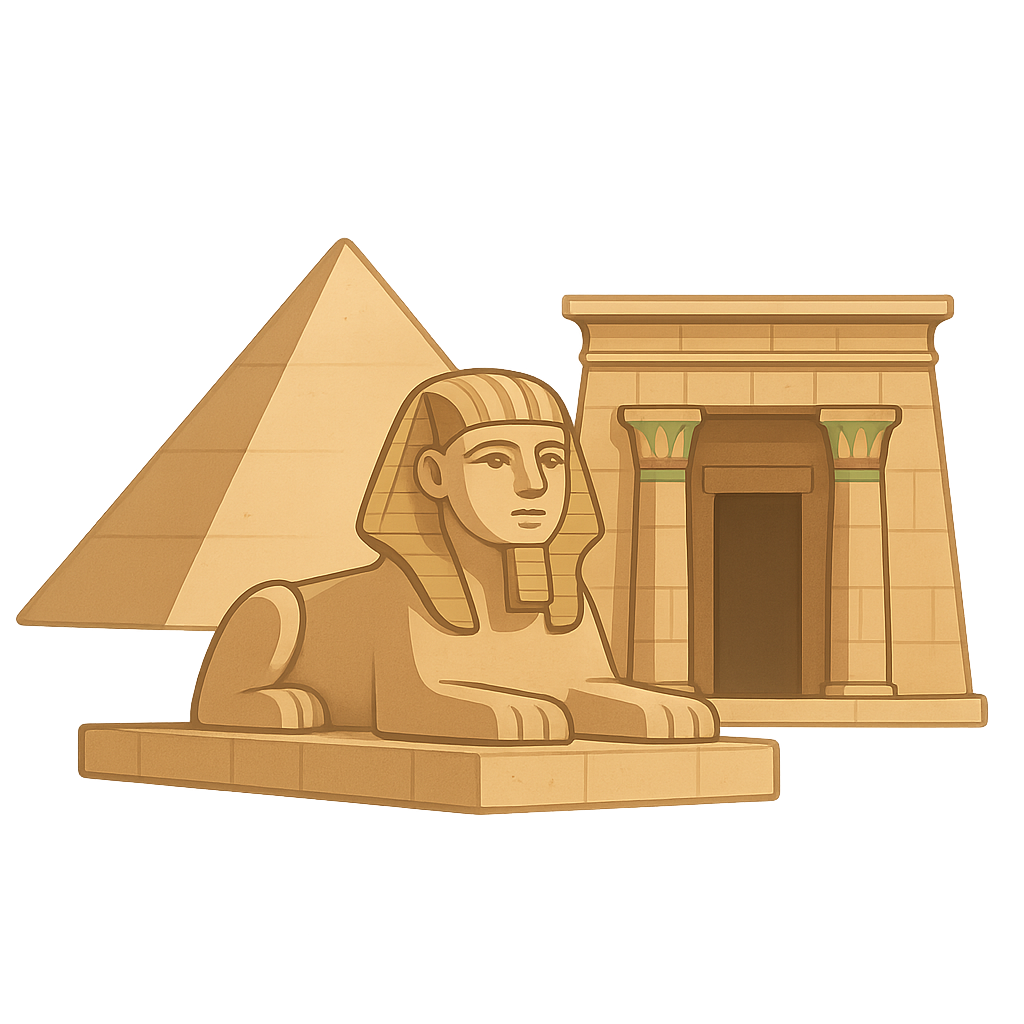
A Whisper from the Sands
Feel the sun warming your face, a golden light stretching across an endless sea of sand. The air is still and dry, carrying whispers from thousands of years ago. A great river, a ribbon of cool blue and green, cuts through the golden landscape, bringing life to the desert. Along its banks, enormous stone triangles reach for the sky, their points seeming to touch the heavens. Beneath the shifting sands lie hidden chambers, filled with treasures and secrets meant to last for eternity. For millennia, I have watched the sun rise and set over this land, guarding the stories of kings and queens, of inventors and dreamers. I am Ancient Egypt.
My story begins and ends with that great river, the Nile. You see, my home is a desert, a place where little can grow. But the Nile was my gift. Every year, between June and September, it would swell with rain from the mountains far to the south and flood my lands. When the waters pulled back, they left behind a layer of rich, dark, fertile mud. My people called this black earth ‘Kemet,’ and it was so precious that they named our entire kingdom after it. This predictable miracle allowed them to become expert farmers, growing wheat for bread and flax for linen cloth. With full bellies and organized lives, they had time to think, to create, and to build. They built villages that grew into bustling cities, all thanks to the life-giving waters of the Nile. Without my river, my pyramids would never have been built, my pharaohs would never have ruled, and my story would have vanished into the dust.
During my early years, in a time historians call the Old Kingdom, my people were led by rulers of incredible power called pharaohs. They were more than just kings; they were seen as gods walking on Earth. They believed that their journey did not end with death but continued into an eternal afterlife. To ensure their spirit, or ‘ka,’ could make this journey safely, they needed a magnificent and permanent home for their body. And so, they built the pyramids. These were not just tombs; they were engineered marvels, stairways to the stars designed to guide the pharaoh’s soul to the heavens. Around 2580 B.C., construction began on the grandest of them all for Pharaoh Khufu. Imagine it. Tens of thousands of skilled workers, quarrying, lifting, and perfectly placing more than two million limestone blocks, some weighing more than a car. They used brilliant mathematics to align the structure with the stars and incredible teamwork to build a monument so massive it remained the tallest structure on Earth for over 3,800 years. It was a testament to their devotion, their ingenuity, and their belief in forever.
My people’s minds were as mighty as the monuments they built. They invented a beautiful and complex form of writing you know as hieroglyphs. These weren't just letters; they were intricate pictures representing sounds, objects, and ideas. Highly trained scribes would spend years learning to read and write the hundreds of signs. They carved my history into the stone walls of temples and painted my myths inside tombs. For everyday records, they created one of the world's first forms of paper from the papyrus reeds that grew along the Nile. My spiritual life was just as rich. My people worshipped a pantheon of gods and goddesses who governed the natural world. Ra, the sun god, sailed his boat across the sky each day, while Osiris ruled the underworld and judged the souls of the dead. These beliefs guided every part of life, especially their preparations for death. They developed mummification, a careful process of preserving the body, because they believed the soul would one day return to it. Every ritual was a promise that life, like the Nile, would always continue.
Centuries passed, and my power grew, leading to the New Kingdom, an age of incredible wealth and empire. During this golden era, some of my most famous rulers took the throne. A remarkable woman named Hatshepsut declared herself pharaoh and ruled for over two decades, not with war, but with prosperous trade expeditions that brought exotic goods to my lands. Then there was Tutankhamun, the ‘boy king.’ He became pharaoh when he was only nine years old and his reign was brief. He is famous today because his tomb was found almost completely untouched. By his time, my pharaohs had learned that the grand pyramids were magnets for tomb robbers. So, they began to hide their burial chambers deep within the rocky cliffs of a secret, sun-scorched canyon known as the Valley of the Kings. They hoped these hidden tombs, filled with golden chariots, jeweled thrones, and everything a king would need in the afterlife, would remain safe for eternity.
Like all great civilizations, my time of glory eventually faded. I was ruled by others, from the Greeks to the Romans, and my last pharaoh was the brilliant Cleopatra VII. After her death in 30 B.C., my ancient ways began to disappear. The meaning of my hieroglyphs was forgotten, and my temples fell silent. For nearly two thousand years, my deepest secrets were locked away. Then, a slab of stone was discovered that changed everything. The Rosetta Stone had the same text written in three scripts, including my hieroglyphs. A clever Frenchman named Jean-François Champollion used it as a key and, in 1822, he finally unlocked my language. The world could hear my voice again. A century later, on November 4th, 1922, an English archaeologist named Howard Carter peered into a dark tomb and discovered the glittering treasures of Tutankhamun, creating a worldwide sensation. Today, my pyramids still stand, my stories still fascinate, and my inventions still inspire. I am a reminder that with belief, ingenuity, and teamwork, humans can create wonders that echo forever.
Activities
Take a Quiz
Test what you learned with a fun quiz!
Get creative with colors!
Print a coloring book page of this topic.











 Free for Educators