

 English

The Land of Endless Questions
Imagine a place where the sun warms ancient stones that have rested for thousands of years. The air smells of salty sea breezes and the sweet scent of olive groves stretching across rolling hills. All around you, the water is a brilliant, sparkling blue, dotted with islands that look like scattered jewels. Mountains rise up to touch the clouds, and in the valleys below, it feels as if the whispers of old stories still linger in the air. Heroes once walked this land, and great thinkers sat under shady trees, puzzling over the mysteries of the world. For a very long time, I have watched people build, dream, and create incredible things on my shores. I have felt the footsteps of artists, athletes, and leaders. I am the land you call Ancient Greece.
My story truly came alive with the people who lived here long ago. They didn't live in one giant country, but in many different city-states, each with its own rules and personality. Two of my most famous cities were as different as night and day. One was Athens, a city buzzing with energy and new ideas. In the 5th century BCE, the people of Athens created something amazing called democracy, where citizens could help make decisions for their city. It was a place filled with artists who carved breathtaking statues, builders who designed magnificent temples, and philosophers like Socrates, who spent his days in the marketplace asking questions to make people think deeply. Then there was Sparta, a city of fierce and disciplined warriors. From a young age, Spartans were trained to be strong, brave, and loyal. While Athenians were discussing poetry, Spartans were practicing for battle. This variety made me a land of fascinating contrasts and powerful stories.
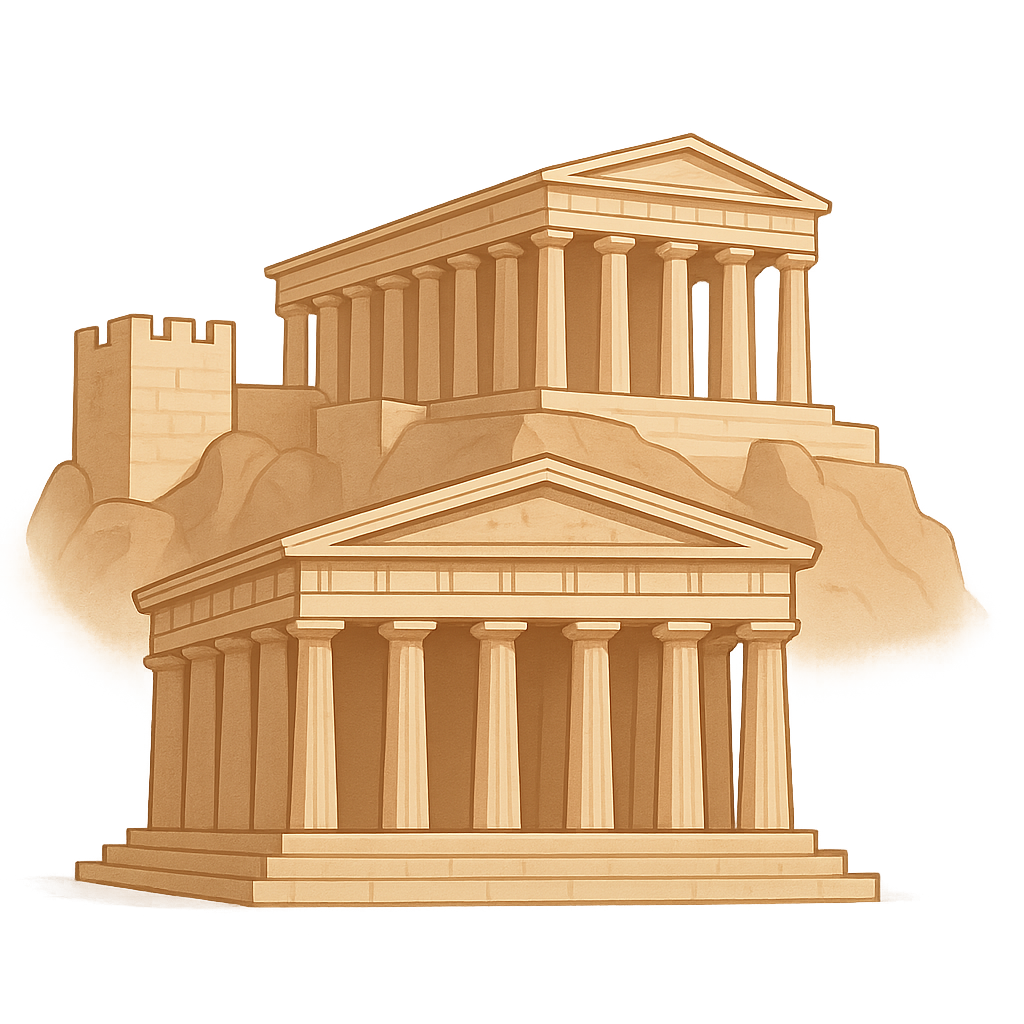
My people loved to celebrate life, honor their gods, and tell stories in grand ways. They invented theater, building huge outdoor stages where actors wore masks to show if they were happy or sad. They performed stories called tragedies that made you think, and comedies that made you laugh. My people also loved competition, and in 776 BCE, they held the very first Olympic Games in a place called Olympia. It started as a festival to honor Zeus, the king of the gods, and athletes came from all over to prove their strength and skill. My people were also incredible builders. On a high, rocky hill in Athens called the Acropolis, they built the Parthenon, a stunning temple with tall, graceful columns, dedicated to the goddess Athena. It was filled with beautiful statues and carvings that told the stories of their gods and heroes. These myths helped them explain everything from the rising sun to the crashing waves of the sea.
Even though my golden age was long ago, my story never really ended. My ideas became like seeds that were carried on the wind, planting themselves all over the world. The idea of democracy, where people have a voice in how they are governed, still inspires nations everywhere. Many words you use in English today have roots in my ancient language. But perhaps my greatest gift is the spirit of curiosity. The love of asking 'why?'—the very heart of my philosophy—is the same spirit that drives scientists to make discoveries and inventors to create new things. I am a reminder that big ideas, a love of learning, and the courage to ask questions can change the world and inspire people forever.
Activities
Take a Quiz
Test what you learned with a fun quiz!
Get creative with colors!
Print a coloring book page of this topic.





 Free for Educators