English
 Continue with Google
 Continue with Apple

The Land Between the Rivers: My Story
Feel the warm sun on my soil, a rich, dark earth that has nourished life for thousands of years. I am nestled between the steady, life-giving currents of two great rivers, the Tigris and the Euphrates. For ages, they have flowed from the mountains to the sea, carrying with them silt that makes my land incredibly fertile. It was this richness that first drew people to my banks. They were nomads at first, wandering in search of food, but they soon discovered something wonderful about me. Anything they planted in my soil grew strong and plentiful. They learned to dig canals, guiding the river water to their crops of barley and wheat, and for the first time, they had more food than they needed. This abundance allowed them to stop wandering and build permanent homes.
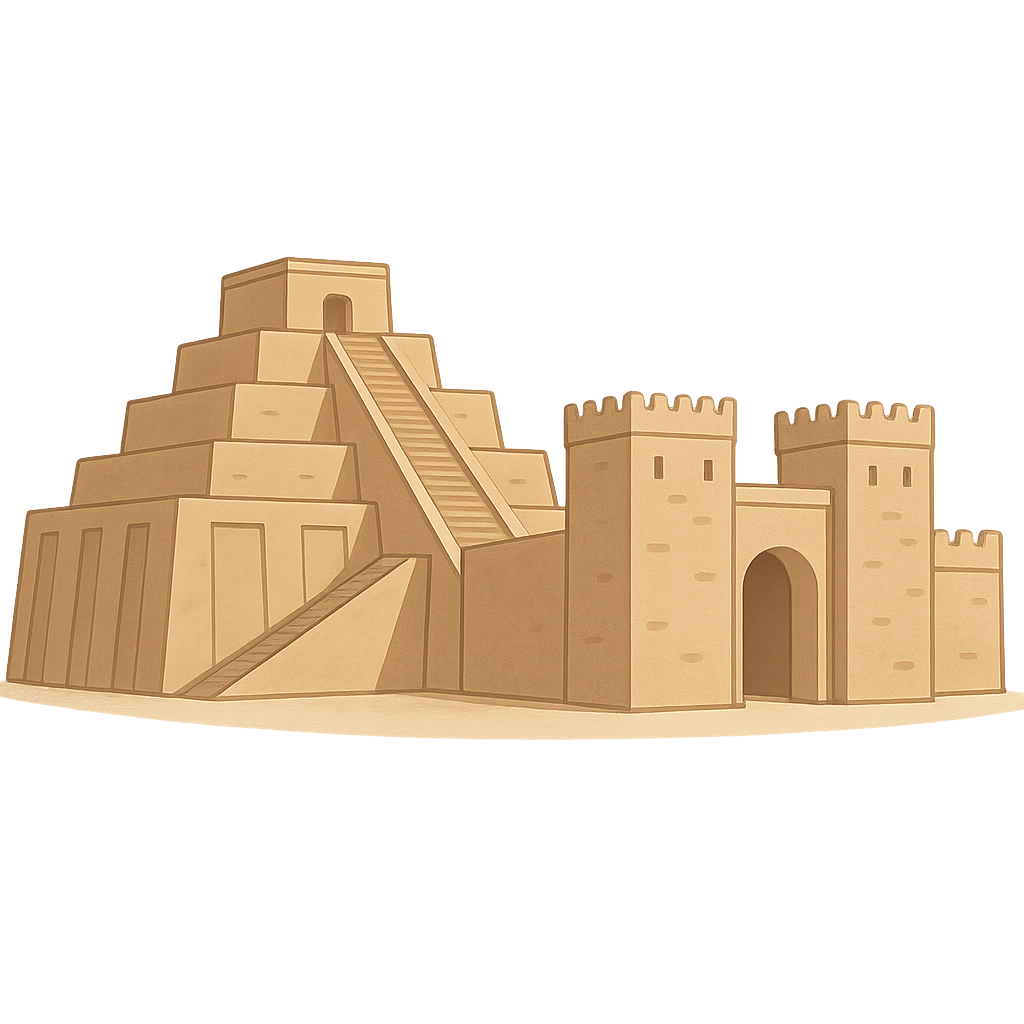
Their small villages of reeds and mud slowly grew into the world’s first great cities. Imagine walls of sun-dried brick rising from the flat plains, creating bustling communities filled with farmers, priests, and artisans. At the heart of each city, they built enormous, stepped temples called ziggurats, which looked like stairways to the heavens, a way to be closer to their gods. From the top of these towers, priests would watch the stars, and down below, life would hum with energy and purpose. It was a world born from mud and water, a place of extraordinary beginnings. They called me Mesopotamia, which means ‘the land between the rivers,’ and my story is the story of where so much of your world began.
My soil was not just good for growing crops; it was a cradle for ideas that would change humanity forever. The first people to truly unlock my potential were the Sumerians. Around the year 3500 BCE, they faced a new problem: as their cities grew, they needed a way to keep track of trade, harvests, and laws. Their solution was revolutionary. Using a reed stylus, they pressed wedge-shaped marks into tablets of soft, wet clay. They called this writing cuneiform. For the first time in history, people could record their thoughts, their business, and their stories. One of the first great works of literature, the Epic of Gilgamesh, was etched onto my clay tablets, a heroic story of a king searching for eternal life. This single invention—writing—allowed knowledge to be passed down through generations, a gift that still powers your world today.
The Sumerians’ creativity didn’t stop there. They also invented the wheel. At first, it wasn't for traveling fast, but for a potter to spin clay into beautiful pots and bowls. Soon after, they turned the wheel on its side and attached it to carts, making it easier to transport heavy loads of grain and goods between my thriving cities. Life became more connected, and trade flourished like never before. After the Sumerians, other great civilizations rose on my lands, like the Akkadians and the Babylonians, each adding new layers to my story. One of the greatest Babylonian kings was Hammurabi, who reigned in the 18th century BCE. He saw that his vast empire needed a single, fair set of rules for everyone. So, he had nearly 300 laws carved into a tall stone pillar for all to see. This Code of Hammurabi was one of the first attempts to create a just society where everyone, from the rich to the poor, knew their rights and responsibilities. It was a powerful statement that justice should be clear and consistent.
My people’s curiosity was as boundless as the sky above them. They were brilliant mathematicians and astronomers. As they gazed up at the night sky from their ziggurats, they mapped the constellations and tracked the movements of the planets. They created incredibly accurate calendars based on the cycles of the moon, which helped them know the perfect times for planting and harvesting. Their mathematical system was based on the number 60, and you can still see its influence every time you look at a clock. The idea of a 60-second minute and a 60-minute hour? That was born right here, on my fertile plains, thousands of years ago. From the first written word to the first laws and the very way you measure time, my people laid the foundation for civilization.
Today, my ancient cities of Ur, Babylon, and Nineveh are quiet ruins, their sun-baked bricks slowly returning to the earth under the hot sun of modern-day Iraq and its neighboring lands. The great ziggurats no longer stand tall, and the bustling marketplaces have fallen silent. But do not think my story is over. My body may be sleeping, but my spirit—my ideas—are more alive than ever. They have traveled across rivers and oceans, across deserts and mountains, and across thousands of years to be with you right now. My legacy is not found in dusty ruins, but in the everyday miracles of your own world.
Every time you write a story, you are using the gift the Sumerians gave to the world. Every time a leader creates a law to protect people and ensure fairness, they are following in the footsteps of King Hammurabi. Every time you check the time on a clock or look at a calendar to plan your year, you are feeling the echo of the astronomers who mapped the stars from my temple towers. I am a reminder that civilization is built not just with bricks and stone, but with curiosity, creativity, and the desire to build a better world. I am the land between the rivers, and my story proves that a single great idea, born in the fertile soil of imagination, can grow to shape the future for all time.
Reading Comprehension Questions
Click to see answer