
 English
 For Schools
 For Homeschool

The Story of Mexico
Imagine a place where the ocean shimmers in a thousand shades of turquoise against white sand, and just beyond, a deep green jungle hums with the calls of howler monkeys and colorful parrots. Picture mountains so high their peaks are dusted with snow, watching over valleys where vibrant cities buzz with life. Can you hear it? The lively strum of mariachi guitars fills the air, a sound that makes you want to tap your feet. Can you smell it? The warm, comforting scent of fresh tortillas cooking on a comal and the rich, sweet aroma of chocolate, a gift that was born here. My marketplaces are an explosion of color, with handcrafted toys, bright fabrics, and intricate pottery telling stories without words. My festivals are celebrations of life itself, with brilliant flowers, joyful music, and faces painted in beautiful designs. For thousands of years, I have been a land of deep roots and soaring dreams, a place where ancient stone pyramids whisper secrets to the modern world. I am a tapestry woven from countless threads of courage, creativity, and community. I am Mexico, a land of many colors and stories.
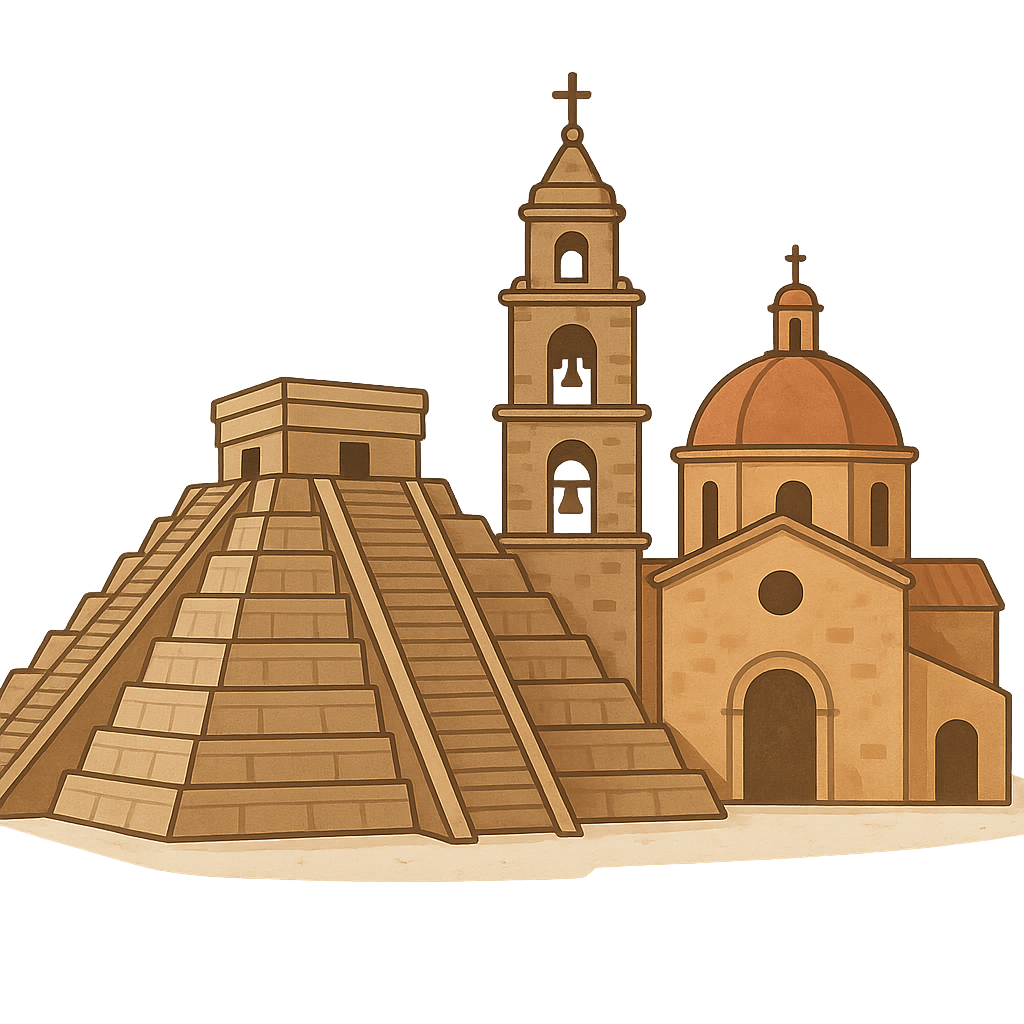
My story begins long before the world knew my current name. It echoes from a time of mystery and wonder, carried on the wind that sweeps across my plains and rustles through my forests. The first powerful voices belonged to the Olmecs, who more than three thousand years ago carved enormous stone heads from volcanic rock. These giant faces, with their calm and powerful expressions, still watch over the land, guardians of a civilization whose secrets we are still uncovering. After them came the brilliant Maya, who built magnificent cities like Chichen Itza and Palenque, with pyramids that were observatories for studying the stars. They were incredible mathematicians and astronomers, creating calendars so precise they rival those we use today. They mapped the heavens and understood the cycles of time in a way that was truly ahead of their world. Then, following a powerful prophecy, the mighty Aztecs journeyed until they saw an eagle devouring a serpent while perched on a cactus. They believed this was a sign from their gods, and there, in the middle of a lake, they began building their capital city, Tenochtitlan, around the year 1325. It was a true marvel of engineering, a floating metropolis with canals for streets, grand temples that seemed to touch the clouds, and incredible floating gardens, called chinampas, that produced bountiful harvests to feed its people.
For centuries, the world of the Aztecs thrived, a center of culture, power, and art. But in the year 1519, my shores witnessed the arrival of something new and unexpected: tall ships with vast white sails, carrying men from a land across the ocean. They were the Spanish, led by a determined explorer named Hernán Cortés. This was a meeting of two entirely different worlds, a moment that would change my story forever. It was a complex time of wonder, misunderstanding, and ultimately, conflict. After a long and difficult struggle, the great city of Tenochtitlan fell on August 13th, 1521. This marked the end of one era and the painful beginning of another. Over the next three hundred years, Spanish and Indigenous cultures began to mix, creating something entirely new. My food, my language, my art, and my people were transformed by this blend. But the desire for freedom never faded. On the morning of September 16th, 1810, a brave priest named Miguel Hidalgo y Costilla rang the church bells in the town of Dolores and gave a powerful speech, the 'Grito de Dolores.' This 'Cry of Dolores' was a call to action that sparked a long and difficult war for independence. For over a decade, my people fought with incredible courage, and finally, in 1821, they won their freedom. This was the birth of my modern nation, a testament to the resilience and spirit of my people.
In the years that followed, I found new ways to tell my story. My modern heartbeat can be seen and felt in the vibrant art that covers the walls of my cities. Great artists like Frida Kahlo and Diego Rivera took up paintbrushes to tell the tales of my history, my struggles, and my joys. They painted giant murals for everyone to see, ensuring that my past would never be forgotten and that the spirit of my people would be celebrated. My heartbeat is also in my unique celebrations. The most famous is Día de los Muertos, the Day of the Dead. It is not a sad time but a joyful and colorful holiday celebrated on November 1st and 2nd, a time to build beautiful altars, or ofrendas, decorated with marigolds and candles to remember and honor loved ones who have passed on. It is a beautiful way to say that family and memory are forever. My spirit is also shared through the gifts I have given the world, foods that are loved everywhere, like creamy avocados, sweet corn, and of course, rich, delicious chocolate. My scientists and thinkers also continue to make important discoveries, adding new chapters to our shared human story.
My story is not just found in history books; it is alive. It is written every day by the millions of people who call me home, in their hard work, their strong family bonds, and their joyful celebrations. I am a place where the past is always present, where you can stand at the top of an ancient pyramid in the morning and walk through a bustling modern city in the afternoon. My story lives in every note of mariachi music that fills the air and in every delicious flavor that graces a plate. It is a story of strength, beauty, and endless creativity. I am more than just a place on a map; I am a living, breathing culture with a heart that beats with passion and resilience. My story is one of survival and transformation, and I invite you to come and discover it for yourself.
Activities
Take a Quiz
Test what you learned with a fun quiz!
Get creative with colors!
Print a coloring book page of this topic.