

 English

The River of Stories
I begin as a whisper, a clear, cool trickle spilling from a northern lake surrounded by tall pines. My journey starts small, but as I flow south, I gather strength from countless streams and tributaries that join my quest. I stretch and widen, carving my path through the heart of a great continent, touching ten states on my long, winding road to the sea. For thousands of miles, I twist and turn, my muddy waters reflecting the changing skies above and the endless forests and fields along my shores. I have felt the dip of paddles from ancient canoes, the powerful churn of steam-powered wheels, and the steady push of modern engines moving goods for the world. I have nourished vast farmlands, carried the dreams of explorers and pioneers, and witnessed the rise and fall of great cities on my banks. I am a flowing ribbon of history, a liquid timeline connecting the past to the present. My story is the story of a nation. I am the Mississippi River.
Long before the first sails appeared on my horizon, my banks were home to people who understood my rhythms. For thousands of years, Indigenous peoples built their lives around my gifts. I remember the Mississippian culture, a remarkable civilization that flourished here between 800 and 1600 A.D. Near present-day St. Louis, they built a magnificent city called Cahokia, a sprawling center of life with enormous earthen mounds that reached toward the sky like man-made mountains. These mounds were places of ceremony, governance, and burial, and their grandest one was larger at its base than the great pyramids of Egypt. Imagine a city of thousands, with a vibrant culture, all thriving because of my proximity. To these people, I was more than just water. I was a highway for their dugout canoes, connecting communities for hundreds of miles and allowing them to trade goods and ideas. I was a pantry, offering them plentiful fish, mussels, and waterfowl, and my annual floods left behind rich, fertile soil for their crops of corn, beans, and squash. Most importantly, I was a sacred presence, a central part of their spiritual world. They gave me names that spoke of their deep respect, names that translate to ‘Father of Waters’ or ‘Great River,’ recognizing my immense power and the life I sustained. Their echoes remain in the land, a timeless reminder of my earliest companions who knew my every current and bend.
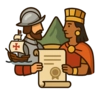
My waters, once familiar only with the silent glide of canoes, began to feel the weight of different ships. In 1541, a Spanish explorer named Hernando de Soto and his men arrived, the first Europeans to gaze upon my southern expanse. They were searching for gold and glory, but found instead my powerful, muddy current. They did not stay long, but their arrival marked the beginning of a profound change. Over a century later, in 1673, two Frenchmen, a priest named Father Jacques Marquette and an explorer named Louis Jolliet, paddled down my upper reaches. They were not seeking treasure, but knowledge, hoping I would lead them to the Pacific Ocean. They mapped my course, creating the first detailed picture for a world that was just beginning to know me. Then came the ambitious René-Robert Cavelier, Sieur de La Salle. On April 9th, 1682, after a long and difficult expedition, he reached my mouth where I empty into the Gulf of Mexico. He planted a flag in the muddy soil and claimed my entire vast valley for France, naming it ‘La Louisiane.’ For decades, I was the spine of a French empire in North America, a vital link between their northern and southern colonies. This chapter closed in 1803 with the Louisiana Purchase, when the young United States bought this territory, and I became the central artery of a nation destined for westward expansion.
The 19th century brought a new sound to my waters: the chuffing, puffing, and churning of the steamboat. These fire-breathing giants, with their tall smokestacks and massive paddlewheels, transformed me from a wild frontier river into a bustling commercial highway. The first to make the journey from the Ohio River down to New Orleans was a vessel named the 'New Orleans' in 1811, an event that opened a new era of trade and travel. Suddenly, goods and people could move upstream against my strong current, connecting the agricultural heartland to the sea. A young man named Samuel Clemens fell in love with this life. He learned to navigate my tricky currents and hidden sandbars as a steamboat pilot, an experience he would later share with the world under his famous pen name, Mark Twain. His stories made me a character known to millions. But my currents also carried the currents of conflict. During the American Civil War, controlling me was essential. The Union and the Confederacy battled for my waters, and the turning point came with the long Siege of Vicksburg in 1863. When the city fell, the Union controlled my entire length, splitting the South in two. In the aftermath of that war, a new and powerful culture was born in my delta. From the work songs and spirituals of African Americans, something new emerged: the blues and jazz. This music, born of hardship and hope, filled the air in cities like New Orleans and Memphis, and its rhythms traveled up my waters to change the sound of the world forever.
Today, my journey continues, though the sights along my banks have changed. The tall smokestacks of steamboats have been replaced by the quiet power of modern towboats pushing immense barges filled with grain, coal, and oil. Great cities with glittering skylines stand where small trading posts once were. But my power is still a force to be respected. I have brought not only life but also destruction. The Great Mississippi Flood of 1927 was a devastating reminder of my strength, when my waters broke free and covered an area the size of a small country. That disaster taught people a hard lesson, leading to the construction of massive levees and floodwalls to protect the communities along my shores. I am more than just water moving to the sea. I am a living connection to history, a vital home for countless birds, fish, and other wildlife, and a constant source of inspiration for poets, musicians, and dreamers. I flow onward, carrying the stories of the past and the hopes for the future, and I invite you to listen to my currents and help care for the life I sustain.
Activities
Take a Quiz
Test what you learned with a fun quiz!
Get creative with colors!
Print a coloring book page of this topic.












 Free for Educators