
 English
 Continue with Google
 Continue with Apple

The Empire of Echoes
I stretch from the misty shores of Britain to the sun-baked sands of Egypt, from the coasts of Spain to the forests of Germany. I am a tapestry woven with marble cities, straight roads that run like arrows, and the murmur of a thousand different voices all trying to speak one language: Latin. I have felt the sandals of soldiers marching in perfect rhythm, the wheels of merchant carts carrying silk and spices, and the quiet footsteps of poets dreaming under olive trees. For centuries, my presence shaped mountains, rivers, and the lives of millions. Before I was a vast empire, I was just an idea, born in a city of seven hills on the Italian peninsula. My story is one of conquest and creation, of power and peace. I am the Roman Empire.
My story began in a small city called Rome, which legend says was founded by the twin brothers Romulus and Remus on April 21st, 753 BCE. For my first several hundred years, I was not an empire but a Republic. This was a revolutionary idea where citizens could vote for leaders, called senators, to represent them and make decisions together. This concept of giving people a voice in their own governance was powerful and drew many to my cause. My legions, famously disciplined and loyal, were the engine of my growth. They were not just conquerors. they were builders. Wherever they went, they constructed incredible feats of engineering. They laid down roads so straight and durable that some are still in use today, connecting my farthest corners. They built magnificent aqueducts, stone bridges that carried fresh, clean water from distant mountains into my bustling cities, allowing them to grow and flourish. A brilliant and ambitious general named Julius Caesar expanded my borders farther than ever before, but his rise to power marked the end of the Republic. After his time, his great-nephew Augustus became my first official emperor on January 16th, 27 BCE, and the Roman Empire truly began.
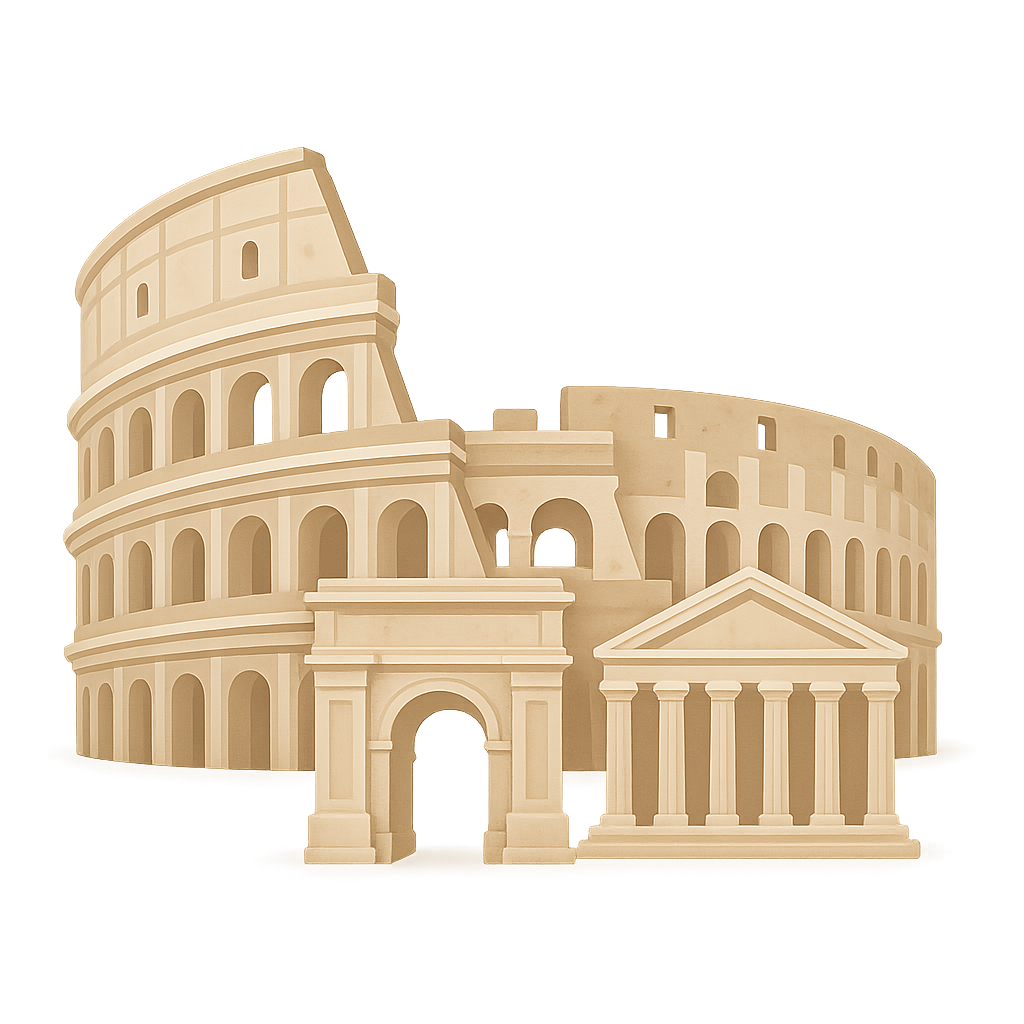
Under my emperors, I entered a golden age that lasted for over 200 years, a period historians call the Pax Romana, or the Roman Peace. For the first time, the lands around the Mediterranean Sea knew a long and stable peace, allowing culture, art, and science to thrive. It was a time of breathtaking invention. In my capital city, Rome, my engineers and architects perfected the use of the arch and the dome. This allowed them to create structures grander than anything the world had ever seen. The Colosseum rose as a massive amphitheater for gladiatorial games and public spectacles, while the Pantheon, a temple to all the gods, was crowned with a magnificent dome featuring an oculus, a circular opening to the sky. My system of laws brought order and a sense of justice that became a model for future civilizations. In my forums, which were the bustling hearts of my cities, people from Africa, Europe, and the Middle East traded goods and exchanged ideas. Children attended schools to learn reading, writing, and mathematics. All across my lands, the Latin language connected people, and it would later become the foundation for modern languages like Spanish, French, and Italian.
But a body as large as mine is difficult to control from a single heart. I had grown so immense that managing my territories from Rome became a great challenge. To make governance more efficient, my leaders made a difficult decision in the 3rd century CE. I was divided into two halves: the Western Roman Empire, with its capital still in Rome, and the Eastern Roman Empire, with a wealthy new capital called Constantinople. For a time, this helped, but the Western part faced growing pressures from migrating tribes, economic troubles, and internal conflicts. Slowly, it began to weaken, and its final emperor was removed from power on September 4th, 476 CE. But this was not my end. It was a transformation. My eastern half, which would become known as the Byzantine Empire, continued to flourish for another thousand years. It carefully preserved my laws, my art, and my knowledge, acting as a library for the future. I didn't just disappear. I changed, like a river finding new paths to the sea, my waters flowing into new lands and shaping them in new ways.
Even though I no longer exist as a single empire on a map, my spirit is everywhere in your world today. You can see my reflection in government buildings with grand domes and stately columns, inspired by my architecture. You can hear my echo in the words you speak, as many English words have roots in my Latin language. You feel my influence in the legal systems that provide justice and order, which were built upon my principles of law. I am the story of how a small city built a world connected by roads, laws, and a shared culture. My story is a reminder that great things are built with courage, brilliant engineering, and the belief that people from different places can unite to create something lasting. I am a part of your history, and my legacy continues to inspire people to build, create, and connect with one another across the world.
Reading Comprehension Questions
Click to see answer