

 English

The Story of London
Feel the deep rumble beneath your feet as a bright red double-decker bus trundles past. The stones underfoot are smooth and uneven, worn down by millions of footsteps over hundreds of years. Look up, and you’ll see a stone tower that has watched over kings and queens for a thousand years standing proudly beside a skyscraper made of gleaming, modern glass. A wide, winding river flows through my heart, reflecting a sky that can be gray one moment and brilliantly sunny the next. I am the hum of countless different languages, the energy of busy markets, and the quiet peace of a green park. My story is a patchwork of old and new, of tragedy and triumph. I am London.
My story begins nearly two thousand years ago, when I was little more than wild fields and marshland bordering the river. Around the year 47 CE, soldiers and builders from the mighty Roman Empire arrived. They saw my river, which you know as the Thames, and realized it was a perfect highway connecting the island to the sea and the rest of their vast empire. They built a settlement here called Londinium. They were brilliant engineers, constructing the very first bridge across my river and a bustling port where ships brought wine, pottery, and other goods from far-flung lands. To protect their valuable new town, they enclosed me within a strong stone wall, pieces of which you can still find today. When the Romans left centuries later, I did not fade away. New people came, like the Saxons, who built their own town beside the old Roman walls. Then, in the year 1066, a powerful leader named William the Conqueror sailed from Normandy and became the King of England. To show everyone his strength and secure his new kingdom, he began building a mighty fortress on the riverbank—the famous Tower of London.
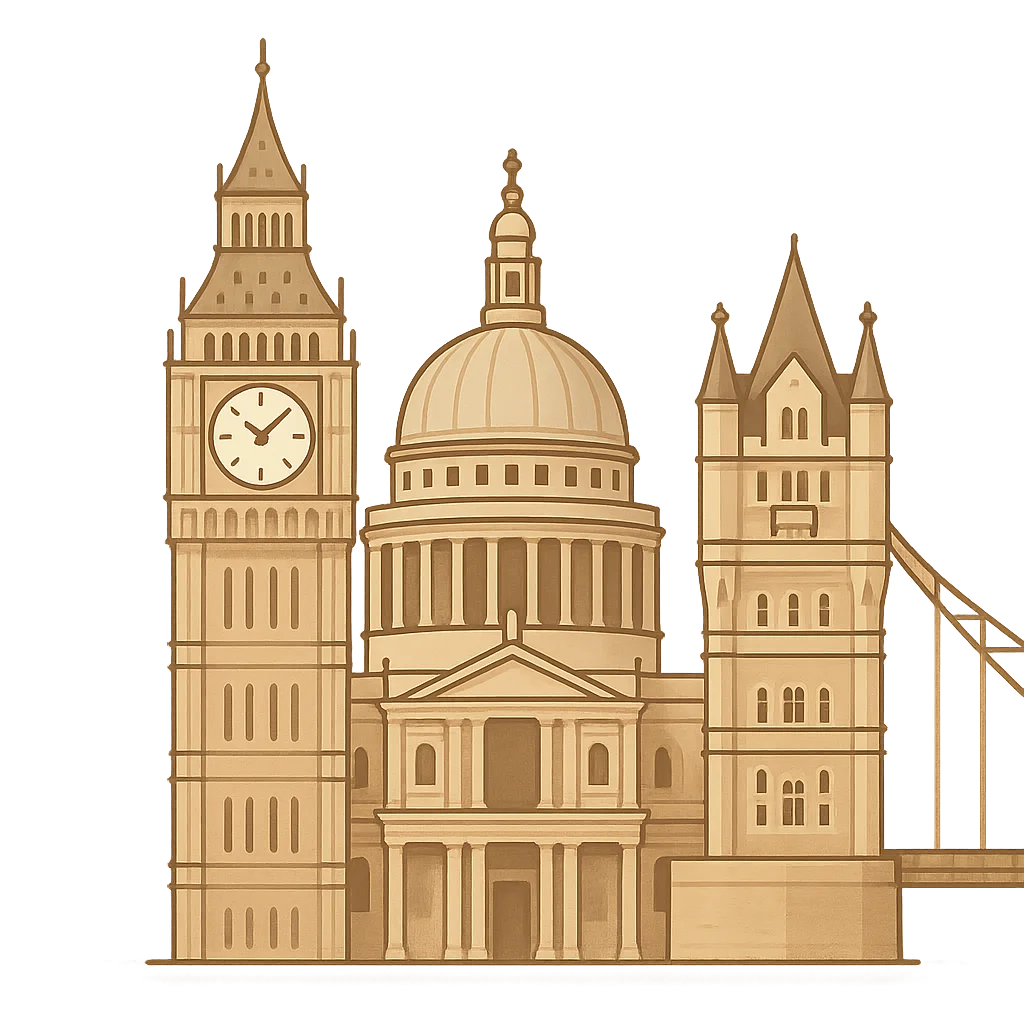
Centuries passed, and I grew into a crowded, bustling medieval city. By the year 1666, my streets were a maze of narrow, twisting lanes lined with timber-framed houses that leaned so closely together you could almost shake hands from the windows. But this cozy, crowded design would prove to be my undoing. On the night of September 2nd, a tiny spark in a baker’s shop on a little street called Pudding Lane was fanned by the wind. It leaped from one wooden house to the next, and soon, a monstrous fire was raging through my heart. The Great Fire of London, as it came to be known, burned for four long days and nights, destroying almost everything within my old Roman walls. It was a terrible disaster, but it was also a chance to begin again. From the ashes, a new vision for me was born. A brilliant architect named Sir Christopher Wren was given the immense task of rebuilding. He designed dozens of beautiful new stone churches, but his masterpiece was the magnificent St. Paul’s Cathedral. Its glorious dome rose high above the new city, a symbol of hope and rebirth that still watches over me today.
As I entered the 19th century, the world was changing faster than ever before. This was the Victorian era, the time of the Industrial Revolution, and I became the biggest, busiest, and most powerful city on Earth. Factories billowed smoke, steam trains crisscrossed the country, and incredible new ideas were born within my streets. But this rapid growth came with challenges. The air was often thick with a foggy mixture of smoke and mist, earning me the nickname ‘The Big Smoke.’ My streets were so crowded with people, horses, and carriages that getting around was a slow and messy business. My clever people came up with a revolutionary solution. They decided to build a railway not over the streets, but under them. On January 10th, 1863, the world’s very first underground railway, the ‘Tube,’ opened to the public. It was an engineering marvel that changed city life forever. This era of invention and confidence also gave me some of my most famous landmarks, like the magnificent Tower Bridge, which can raise its arms to let tall ships pass, and the grand Houses of Parliament, home to my famous clock tower, Big Ben.
My story has always been one of resilience. In the 20th century, I faced one of my greatest tests during World War II. For many months, from September 7th, 1940, to May 11th, 1941, a period known as The Blitz, enemy bombs fell from the sky, damaging many of my beloved buildings and homes. But the spirit of Londoners never broke. They protected one another in underground shelters, put out fires, and vowed to rebuild me, brick by brick. And they did. Today, I am a vibrant and welcoming home to people from every corner of the globe. My streets are filled with the wonderful sights, sounds, and tastes of countless different cultures. My story is still being written every single day in my bustling theaters, my world-class museums, and my peaceful Royal Parks. I am a city that honors its deep past while always looking toward the future, inviting everyone to dream, create, and find their own place in my long and amazing tale.
Activities
Take a Quiz
Test what you learned with a fun quiz!
Get creative with colors!
Print a coloring book page of this topic.















 Free for Educators