English
 For Schools
 For Homeschool

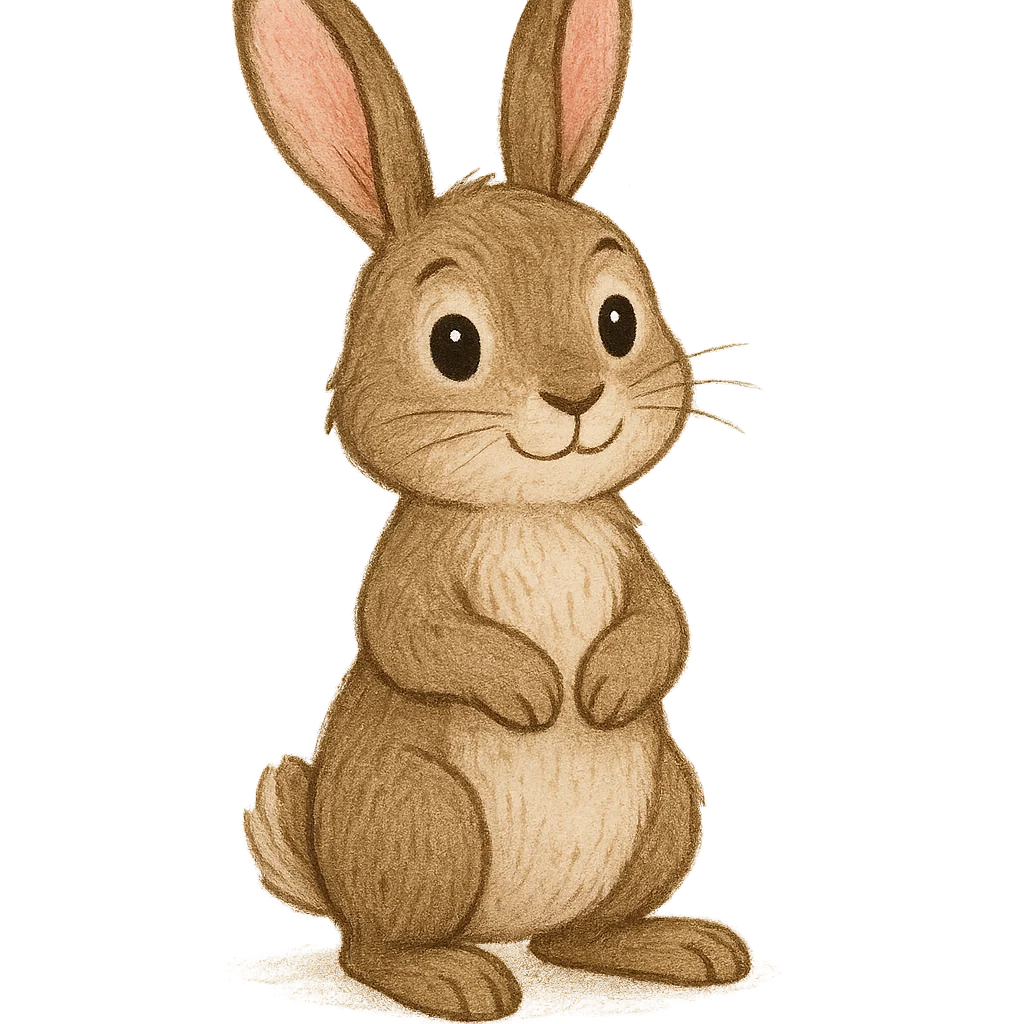
My Journey as a European Rabbit
Hello, I am a European Rabbit. My story begins on the sunny Iberian Peninsula, which you now know includes Spain, Portugal, Andorra, Gibraltar, and a portion of France. This was my native home, a warm and wonderful place to live. I was born into a very large family, and we all lived together in a cozy, underground home called a warren. Our warren was a network of tunnels that kept us safe and warm. Life was simple and happy. During the day, we would come out to nibble on all sorts of delicious grasses and herbs. We had to be careful, though. I learned from a young age to always keep my ears up and my nose twitching, staying alert for sneaky foxes who might be hunting for their dinner. Our family life in the warren was all about looking out for one another and enjoying the sunshine.
My ancestors' lives began to change when humans took an interest in us. My first big journey started with the Romans around the 1st century BCE. They thought we were quite tasty, so they began to keep my relatives in special walled gardens called leporaria. This kept us from escaping while they raised us for food. Many centuries later, in the 12th century, our travels continued when the Normans decided to bring us to Britain. Just like the Romans, they planned to raise us for our meat. But we rabbits have a few tricks up our sleeves. We are expert diggers and escape artists. It wasn't long before some of us tunneled our way to freedom. We are also very quick breeders, so once we were out in the open countryside of Britain, our families grew and grew until the whole island became our new home.
My most famous adventure, however, happened far across the world in Australia. It all started when Thomas Austin's brother shipped 24 of my relatives from England on October 6, 1859. They arrived in Australia on December 25, 1859, and were subsequently released into the wild there. He had brought them from Europe because he wanted to hunt them for sport. For us rabbits, Australia was a paradise. There was so much food to eat and very few predators to worry about. Because of these perfect conditions, our population grew incredibly fast. Soon, there were millions of us. While it was a great time for my family, our huge numbers began to cause problems. We ate so many plants that many native Australian animals, who depended on that same food, started to go hungry. To try and stop us from spreading across the entire continent, people built a giant fence between 1901 and 1907. It was called the Rabbit-Proof Fence, and it stretched for hundreds of miles across the land.
My story took another turn in Australia. Because our numbers were so high, people looked for other ways to control our population. In 1950, they released a serious sickness called myxomatosis. This disease spread quickly among us and made many of my relatives very sick. It was a difficult time for my species in Australia. But here is a surprising twist to my tale. While we were seen as a pest in Australia, a different story was unfolding back in my original home. Those same diseases, along with others, found their way back to Spain and Portugal. In the place where my story began, these sicknesses have made my species considered near threatened. It's strange to think that in one part of the world we are too common, and in another, we are in danger of disappearing.
Legacy & Remembering
My journey across the world shows just how important balance is in nature. When I was moved to a new place like Australia, my population grew so large that it upset the natural environment. But in my native home on the Iberian Peninsula, I am a vital part of the ecosystem. My digging and burrowing create homes and shelters for other small creatures. More importantly, I am the main food source for the very rare Iberian Lynx, which depends on me to survive. My tale is a reminder that every animal has a special place in the world, and that where we live matters a great deal to the health of our planet.
Activities
Take a Quiz
Test what you learned with a fun quiz!
Get creative with colors!
Print a coloring book page of this topic.