English
 For Schools
 For Homeschool

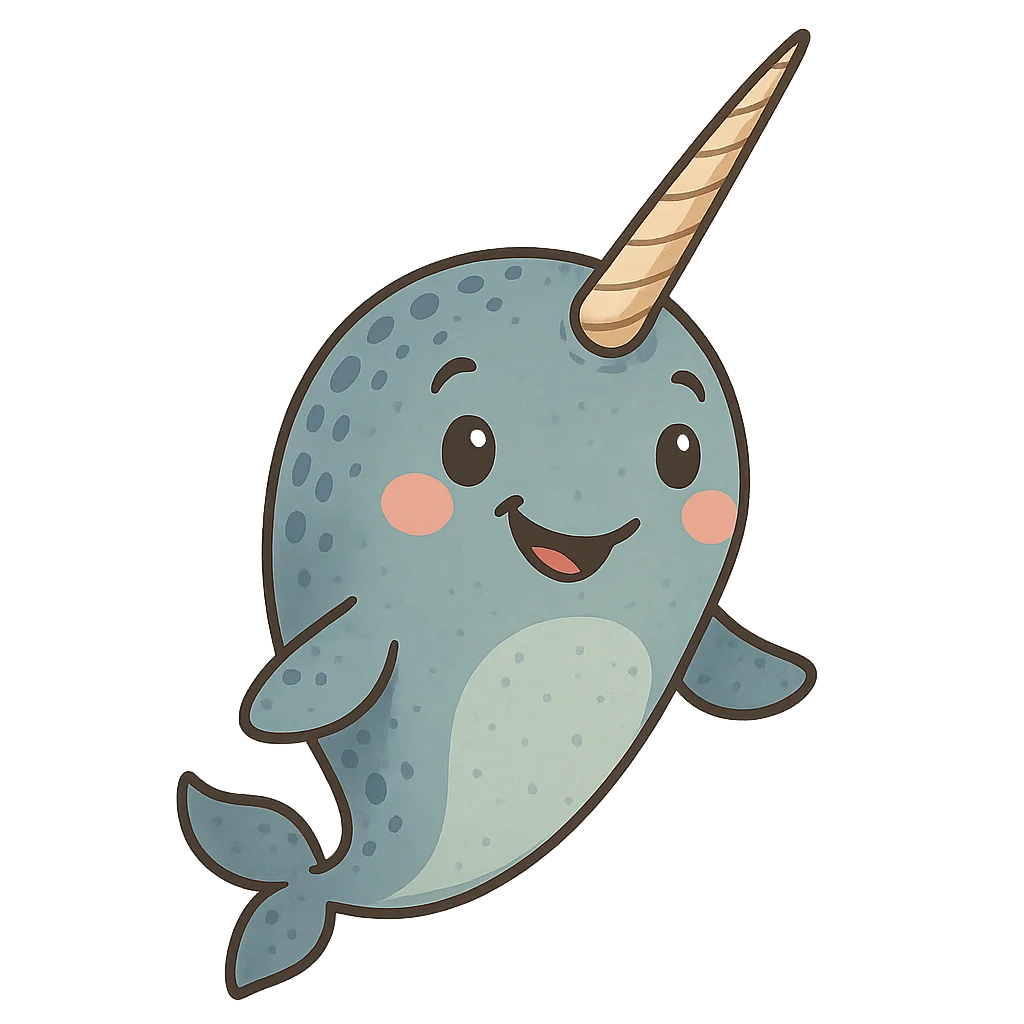
The Unicorn of the Sea
Hello, I am a narwhal, and for centuries, humans have called me the 'unicorn of the sea.' My story begins in the vast, icy waters of the Arctic, a breathtaking world of shifting ice and deep blue that I have called home since the day I was born. My scientific name is Monodon monoceros, which is a fancy way of saying 'one-tooth, one-horn,' a name that hints at my most famous feature. Imagine a world where the water is so cold it can freeze solid, and the sun disappears for months at a time. This is my home, a challenging but beautiful environment that has shaped every part of my existence. I spend my days navigating through a maze of ice floes, my life dictated by the rhythm of the freezing and thawing sea. This incredible, frigid world is all I have ever known, and my body is perfectly adapted to thrive at the top of the world.
My most distinguishing feature, the one that earned me my mythical nickname, is my long, spiraling tusk. For a long time, its purpose was a great mystery. It isn't a horn at all, but a very long canine tooth that grows right through my upper lip. In some of us males, this tooth can grow to be an astonishing 10 feet long. For centuries, humans didn't understand what it was for. They thought it was a weapon or perhaps just for show. But then, in 2014, scientists published further evidence confirming the narwhal's tusk functions as a sensory organ, building upon initial discoveries made in 2005. They learned that my tusk is actually a highly advanced sensory organ. It is filled with millions of tiny nerve endings that connect directly to my brain, allowing me to sense subtle changes in my environment. With my tusk, I can feel shifts in water temperature, pressure, and even the saltiness of the sea. This incredible sense helps me navigate the dark waters and, most importantly, find the fish I need to survive.
My entire life is guided by the sea ice. I live in the frigid Arctic waters surrounding Greenland, Canada, and Russia, and the presence of ice is crucial for my survival. The thick sheets of ice provide a perfect ceiling to hide under, protecting me from predators like orcas who hunt in the open water. The cracks and openings in the ice are also my lifeline, giving me places to surface and breathe as I travel. Every year, I undertake a long migration, a journey that my ancestors have been making for thousands of years. I follow the edge of the sea ice, moving into deeper waters as it freezes over in the winter and returning to coastal areas as it melts in the summer. This constant movement is not just a habit; it is a necessary rhythm of life that ensures I am always near the resources I need and the protection the ice provides.
I am one of the deepest diving marine mammals on the planet. My search for food often takes me on incredible journeys down into the midnight zone of the ocean, an area so deep that sunlight cannot reach it. I can plunge more than a mile below the surface, into a world of immense pressure and complete darkness. To navigate and hunt in such an environment, I rely on a special ability called echolocation. I send out a series of clicking sounds that travel through the water. When these clicks hit an object, like a fish or the seafloor, they bounce back as echoes. By listening to these echoes, I can create a detailed mental map of my surroundings. This allows me to find my favorite foods, such as Greenland halibut, cod, and squid, which thrive in the cold, dark abyss where few other predators can reach them.
I am a very social creature, and I rarely travel alone. I live with my family in groups called pods, which can range from a few individuals to more than twenty. Within our pods, we have a complex way of communicating. We use a language of clicks, whistles, and pulsed sounds to stay in touch with one another, share information about food, and warn each other of danger. This constant communication strengthens our family bonds and helps us work together. During our long annual migrations, something truly spectacular happens. Our smaller family pods join with others, and we form enormous groups called 'superpods.' These gatherings can include hundreds or even thousands of narwhals, all traveling together through the Arctic seas. It is an amazing sight, a vast community moving as one through the icy waters.
My story has been connected to humans for a very long time. The Inuit people of the Arctic have known and respected my kind for centuries, understanding our place in this environment. My tusk, however, led to legends far from my home. Around the 1100s, during the Middle Ages, Vikings who traveled to my waters brought my tusks back to Europe. They claimed the tusks were from unicorns, and they became incredibly valuable. Today, the connection is different, and I face new challenges. Since the late 20th century, the world's climate has been warming, causing the sea ice I depend on to melt at an alarming rate. This loss of my habitat makes it harder to hide from predators and find food. At the same time, increasing noise from shipping traffic disrupts my ability to communicate and navigate using sound. Because of these serious threats, scientists officially listed the narwhal as 'Least Concern' in 2017, a warning that my future is uncertain.
My Arctic Legacy
As a narwhal, I am more than just a mysterious creature with a tusk. I am a key part of the Arctic ecosystem, a top predator that helps maintain the balance of life in the deep sea. My health and survival are an important indicator of the health of the entire Arctic. When my pod and I are thriving, it means the waters are healthy and the ice is stable. My story is a reminder of how deeply connected everything is at the top of the world. Protecting my icy home is not just about saving the 'unicorn of the sea'; it is about preserving the health of our entire planet, as the Arctic plays a vital role in regulating the global climate.
Activities
Take a Quiz
Test what you learned with a fun quiz!
Get creative with colors!
Print a coloring book page of this topic.