English
 For Schools
 For Homeschool

My Life as a Triceratops
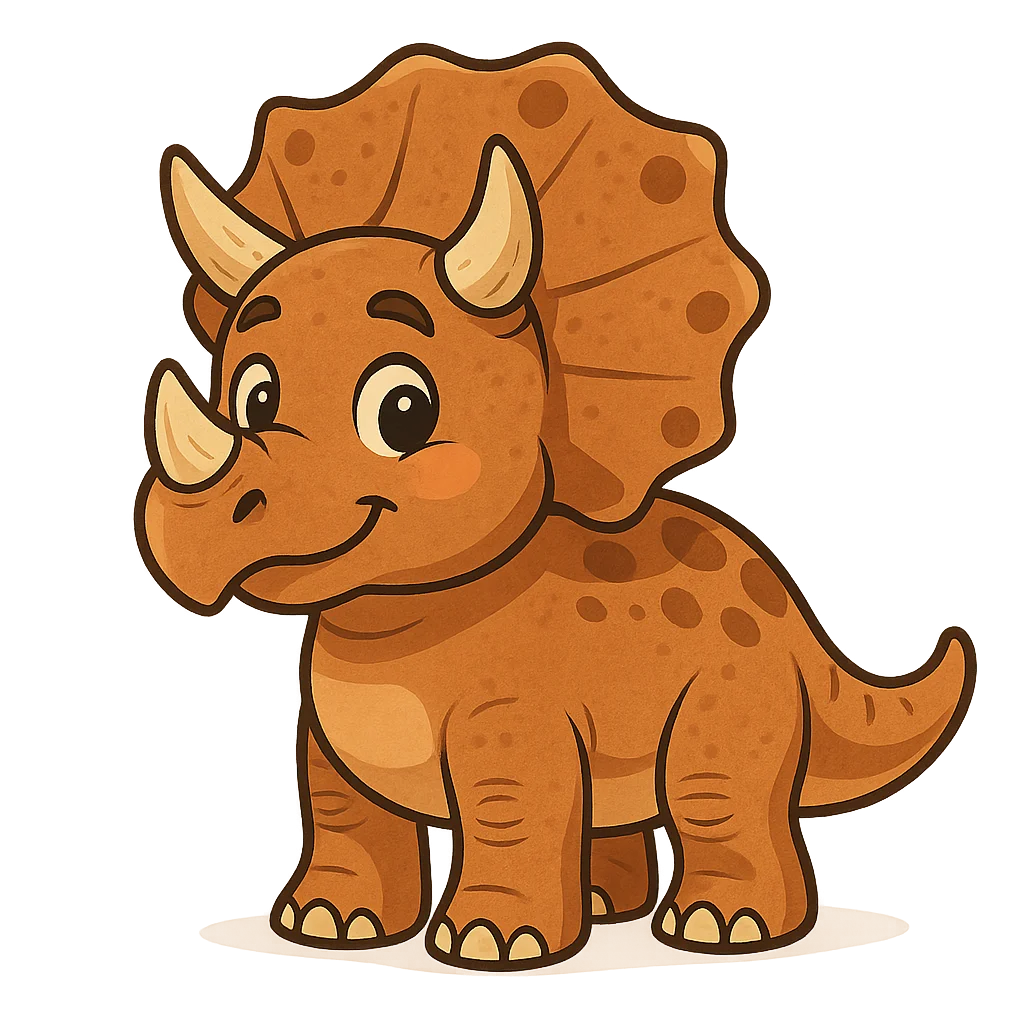
Hello, I am a Triceratops. My story begins a very long time ago, around 68 million years ago, when I hatched from my egg in a warm, lush world. The place I called home is now known as North America, and it was filled with giant ferns and towering trees. I was part of a large family herd, and as a small hatchling, I stayed very close to my mother. I didn't look very impressive back then. My famous horns hadn't grown in yet, just little bumps on my face. In fact, my name, Triceratops, means 'three-horned face,' but it would take me many years to grow into it. My skin was thick and bumpy, and I was small enough to hide behind my mother’s giant legs, peering out at a world full of giants just like us.
As the years went by, I grew and grew. My body became as large and heavy as a big truck, and my little bumps sprouted into three mighty horns. My longest horns grew above my eyes, and a shorter one grew on my nose. Behind my head, a magnificent, solid shield of bone called a frill grew wide and strong. This frill wasn't just for show; it was very important for my survival. It protected my neck from predators, and the bright patterns on it were a signal to other Triceratops in my herd. It helped us communicate and recognize each other. My life was spent as an herbivore, which means I only ate plants. I spent my days walking with my herd, using my powerful, beak-like mouth to munch on tough, low-growing plants like cycads and ferns. One day, a huge Tyrannosaurus rex appeared at the edge of the forest. It was a tense moment, but my herd knew just what to do. We gathered together, facing the predator with our sharp horns pointing forward. Seeing our powerful defense, the T. rex decided we were not an easy meal and moved on. My horns and my herd had kept me safe.
For a long time, my life was peaceful. But around 66 million years ago, the world I knew began to change. Volcanic activity, including the Deccan Traps eruptions, occurred around the time of the Cretaceous–Paleogene extinction, potentially impacting global environments. The air often filled with strange, sharp smells. It became harder to find the plants I loved to eat; they started to become scarce. The biggest change was in the sky. It began to grow dark as ash and dust from the volcanic eruptions filled the air, blocking out the warm sunlight. The world became cooler and dimmer primarily due to the Chicxulub asteroid impact, though volcanic eruptions may have also contributed. This was a difficult and confusing time for my herd and all the other dinosaurs. We had to travel farther and farther to find food, and the world no longer felt as safe and predictable as the one I had been born into.
My time on Earth, along with all the other dinosaurs, eventually came to an end. I lived in the Late Cretaceous Period. Millions of years passed, and the world changed completely. Then, in the year 1887, people found the first parts of a dinosaur like me. A scientist named Othniel Charles Marsh was the one who officially gave us our name, Triceratops, in 1889. Today, my giant bones are treasures that you can see in museums all over the world. They tell the story of an ancient world ruled by incredible creatures. I am remembered as one of the last great dinosaurs, a powerful plant-eater that stood its ground. My story helps you understand the incredible history of our planet and the amazing life that came before.
Activities
Take a Quiz
Test what you learned with a fun quiz!
Get creative with colors!
Print a coloring book page of this topic.