English
 For Schools
 For Homeschool

My Story: A White Rhinoceros's Journey
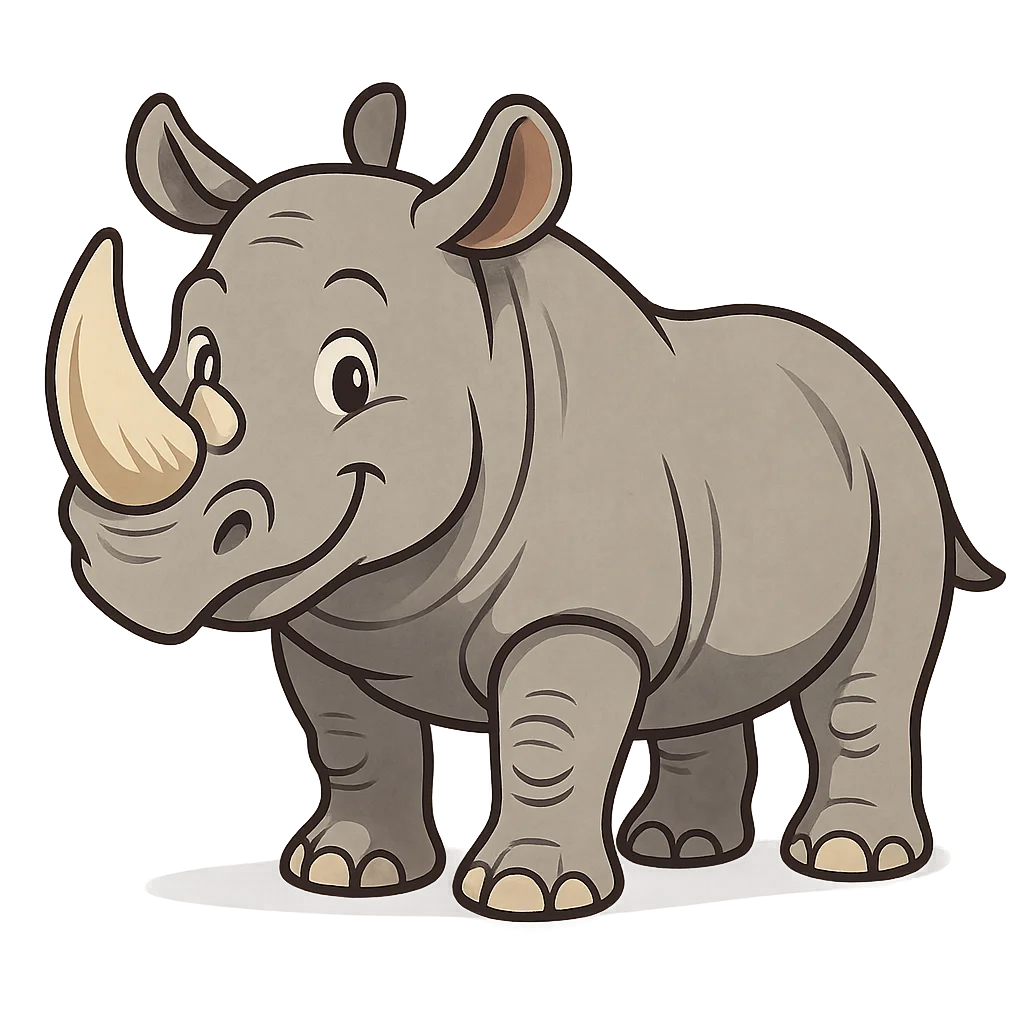
Hello. I am a White Rhinoceros, and my story is one of survival, stretching across the vast, grassy savannas of Africa. Standing as one of the largest land animals on Earth, you might think my name comes from my color, but that's not quite right. It's a misunderstanding that began long ago. The exact origin of the name 'White Rhinoceros' is uncertain, and the 'wijd' theory lacks definitive evidence. It perfectly describes my square, wide lips, which are specially designed for grazing. In 1817, a naturalist named William John Burchell was the first person to formally describe my kind to the wider scientific world, helping people understand our unique place in nature. My home is a world of open plains under a wide sky, where my thick, grey skin protects me like a suit of armor. On my face, I proudly wear two horns, a defining feature of my species and a tool that has shaped my destiny.
My days on the savanna follow a simple and important rhythm. I am a grazer, and my life is dedicated to eating grass. Using my wide, flat lips like a natural lawnmower, I trim the grasslands, keeping them short and healthy. This isn't just for me; my constant mowing helps smaller animals thrive by maintaining the open spaces they need to find food and watch for predators. My work shapes the very landscape I call home. When the African sun beats down, my favorite activity is finding a cool, muddy wallow. Rolling in the thick mud is more than just fun; it's a vital part of my routine. The mud acts as a natural sunscreen and insect repellent, protecting my sensitive skin. Unlike some of my more solitary rhino cousins, I am quite social. I enjoy the company of my family, and we often live together in a group that humans call a 'crash.'
Though my life is peaceful now, my family has faced a dark and difficult past. During the late 1800s, my southern relatives were hunted relentlessly. Our numbers plummeted at an alarming rate, and it seemed as though we would vanish from the Earth forever. The situation became desperate. By the year 1895, a tragically small number of us remained—fewer than 100 in the entire world. Our entire surviving population was confined to a single sanctuary, a protected area in South Africa known as the Hluhluwe-iMfolozi Park. It was there, in that one small corner of the world, that the hope for our future rested.
From that point of near-extinction, a remarkable story of hope began to unfold. In the 1960s, a massive conservation effort called 'Operation Rhino' was launched. It was an ambitious plan created by dedicated people who refused to let us disappear. Their mission was to carefully and safely move some of us from our last refuge in Hluhluwe-iMfolozi Park to other protected parks and reserves. This incredible project transported us across Africa and even to other parts of the world, establishing new, safe populations. Operation Rhino was a monumental success. Thanks to this effort, our southern family made an amazing comeback. Our numbers grew from fewer than 100 to many thousands, a powerful testament to what is possible when humans decide to protect nature.
While my southern family was part of this story of recovery, my northern cousins were not as fortunate. Their journey was much harder. Their homelands were often affected by human conflict, and they faced severe poaching that pushed them to the brink. Their story reached a heartbreaking moment on March 19th, 2018. On that day, the very last male Northern White Rhino, a gentle giant named Sudan, passed away peacefully. His death left only two females of his kind remaining on the entire planet. The future of the Northern White Rhino now depends entirely on groundbreaking science and the continued help of caring people around the world.
As a keystone species, my presence on the savanna is crucial for the health of the entire ecosystem. I shape the land just by living my life. It's strange to think that my horn, which has caused so much danger for my kind, is made of keratin—the very same material as your fingernails. Poaching for our horns remains the single biggest threat to our survival. Yet, the story of my southern family proves that it is never too late. Our comeback from the edge of extinction shows that conservation efforts can work wonders. My hope is that our story inspires people to act, ensuring that White Rhinos can continue to roam the savannas for all the generations to come.
Activities
Take a Quiz
Test what you learned with a fun quiz!
Get creative with colors!
Print a coloring book page of this topic.