

 English

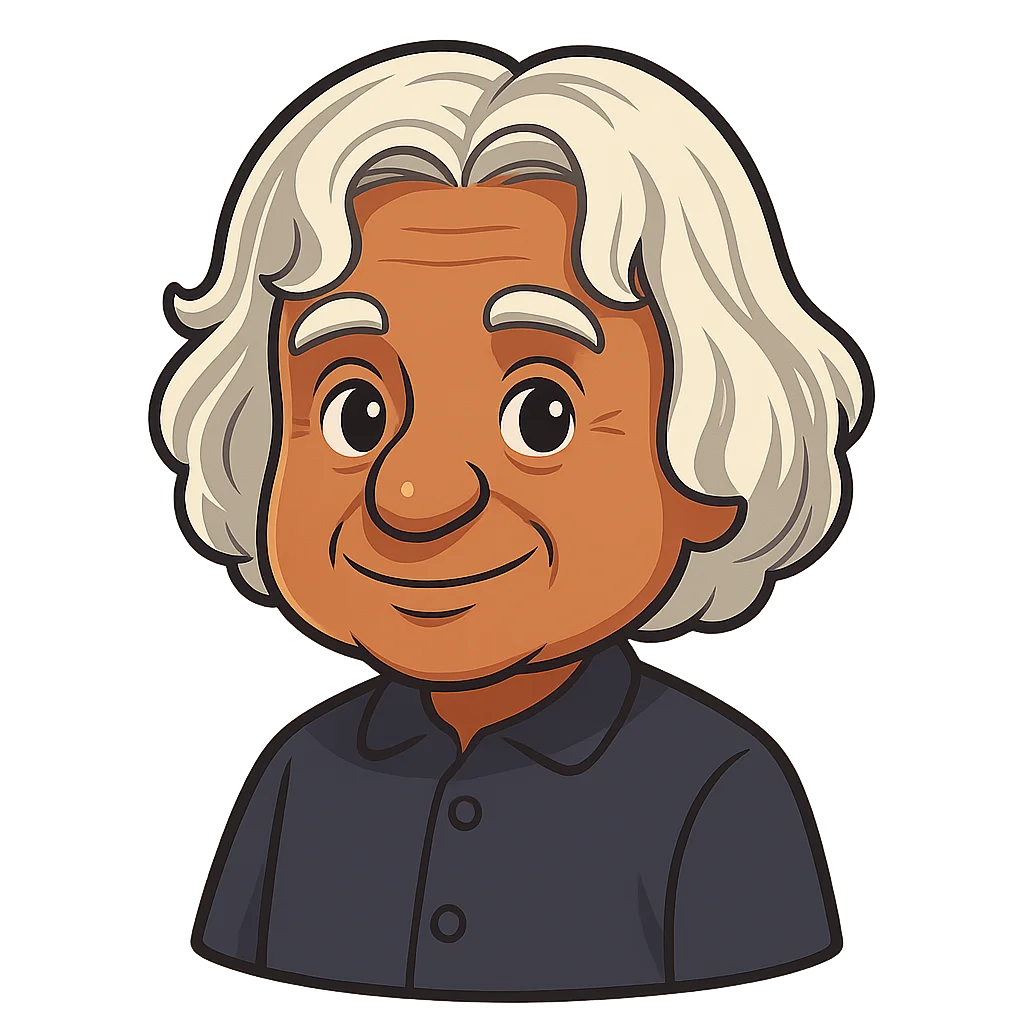
A. P. J. Abdul Kalam
Hello, my name is Avul Pakir Jainulabdeen Abdul Kalam, but you can call me A. P. J. Abdul Kalam. My story begins on October 15th, 1931, in a small island town called Rameswaram, off the coast of southern India. Life was simple, but full of love and learning. My father was a boat owner and an imam at our local mosque, and he taught me the value of honesty and discipline. My mother was a kind woman who taught me to have faith in goodness. Though we did not have much money, our home was rich in spirit. I remember spending hours watching the birds soar and glide over the sea. Their graceful flight fascinated me and planted a seed in my mind—a dream of one day flying in the sky. To help my family and pay for my school fees, I took up a job delivering newspapers every morning. Waking up before dawn was tough, but throwing those papers taught me responsibility and gave me my first earnings. It was a small job, but it made me feel proud and connected me to the world beyond my little island.
That childhood dream of flying followed me as I grew older. I was deeply curious about how things worked, especially how anything could fly. I loved physics, and I knew I wanted to study the science of flight. This passion led me to the Madras Institute of Technology, where I pursued aerospace engineering. My ultimate goal was to become a fighter pilot in the Indian Air Force. I studied harder than ever before and poured all my energy into my exams. When the results came, I was heartbroken. I had placed ninth in the selection, but there were only eight positions available. I had missed my dream by the narrowest of margins. For a moment, I felt lost. But as one door closed, another opened. This setback guided me toward a different path. I first joined the Defence Research and Development Organisation, or DRDO. Later, a truly great opportunity came when I moved to the Indian Space Research Organisation (ISRO). There, I had the privilege of working with the visionary scientist Vikram Sarabhai, who became a great mentor to me.
At ISRO, I was given a challenge that would define my career. I was appointed the project director for India's very first Satellite Launch Vehicle, known as SLV-III. Our mission was to design and build a rocket that could place a satellite into orbit around the Earth. It was a monumental task. Our team faced countless problems and setbacks. Our first launch attempt in 1979 ended in failure, and the rocket crashed into the sea just minutes after takeoff. It was a devastating moment, but we refused to give up. We learned from our mistakes, worked tirelessly, and a year later, on July 18th, 1980, we tried again. This time, we succeeded. Watching SLV-III soar into the sky and successfully place the Rohini satellite into orbit was one of the proudest moments of my life. This success paved the way for my work on India's missile development program. I led projects to develop powerful missiles, which earned me the nickname 'The Missile Man of India.' Later, in 1998, I played a key role in the Pokhran-II nuclear tests. These achievements were not about power, but about making my country strong, secure, and self-reliant.
In 2002, my life took another unexpected turn. I was elected to become the 11th President of India, a position I held from July 25th, 2002, until July 25th, 2007. I never imagined that a boy from a small island town could hold the highest office in the country. I didn't want to be a president who was distant from the people. Instead, I wanted to be the 'People's President.' I opened the grand presidential palace to the public, especially to children. My greatest joy was traveling across the nation and speaking with students. I saw so much potential in their bright eyes and curious minds. I encouraged them to dream big, to read books, and to believe in the power of their ideas. My vision was for India to transform into a developed nation by the year 2020, and I knew that the youth of India were the ones who would make this dream a reality. I urged them to aim high and work with dedication to build a better future for our country.
My journey on this Earth came to an end on July 27th, 2015. I was 83 years old and doing what I loved most—delivering a lecture to students at the Indian Institute of Management in Shillong. I collapsed while speaking, and my life concluded in a room full of young, aspiring minds. My story is a testament to the power of dreams. It shows that your circumstances at birth do not define your future. Never be afraid of failure; it is simply the first attempt at learning. With hard work, perseverance, and an unwavering belief in your goals, you can overcome any obstacle and reach for the stars. Keep learning, keep dreaming, and never stop trying to make the world a better place.
Activities
Take a Quiz
Test what you learned with a fun quiz!
Get creative with colors!
Print a coloring book page of this topic.















 Free for Educators