

 English
 Continue with Google
 Continue with Apple

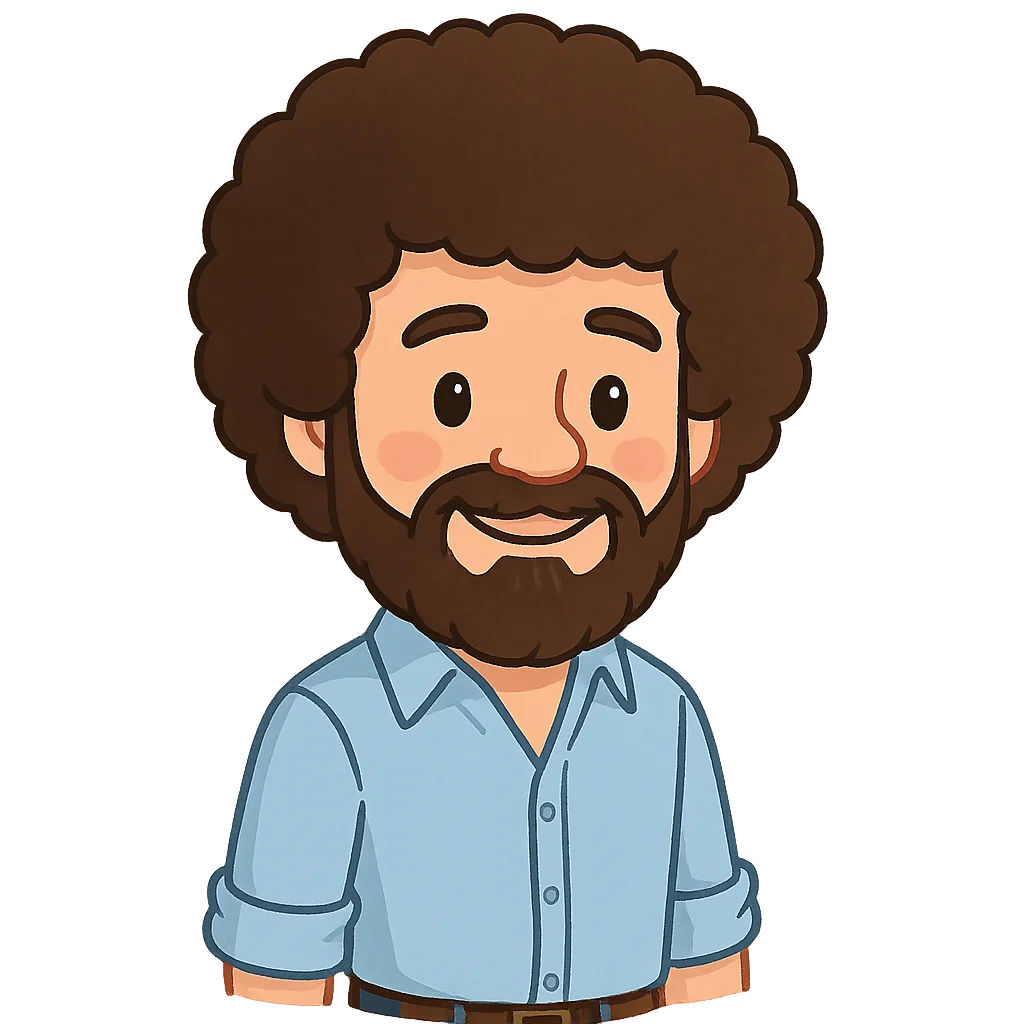
Bob Ross: Painting Happy Little Worlds
Hello there, my friend. My name is Bob Ross, and I’m so glad you’re here. I believe everyone has a little artist inside them, just waiting to create. For many years, people knew me as the soft-spoken painter with the big hair on the television show 'The Joy of Painting.' But my story started long before that, in a sunny little corner of the world. I was born on October 29th, 1942, in Daytona Beach, Florida. Growing up, the world outside my window was my greatest teacher. I didn’t have a lot of toys, but I had something much better: nature. I spent my days exploring the woods and wetlands, and I developed a deep love for animals. I was always bringing home little creatures that needed help, like injured squirrels, alligators, or snakes. My mother was a kind soul and always let me care for them in our home. This gentleness toward the world’s creatures was a part of me from the very beginning. When I turned 18 years old in 1961, I decided to join the United States Air Force. It was a big change for a quiet boy from Florida. My job took me far from home, and over the years, I worked my way up to the rank of Master Sergeant. Part of my duty was to be the person who gave orders and made sure things were done right and on time. I had to be tough and loud, which was the complete opposite of who I felt I was on the inside. For twenty years, I was the guy who made you scrub the latrines, the guy who made you make your bed, the guy who screamed at you for being late to work. I promised myself that if I ever left the military, I would never raise my voice again.
My life took another turn when the Air Force stationed me at Eielson Air Force Base in Alaska. I had never seen anything like it. Florida was flat and warm, but Alaska was a world of majestic, snow-capped mountains that seemed to touch the sky. There were vast forests filled with enormous evergreen trees, their branches heavy with snow. The air was crisp and cold, and there was a deep, powerful silence that I had never experienced before. That quiet landscape spoke to my soul. During my short lunch breaks, I would sit inside my car and look out at the incredible scenery, trying to memorize every detail. I felt an overwhelming urge to capture that beauty so I could keep it forever. It was then that I truly began my journey as a painter. I didn't have much time, so I needed a technique that was fast. One day, I saw a painter named Bill Alexander on television. He used a 19th-century painting style called 'wet-on-wet,' or alla prima, which means 'first attempt' in Italian. With this method, you could apply layers of wet paint on top of each other without waiting for them to dry. It allowed him to complete an entire, beautiful landscape in about thirty minutes. I was mesmerized. I thought, 'I can do that.' I studied his technique and practiced every chance I got. Alaska became my studio, and the mountains and trees became my favorite subjects. Painting was my escape from the demanding life of a sergeant. It was my quiet place, my world of peace.
After serving for twenty years, I retired from the Air Force in 1981. I kept the promise I had made to myself all those years ago: I never shouted again. I knew I wanted to share the peace I found in painting with others, so I started teaching art classes. At first, my business struggled. I would travel around the country in a motorhome, teaching classes wherever I could, sometimes in the back of a store or at a local fair. It was during this time that I met a wonderful woman named Annette Kowalski, who had taken one of my classes. She and her husband, Walt, believed in my gentle teaching style and saw something special in what I was doing. They encouraged me to bring my lessons to television so I could reach more people. Together, we created 'The Joy of Painting,' which first aired on January 11th, 1983. My goal for the show was simple. I wanted to create a relaxing half-hour where anyone, even someone who had never picked up a brush, could feel empowered to create. I taught that there are no mistakes in art, only 'happy accidents.' A smudge could become a cloud, and an unplanned streak of color could become a beautiful reflection in the water. I wanted everyone watching to know that they had the power to create their own world on the canvas. I used simple tools and a limited palette of colors to show that you didn’t need expensive supplies to make something beautiful. I spoke in a calm, soothing voice, and I filled my world with 'happy little trees' and 'almighty mountains' because that's how I saw them. The show was never about me being a great artist; it was about you discovering the great artist inside yourself.
'The Joy of Painting' ran for more than a decade, and I was blessed to connect with millions of people all over the world. We created thousands of paintings together, but more importantly, we built a community of creators who weren't afraid to try something new. In the early 1990s, I was diagnosed with an illness called lymphoma, and I had to focus on my health. Even during that difficult time, painting remained my peaceful escape. My life came to a quiet end on July 4th, 1995, but I believe my work is far from over. My real legacy isn't the pile of canvases I left behind; it's the feeling of confidence and joy that I hope I sparked in you. It's the belief that you can do anything you set your mind to. So, the next time you see a beautiful cloud or a majestic mountain, remember that you have the power to create that world. The real masterpiece isn't on the canvas; it's the belief you find in yourself. I wish you happy painting, and God bless, my friend.
Reading Comprehension Questions
Click to see answer