

 English

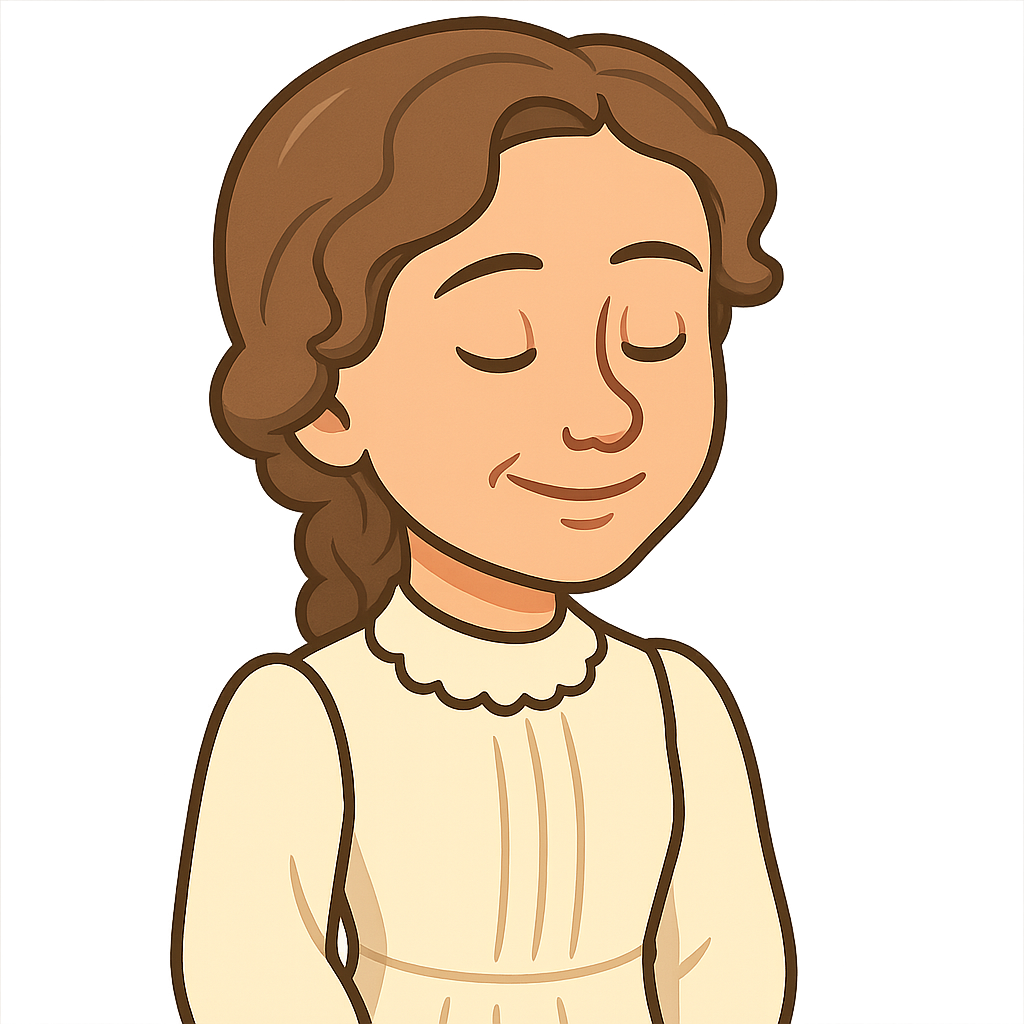
Helen Keller
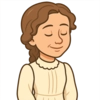
Hello, my name is Helen Keller, and I want to tell you the story of my life. My journey began in a small, sunny town called Tuscumbia, Alabama, where I was born on June 27th, 1880. For the first nineteen months of my life, the world was full of light and sound. I saw the green leaves on the trees and heard my mother’s gentle voice. But in February of 1882, a sudden illness, which doctors called 'acute congestion of the stomach and brain,' swept through my small body. When the fever finally broke, my family rejoiced, but their joy soon turned to sorrow. The illness had taken my sight and my hearing, plunging me into a silent, dark world. I was trapped. Imagine not being able to see the faces of your loved ones or hear them call your name. I couldn’t understand what was happening around me, and I couldn't tell anyone what I wanted or how I felt. This deep frustration grew inside me, and I often burst into fits of rage, kicking and screaming. My family didn’t know how to reach me, and they called me a 'wild little creature.' I was desperately lonely, a ghost in my own home. My parents, Arthur and Kate, were heartbroken but refused to give up. They traveled to doctors and experts, searching for a ray of hope, for someone who could unlock the door to my dark prison.
That ray of hope arrived at my home on March 3rd, 1887. Her name was Anne Sullivan, and she would become my teacher, my companion, and my lifelong friend. Anne was not much older than a child herself, only twenty years old, and she too knew about darkness, having partially lost her own sight. She was patient but also incredibly determined. At first, I resisted her completely. I was a stubborn child, and I did not understand the strange finger games she played in my hand. We battled for weeks, a clash of two strong wills. She tried to teach me that things had names by spelling them into my palm. She spelled d-o-l-l for the new doll she brought me, but I didn't understand the connection and, in a fit of anger, I smashed it. Then came the day that changed everything. We were at the old water pump in the yard. Anne placed one of my hands under the cool, rushing stream of water. In my other hand, she spelled the word 'w-a-t-e-r,' first slowly, then quickly. Suddenly, a jolt of understanding shot through me. The cool sensation on my hand was this word, water. In that instant, the mystery of language was revealed to me. I finally understood that everything had a name. I was so excited that I touched the ground and demanded its name, then the pump, then my teacher. By the end of the day, I had learned thirty new words. A new, vibrant world opened up, and a fire was lit inside me—a burning hunger for knowledge that would last my entire life.
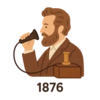
With language as my key, I was ready to unlock the world. My first great adventure in learning was reading. Anne taught me to read Braille, a system of raised dots that I could feel with my fingertips. Suddenly, I could read books all by myself. The thoughts and stories of people from all over the world were finally open to me, and I read everything I could get my hands on. I attended the Perkins School for the Blind in Boston, where for the first time, I was surrounded by other children who understood my world. But my ambition grew larger; I dreamed of attending college just like any other young woman. In the year 1900, with enormous effort, I was accepted into Radcliffe College, the sister school to the all-male Harvard University. The challenge was immense. I couldn't read the textbooks fast enough or take notes in class. Anne sat beside me in every lecture, tirelessly spelling every word the professors said into my hand. It was an exhausting process, but we did it together. Around this time, I also became determined to learn how to speak. I wanted people to hear my thoughts from my own voice. It was a long and difficult struggle, and my speech was never perfect, but I never gave up. Throughout this journey, I had the support of incredible friends, including the inventor of the telephone, Alexander Graham Bell, who had encouraged my parents to find Anne and always believed in my potential.
After I graduated from Radcliffe in 1904, I knew my education was not just for my own benefit. I had been given a chance to escape my silent prison, and I felt a deep responsibility to help others find their own way out of darkness. I had fought so hard to find my voice, and now I was determined to use it. I began to write about my experiences, and in 1903, my autobiography, 'The Story of my Life,' was published. It showed the world what a person with disabilities could achieve. I also became a public speaker. With Anne or my later companion, Polly Thomson, by my side to interpret, I traveled all across the United States and to over thirty-five countries around the world. I spoke not only about rights for the blind and deaf but for all people who were treated unfairly. I became a passionate advocate for women's right to vote, for racial equality, and for workers' rights. I even helped found the American Civil Liberties Union (ACLU) in 1920 to defend the rights of all citizens. My life was long and full, a journey I never could have imagined as that frustrated little girl at the water pump. I lived until June 1st, 1968, passing away peacefully in my sleep. My story is not just about overcoming blindness and deafness; it is about proving that every person has a voice that deserves to be heard and that the human spirit can triumph over any obstacle.
Activities
Take a Quiz
Test what you learned with a fun quiz!
Get creative with colors!
Print a coloring book page of this topic.










 Free for Educators