English


The Telephone
The telephone is a communication device that converts sound, specifically the human voice…
Reads at Grades 3–5 Listens at Grades 1–5
Print & create
Answer keys·No prep·Free with an account
28 worksheets · answer keys · full story · quiz · Ages 8-10 · CEFR B1
Plus adds 244,000+ more stories in 27 languages, audio for every one, and printables for all of them.
Just want The Telephone?

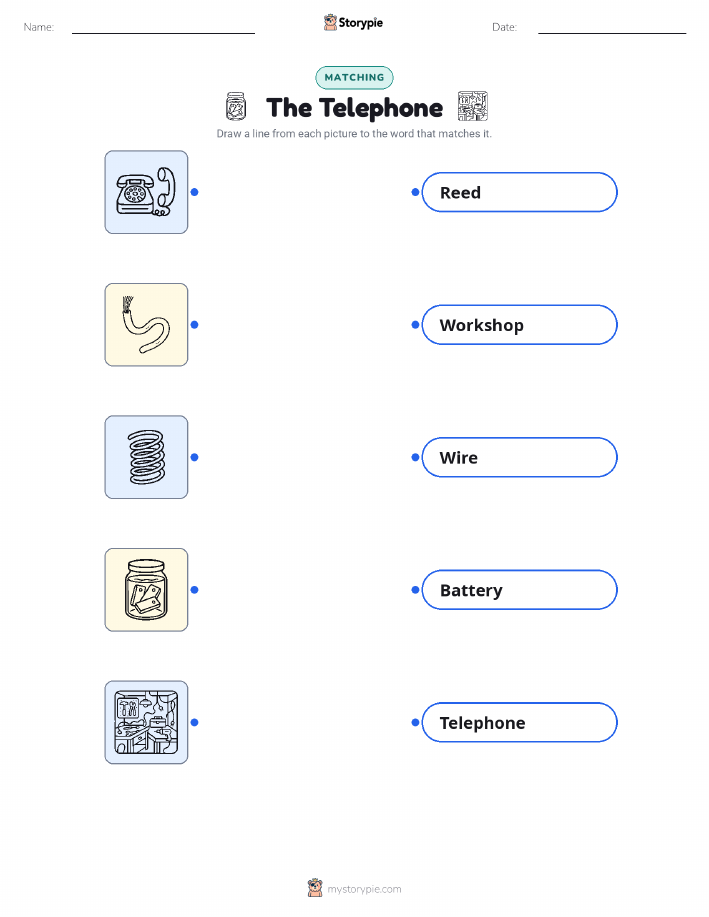
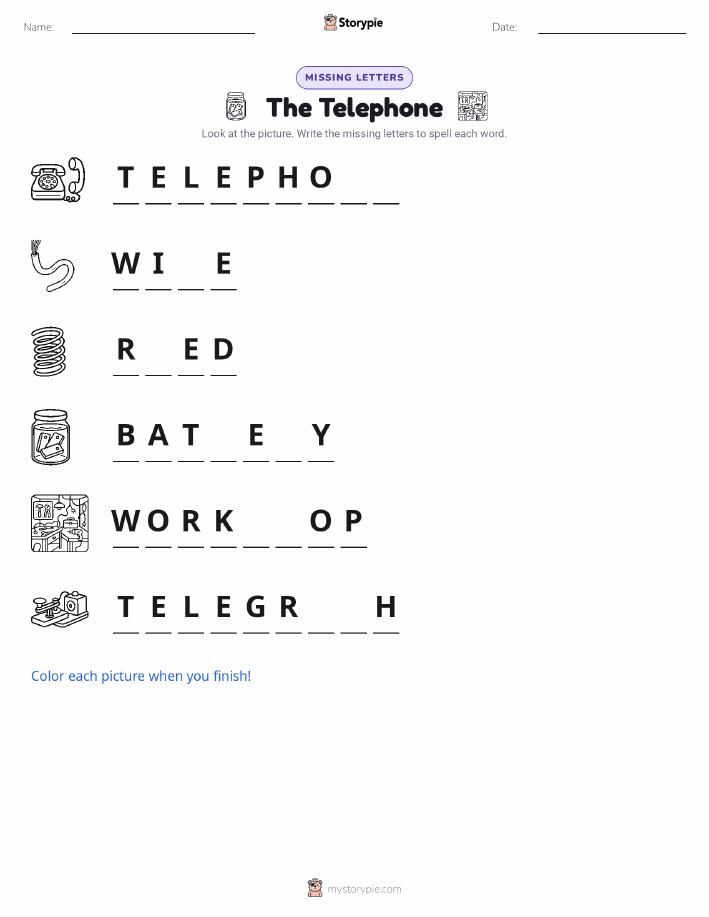
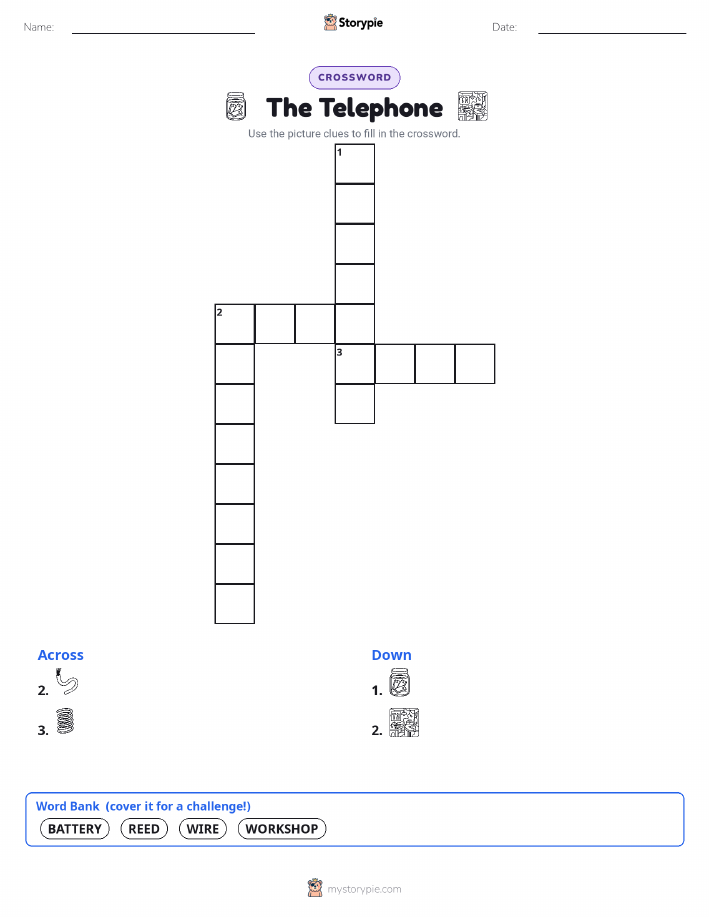
Hello there. My name is Alexander Graham Bell, but you can call me Aleck. Ever since I was a boy, I have been utterly fascinated by sound. Not just music or talking, but all sounds. The chirping of a bird, the whistle of a train, the rustle of leaves in the wind. Can you imagine a world where the only way to talk to someone far away was to write a letter that might take weeks to arrive? Or to send a message using a telegraph, which could only send clicks and beeps—dots and dashes—that had to be translated? That was the world I grew up in. It was a much quieter world, in a way. My mother was hard of hearing, and I spent my life teaching students who were deaf. This work was very important to me. I spent hours studying the human ear, a marvelous and intricate device. I wondered, if the ear could turn vibrations into sounds in our brain, could I create a machine that did something similar? In my busy Boston workshop, surrounded by wires and batteries, I dreamed of making a 'talking wire' that could carry a human voice from one place to another, just like magic.
My first idea wasn't actually for a telephone. I was trying to invent something called a 'harmonic telegraph.' The idea was to send many telegraph messages over a single wire at the same time, each with a different musical pitch, like notes in a chord. To help me with my experiments, I hired a brilliant young man named Thomas Watson. Mr. Watson was a wizard with machines and could build anything I could imagine. Our workshop was a jungle of coiled wires, strange-looking metal reeds, and bubbling jars of battery acid. It was often messy, but it was a place of endless possibility. We worked for months, trying to get our harmonic telegraph to work just right. We would be in separate rooms, with me at the transmitter and Mr. Watson at the receiver, shouting back and forth through the walls when something went wrong, which it often did. Then, on a hot afternoon in June of 1875, something amazing happened. It was a complete accident. Mr. Watson was in the other room, trying to free a metal reed on his machine that had gotten stuck. He plucked it to get it loose. In my room, I was holding my receiver to my ear, and suddenly I heard it. It wasn’t a click or a beep. It was a clear, musical *twang*. It was the sound of the reed vibrating. Can you believe it? My heart leaped into my throat. That sound was more than just a musical note; it was a complex sound, just like the ones that make up a human voice. In that single moment, I knew. I knew we could send more than just tones. We could send speech. We could make the wire talk. I raced into the other room, so excited I could barely speak. 'Watson, don't change a thing.' I yelled. 'You have just given me the key.'.
The Talking Wire: My Story of the Telephone
Hello there. My name is Alexander Graham Bell, but you can call me Aleck. Ever since I was a boy, I have been utterly fascinated by sound. Not just music or talking, but all sounds. The chirping of a bird, the whistle of a train, the rustle of leaves in the wind. Can you imagine a world where the only way to talk to someone far away was to write a letter that might take weeks to arrive? Or to send a message using a telegraph, which could only send clicks and beeps—dots and dashes—that had to be translated? That was the world I grew up in. It was a much quieter world, in a way. My mother was hard of hearing, and I spent my life teaching students who were deaf. This work was very important to me. I spent hours studying the human ear, a marvelous and intricate device. I wondered, if the ear could turn vibrations into sounds in our brain, could I create a machine that did something similar? In my busy Boston workshop, surrounded by wires and batteries, I dreamed of making a 'talking wire' that could carry a human voice from one place to another, just like magic.
My first idea wasn't actually for a telephone. I was trying to invent something called a 'harmonic telegraph.' The idea was to send many telegraph messages over a single wire at the same time, each with a different musical pitch, like notes in a chord. To help me with my experiments, I hired a brilliant young man named Thomas Watson. Mr. Watson was a wizard with machines and could build anything I could imagine. Our workshop was a jungle of coiled wires, strange-looking metal reeds, and bubbling jars of battery acid. It was often messy, but it was a place of endless possibility. We worked for months, trying to get our harmonic telegraph to work just right. We would be in separate rooms, with me at the transmitter and Mr. Watson at the receiver, shouting back and forth through the walls when something went wrong, which it often did. Then, on a hot afternoon in June of 1875, something amazing happened. It was a complete accident. Mr. Watson was in the other room, trying to free a metal reed on his machine that had gotten stuck. He plucked it to get it loose. In my room, I was holding my receiver to my ear, and suddenly I heard it. It wasn’t a click or a beep. It was a clear, musical twang. It was the sound of the reed vibrating. Can you believe it? My heart leaped into my throat. That sound was more than just a musical note; it was a complex sound, just like the ones that make up a human voice. In that single moment, I knew. I knew we could send more than just tones. We could send speech. We could make the wire talk. I raced into the other room, so excited I could barely speak. 'Watson, don't change a thing.' I yelled. 'You have just given me the key.'.
We worked tirelessly for months after that magical 'twang.' We built a new transmitter, one that had a small cone you could speak into, and a receiver to listen with. Finally, the big day arrived: March 10, 1876. Mr. Watson and I were in our workshop, but this time, we were in separate rooms on different floors, connected only by our new invention. I was in my workroom with the transmitter, and he was downstairs with the receiver pressed to his ear, waiting. My hands were trembling with a mix of excitement and nervousness. What if it didn't work? As I was adjusting the last few wires on the transmitter, my hand slipped, and I knocked over a jar of battery acid. The stinging liquid splashed all over my clothes. Without thinking, I leaned toward the mouthpiece of my invention and shouted, 'Mr. Watson, come here. I want to see you.' I wasn't even thinking of it as an experiment anymore; I was just calling for help. A few moments later, I heard footsteps pounding up the stairs. The door burst open, and there was Mr. Watson, his face pale and his eyes wide with astonishment. 'I heard you.' he gasped, out of breath. 'I heard every word you said, as clear as day.' We both just stood there for a second, staring at each other. Then, we burst out laughing and cheering. We had done it. We had made a machine talk.
That first phone call was just the beginning. Soon, telephones began appearing in homes and offices, weaving a web of wires across the country and then the world. Suddenly, distance didn't seem so vast. A doctor could be called in an emergency without waiting for a messenger. Grandparents could hear the voices of their grandchildren who lived miles away. The world became a smaller, more connected place, all because of that talking wire. My invention was like planting a tiny seed that has now grown into a giant forest of communication. The phone I invented looks very different from the amazing devices you have today, which can send pictures, play games, and hold all the world's knowledge in your pocket. But every time you talk to a friend or family member on the phone, you are using a little piece of that same magic Mr. Watson and I discovered in our workshop so many years ago.
Wow facts
About
The telephone is a communication device that converts sound, specifically the human voice, into electronic signals that can be transmitted over distances and then converted back into sound.
Take a Quiz
Question 1 of 5
In the story, Alexander Graham Bell says his workshop was a 'jungle of coiled wires.' What does he mean by this?
Explore next






Want to do even more?
Go beyond exploring. Unlock tools that turn every story into real learning.

Storypie Plus for families
Full stories, quizzes, and printables. Nights and car rides, sorted.
- Unlimited audio stories
- Create Mode: your child stars in the story
- Offline downloads
- Printable worksheets & coloring pages

Why Storypie for Schools
Students engaged. Prep in seconds. Evenings back to you.
- Worksheets & Quizzes
- Classroom Management
- Formative Assessment
- Custom Curriculum & Lesson Plans
- 27 Languages

Why Storypie for Homeschool
Curriculum done. They'll ask for more. Hours back in your day.
- Worksheet Generator
- First-Person Audio Stories
- Built-in Comprehension Quizzes
- Custom Curriculum & Lesson Plans
- Print & Go Activities