

 English

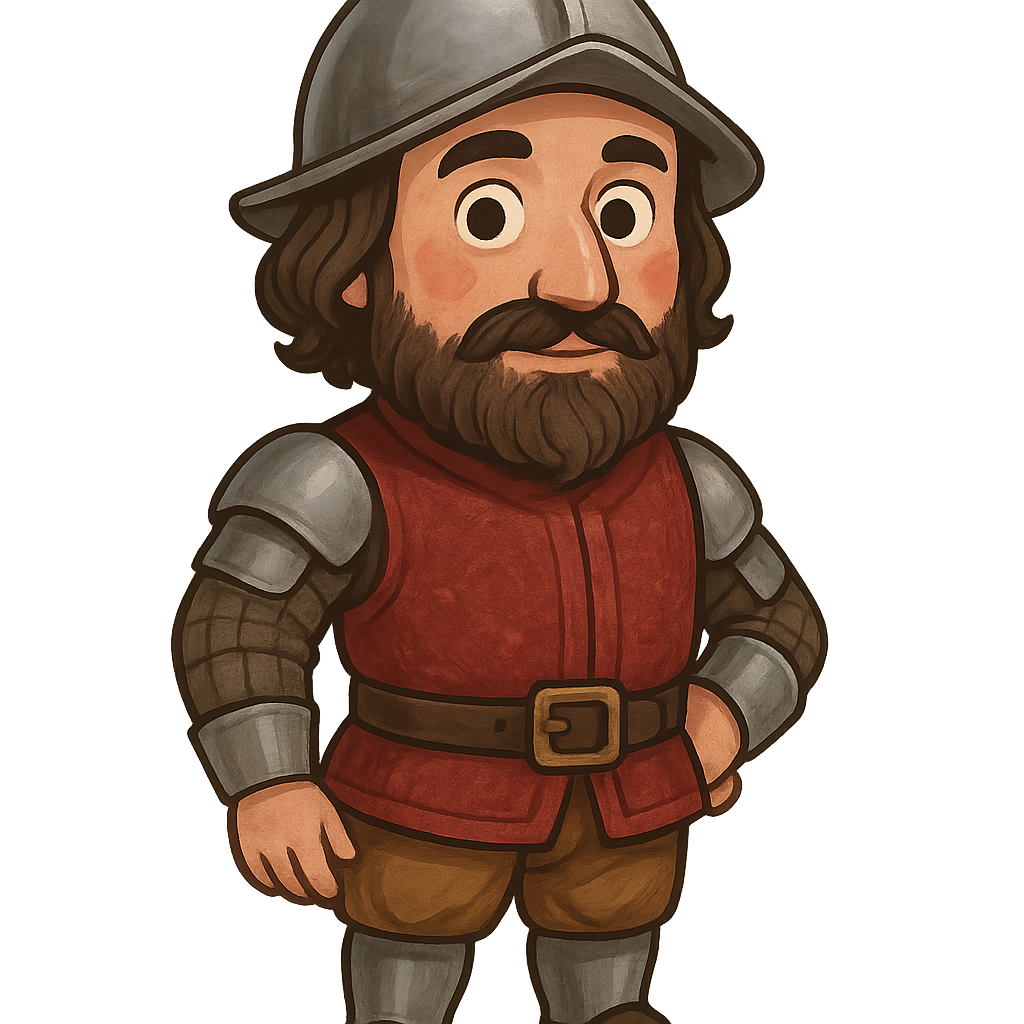
Hernán Cortés: The Conquistador of the Aztec Empire
My name is Hernán Cortés, and my story is one of ambition, exploration, and the collision of two worlds. I was born around the year 1485 in a small town called Medellín, in the kingdom of Castile, which you now know as Spain. My family was of noble blood, a fact my parents were very proud of, but we did not have much money to go with our name. They sent me to study law, hoping I would have a stable and respected career. But I found the dusty books and endless rules to be a cage for my spirit. My mind was not in the lecture halls; it was far away, across the vast Atlantic Ocean. In those days, the air was filled with electrifying stories about a 'New World,' discovered by a brave navigator named Christopher Columbus just a few years before I was born. Men were sailing west and returning with tales of incredible lands, strange peoples, and unimaginable riches. I listened to these stories with a restless heart. I knew that a quiet life as a lawyer was not my destiny. I dreamed of glory, of commanding ships and armies, and of carving out a name for myself that would be remembered for centuries. Spain felt too small for my dreams; my future, I was certain, lay across the sea.
The call of adventure was too strong to ignore. In 1504, I finally left Spain behind and boarded a ship bound for the New World. The voyage itself was an ordeal, with towering waves and the constant uncertainty of what lay ahead, but I felt more alive than ever before. I landed on the island of Hispaniola, the first major Spanish settlement, a bustling hub of activity where fortunes were made and lost. For several years, I worked as a farmer and a local official, learning the ways of this new land. In 1511, I joined an expedition to the nearby island of Cuba, led by a man named Diego Velázquez. I proved myself to be a capable and daring leader, and when Cuba was brought under Spanish control, Governor Velázquez rewarded me with land and a position of authority. For a time, I was content. I was a respected man, far wealthier than I could ever have been in Spain. But my ambition was a fire that could not be easily quenched. Whispers began to reach Cuba from the mainland to the west. They spoke of a powerful and incredibly wealthy empire, ruled by a mighty king. The stories described cities of gold and a civilization more advanced than any we had yet encountered. My imagination was set ablaze. This was the grand adventure I had been waiting for. I spent a great deal of time and my own money convincing Governor Velázquez to let me lead an expedition to explore these lands and establish trade. He finally agreed, and I began preparing my ships and recruiting men for the journey of a lifetime.
In February of 1519, my fleet of eleven ships was ready to sail. But at the very last moment, a jealous Governor Velázquez changed his mind and tried to revoke my command. He feared I was becoming too powerful. I knew this was my one chance at greatness, so I defied his orders and set sail anyway, effectively becoming a rebel. Our journey took us to the coast of what is now Mexico. It was there I met one of the most important people in my life, a clever and resourceful native woman named Malintzin. She had been sold into slavery and could speak both the language of the coastal peoples and the Nahuatl language of the powerful Aztec Empire. We called her Doña Marina, and she quickly learned Spanish as well. She was more than just an interpreter; she was my advisor, my cultural guide, and the key to understanding the complex politics of this land. Without her, my expedition would have surely failed. She helped me learn that many of the local tribes deeply resented the Aztecs, who demanded tribute and sacrifice from them. I saw an opportunity. As we marched inland, we faced fierce resistance, but we also formed crucial alliances. The most powerful of our allies were the Tlaxcalans, a proud people who had never been conquered by the Aztecs. After a series of hard-fought battles, they agreed to join me, hoping to finally defeat their old enemies. With my Spanish soldiers and thousands of Tlaxcalan warriors, we marched toward the heart of the Aztec Empire. Then, one day, we crested a mountain pass and saw it. Spread out before us in a vast lake was the city of Tenochtitlán, the Aztec capital. It was a breathtaking sight, a city of gleaming white temples and palaces connected by causeways, seemingly floating on the water. It was larger and more magnificent than any city in Europe.
On November 8th, 1519, we marched across one of the long causeways into the city. The great Aztec emperor, Moctezuma II, came out to greet us. He was carried on a magnificent litter and treated me with great honor, believing I might be a god from an ancient prophecy. He welcomed us into one of his palaces, and for a time, we lived as his guests. But the peace was fragile. I knew we were vastly outnumbered in a city of hundreds of thousands. To secure my position, I made a bold move: I took Moctezuma hostage, placing him under guard in our quarters and ruling the empire through him. This created a tense and dangerous situation that lasted for months. The breaking point came when I had to leave the city to deal with another Spanish force sent by Governor Velázquez to arrest me. In my absence, my men attacked the Aztecs during a religious festival, leading to an uprising. I rushed back to a city in chaos. On the night of June 30th, 1520, the Aztec warriors rose up and drove us from Tenochtitlán. We fought our way out of the city in a desperate retreat, losing hundreds of Spanish soldiers and thousands of our native allies. That night became known as 'La Noche Triste,' or 'The Sad Night.' It was a devastating defeat, but I refused to give up. We retreated to the safety of Tlaxcala, where we recovered and planned our return. I ordered the construction of a fleet of small ships that could be carried in pieces over the mountains and reassembled on the shores of the lake. With these ships and a massive army of allies, we returned to Tenochtitlán and began a long, brutal siege. For months, we cut off the city's food and water. Finally, on August 13th, 1521, the last Aztec emperor surrendered, and the magnificent city fell.
The great city of Tenochtitlán was in ruins, but from its ashes, I began to build something new. On that very spot, we laid the foundations for Mexico City, which would become the capital of the vast territory we called New Spain. My life was one of constant striving and immense risk. I had left Spain as a young man with nothing but a noble name and a thirst for adventure. Through determination and daring, I toppled an empire and claimed a continent for my king. My actions changed the course of history forever, bringing together the worlds of Europe and the Americas in a powerful and often painful clash that created a new culture and a new people. My story is a complex one, but it is a reminder that history is often shaped by those who are bold enough to sail beyond the horizon and into the great unknown.
Activities
Take a Quiz
Test what you learned with a fun quiz!
Get creative with colors!
Print a coloring book page of this topic.













 Free for Educators