

 English

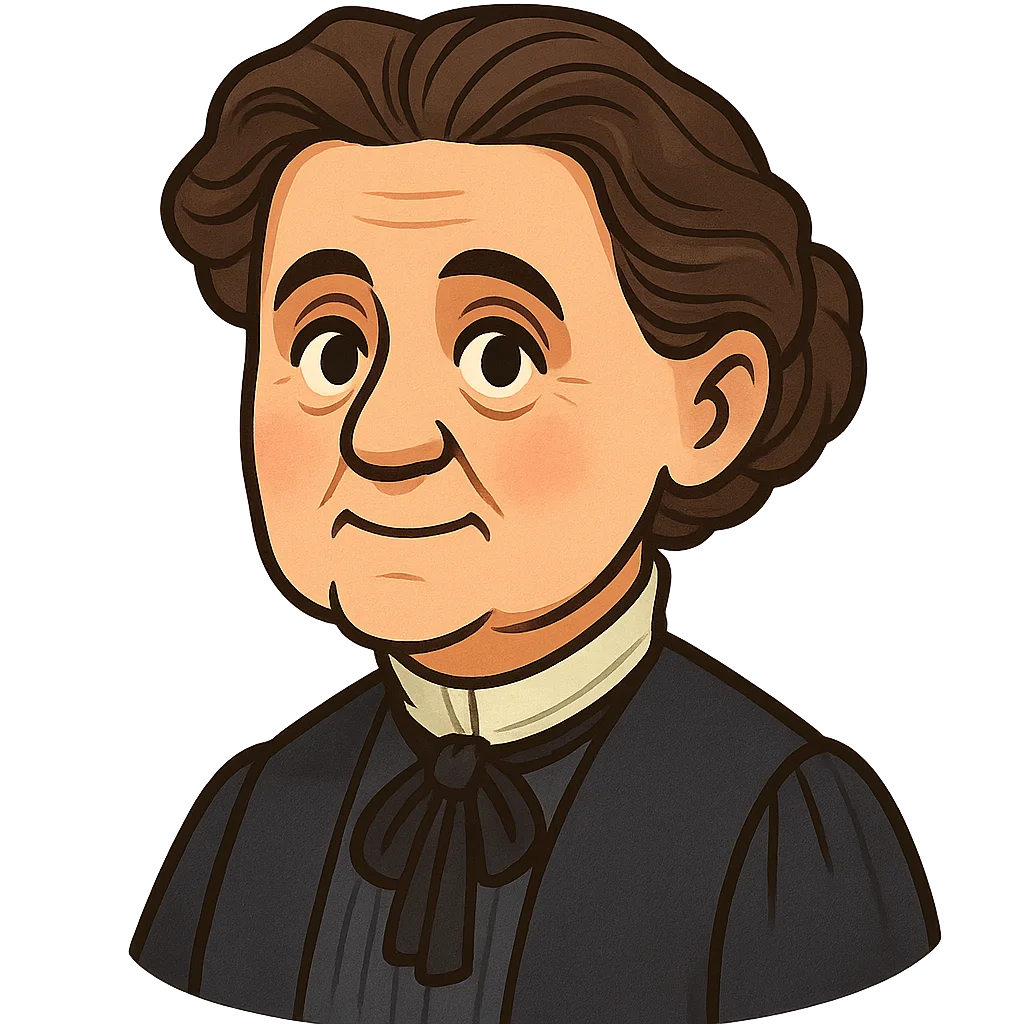
Jane Addams: A Neighbor to the World
Hello, my name is Jane Addams. I was born on September 6th, 1860, in a small town called Cedarville, Illinois. My father was a great inspiration to me; he taught me the importance of being a good neighbor and helping others, which became the guiding principle of my life. Even as a young girl, I knew I wanted to do something important, especially for people who didn't have the same advantages as my family. I attended college at the Rockford Female Seminary and graduated in 1881 with a strong sense of purpose. My original dream was to become a doctor so I could directly help the sick. However, I experienced some health problems of my own that made it difficult to pursue that specific path. Even though my plan had to change, I never gave up on my fundamental dream of making a meaningful difference in the world.
After college, I felt a bit lost about what to do next, so I traveled through Europe with some of my friends. It was during a trip to London, England, in 1888 that I discovered something that would change my life and give me a clear direction. I visited a remarkable place called Toynbee Hall. It was a 'settlement house,' which was a very new and exciting idea at the time. The concept was simple but powerful: educated people would live right in the middle of a poor neighborhood, sharing their knowledge, skills, and resources directly with their neighbors. They offered classes, formed clubs, and most importantly, offered friendship and support. Seeing Toynbee Hall in action was like a lightbulb turning on in my head. I knew, with absolute certainty, that this was what I wanted to do back home in America. I had found my mission.
When I returned to the United States, I was filled with a new sense of purpose. My good friend, Ellen Gates Starr, shared my vision, and together we decided to start our own settlement house in the bustling city of Chicago. In 1889, we found a large, old mansion on Halsted Street that had once belonged to a man named Charles Hull. The house was located in the heart of a neighborhood crowded with families who had recently immigrated from countries like Italy, Germany, and Poland, all trying to build new lives. On September 18th, 1889, we officially opened the doors to what we called Hull House. At first, we just wanted to be good neighbors and offer a helping hand. We soon realized the community needed so much more. We started a kindergarten for children whose mothers worked long hours in factories, opened a public kitchen, and offered classes in English, cooking, and sewing. Soon, Hull House grew to include a gymnasium, an art gallery, a music school, and even a theater. It became a vibrant community center where everyone was welcome—a place where people could find help, learn new skills, and celebrate their cultures together.
Living at Hull House opened my eyes to the much bigger problems our neighbors faced every day. I saw young children working long, exhausting hours in dangerous factories, and I saw families living in dirty, unsafe buildings that were not fit for anyone. I came to understand that simply helping people one by one wasn't enough to solve these deep-rooted issues; we had to change the laws to protect them. This realization turned me into an activist. I worked with others to investigate and document the terrible conditions in factories and neighborhoods. Our hard work paid off when, in 1893, we helped pass the first law in Illinois to require safety inspections in factories. We continued to fight for laws that would limit how many hours women and children could work and for the creation of public parks and playgrounds. I also became a strong supporter of women's suffrage—the right for women to vote—because I believed their voices were essential to solving society's most pressing problems.
My desire to help people was not limited to Chicago or even the United States. I held a deep belief that countries, just like individual neighbors, should find peaceful ways to solve their disagreements instead of resorting to war. When World War I began in 1914, I spoke out against it, even though it was not a popular position to take at the time. I was convinced that violence was not the answer. To further this cause, I traveled to Europe to meet with other women who also wanted to work for peace. In 1919, after the war ended, I helped found an important organization called the Women's International League for Peace and Freedom, and I had the honor of serving as its first president. For the rest of my life, I argued that true peace was about more than just the absence of fighting; it was about creating a world where every person was treated with fairness and respect.
For my lifelong work in social reform and my dedicated efforts to promote world peace, I was awarded the Nobel Peace Prize in 1931. It was a tremendous honor to be recognized for the causes to which I had dedicated my life. I lived to be 74 years old, passing away in 1935. Today, I am often remembered as the 'mother' of social work in America. The ideas we pioneered at Hull House spread across the country, inspiring the creation of hundreds of other settlement houses and helping to establish new laws that protect workers and families. I hope my story shows you that when you see a problem in the world, no matter how big it seems, you have the power to help fix it, one neighbor at a time.
Activities
Take a Quiz
Test what you learned with a fun quiz!
Get creative with colors!
Print a coloring book page of this topic.
















 Free for Educators