English

Kalpana Chawla
Kalpana Chawla was an Indian-born American astronaut and aerospace engineer who was the first woman of Indian…
Reads at Grades 6–8 Listens at Grades 4–8
Print & create
Answer keys·No prep·Free with an account
28 worksheets · answer keys · full story · quiz · Ages 10-12 · CEFR B2
Plus adds 280,000+ more stories in 27 languages, audio for every one, and printables for all of them.
Just want Kalpana Chawla?
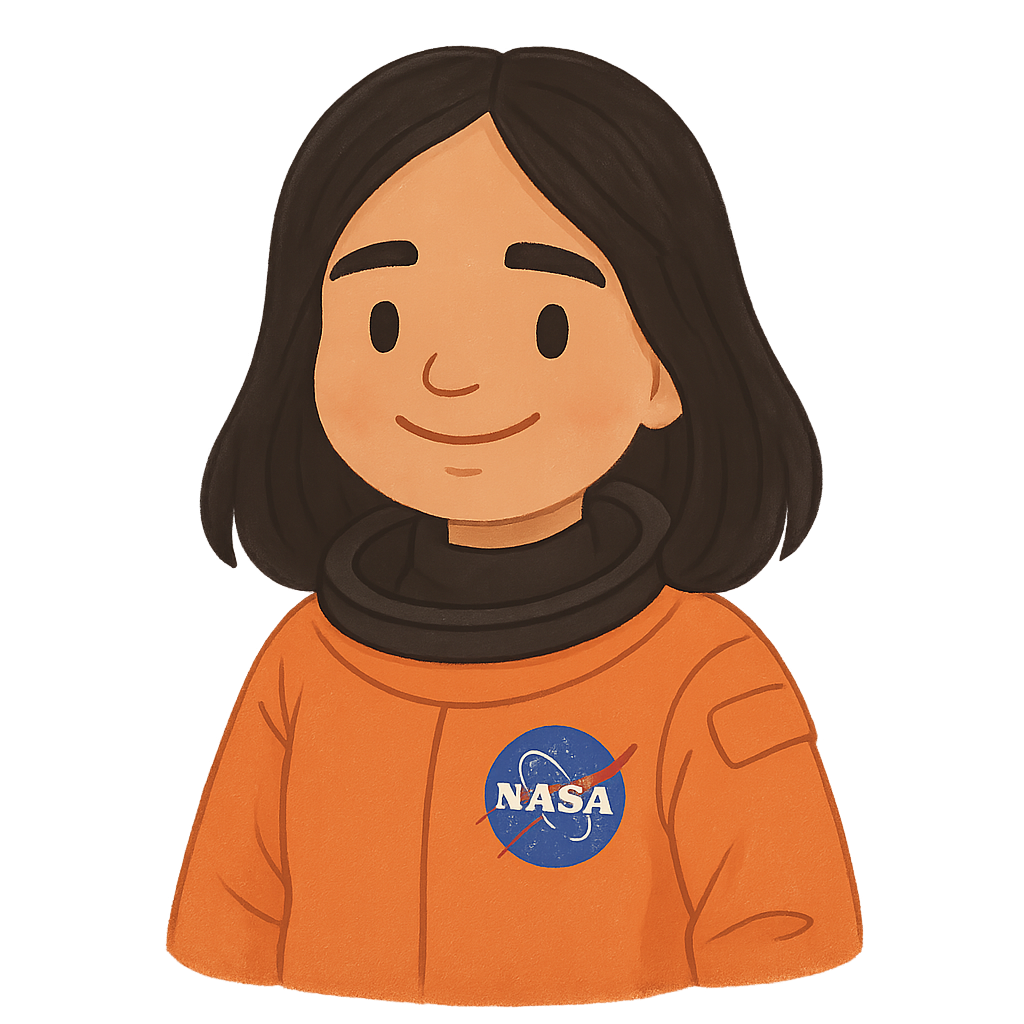
Hello, my name is Kalpana Chawla, and I want to tell you my story about reaching for the stars. I was born on March 17th, 1962, in a town called Karnal, India. From a very young age, I was completely fascinated by the sky. I loved watching airplanes fly high above my home and would often ask my father to take me to the local flying club just so I could see them up close. In school, my notebooks were filled with drawings of airplanes, and I dreamed of one day soaring among the clouds myself. I knew I wanted to study how things fly, which led me to the field of aeronautical engineering. At that time in India, this was not a common path for girls, but I was determined to follow my passion. I worked hard in my classes, and my dedication paid off when I earned my degree in Aeronautical Engineering from Punjab Engineering College in 1982.
My dream was bigger than just flying in airplanes; I wanted to travel all the way to space. To achieve that, I knew I had to move to the United States, where the most advanced space programs were. So, in 1982, I left my home in India to continue my education. It was a very big change, but my excitement for what lay ahead gave me strength. I first attended the University of Texas at Arlington, where I earned a master's degree in aerospace engineering in 1984. I didn't stop there. I went on to the University of Colorado Boulder and earned a PhD in the same field in 1988. During these busy years of study, I also met a wonderful man and flight instructor named Jean-Pierre Harrison, and we were married in 1983. Another crucial step toward my ultimate goal came in 1991, when I became a naturalized U.S. citizen, which was a requirement to become a NASA astronaut.
Kalpana Chawla
Hello, my name is Kalpana Chawla, and I want to tell you my story about reaching for the stars. I was born on March 17th, 1962, in a town called Karnal, India. From a very young age, I was completely fascinated by the sky. I loved watching airplanes fly high above my home and would often ask my father to take me to the local flying club just so I could see them up close. In school, my notebooks were filled with drawings of airplanes, and I dreamed of one day soaring among the clouds myself. I knew I wanted to study how things fly, which led me to the field of aeronautical engineering. At that time in India, this was not a common path for girls, but I was determined to follow my passion. I worked hard in my classes, and my dedication paid off when I earned my degree in Aeronautical Engineering from Punjab Engineering College in 1982.
My dream was bigger than just flying in airplanes; I wanted to travel all the way to space. To achieve that, I knew I had to move to the United States, where the most advanced space programs were. So, in 1982, I left my home in India to continue my education. It was a very big change, but my excitement for what lay ahead gave me strength. I first attended the University of Texas at Arlington, where I earned a master's degree in aerospace engineering in 1984. I didn't stop there. I went on to the University of Colorado Boulder and earned a PhD in the same field in 1988. During these busy years of study, I also met a wonderful man and flight instructor named Jean-Pierre Harrison, and we were married in 1983. Another crucial step toward my ultimate goal came in 1991, when I became a naturalized U.S. citizen, which was a requirement to become a NASA astronaut.
After finishing all my years of school, I started my professional career as a scientist for NASA at their Ames Research Center in 1988. I truly enjoyed my research work, but I never lost sight of my dream to fly into space. In 1994, I took the chance and applied to NASA's astronaut program. It was an extremely competitive process, with thousands of very qualified applicants, but I was overjoyed when I was chosen. In March of 1995, I reported to the Johnson Space Center in Texas to begin my official training. The training was some of the hardest work I had ever done. My fellow astronaut candidates and I had to learn all about the complex systems of the spacecraft, practice doing spacewalks in a giant swimming pool, and fly in special jets that simulate the feeling of spaceflight. I was finally on my way to fulfilling the dream I'd had since I was a little girl in Karnal.
On November 19th, 1997, the moment I had worked toward for so long finally arrived. I flew into space for the first time aboard the Space Shuttle Columbia on mission STS-87. The feeling of the powerful launch, pushing us faster and faster into the sky, was absolutely incredible. As a mission specialist, one of my main jobs was to operate the shuttle's robotic arm. Over the course of our 16 days in space, our crew traveled more than 6.5 million miles. But the most memorable part for me was looking down at our beautiful, blue planet from the window of the shuttle. It was a breathtaking experience that I will never forget. When I landed back on Earth on December 5th, 1997, I became the first woman of Indian origin to have ever traveled to space. I hoped my journey would inspire other people, especially young ones, to follow their own dreams, no matter how impossible they might seem.
I was so grateful to be chosen for a second space mission, STS-107, which was also on the Space Shuttle Columbia. Our crew of seven launched on January 16th, 2003. This was a very special mission because it was dedicated completely to science. For 16 days, we worked around the clock, conducting more than 80 different experiments that would help scientists on Earth learn more about our world, and about how being in space affects the human body. We all worked together as a close team, and I was very proud of everything we were able to accomplish for the sake of science and discovery.
Our mission came to an end on February 1st, 2003. During our return to Earth, the space shuttle was damaged and tragically broke apart. My crew and I did not survive. I lived to be 40 years old, and I filled my life with the pursuit of a dream I held since childhood. My life is proof that your background does not have to define your future. I hope my story continues to encourage young people everywhere, especially girls in India, to look up at the stars and know that with dedication and courage, anything is possible.
Wow facts
About
Kalpana Chawla was an Indian-born American astronaut and aerospace engineer who was the first woman of Indian origin to go to space. She was one of seven crew members who died in the Space Shuttle Columbia disaster in 2003.
Take a Quiz
Question 1 of 5
In your own words, describe the main steps Kalpana Chawla took to achieve her dream of going to space, starting from her education in India.
Explore next

Want to do even more?
Go beyond exploring. Unlock tools that turn every story into real learning.

Storypie Plus for families
Full stories, quizzes, and printables. Nights and car rides, sorted.
- Unlimited audio stories
- Create Mode: your child stars in the story
- Offline downloads
- Printable worksheets & coloring pages

Why Storypie for Schools
Students engaged. Prep in seconds. Evenings back to you.
- Worksheets & Quizzes
- Classroom Management
- Formative Assessment
- Custom Curriculum & Lesson Plans
- 27 Languages

Why Storypie for Homeschool
Curriculum done. They'll ask for more. Hours back in your day.
- Worksheet Generator
- First-Person Audio Stories
- Built-in Comprehension Quizzes
- Custom Curriculum & Lesson Plans
- Print & Go Activities