English


Vikram Sarabhai
Vikram Sarabhai was an Indian physicist and astronomer who is widely regarded as the father of India's space…
Reads at Grades 6–8 Listens at Grades 4–8
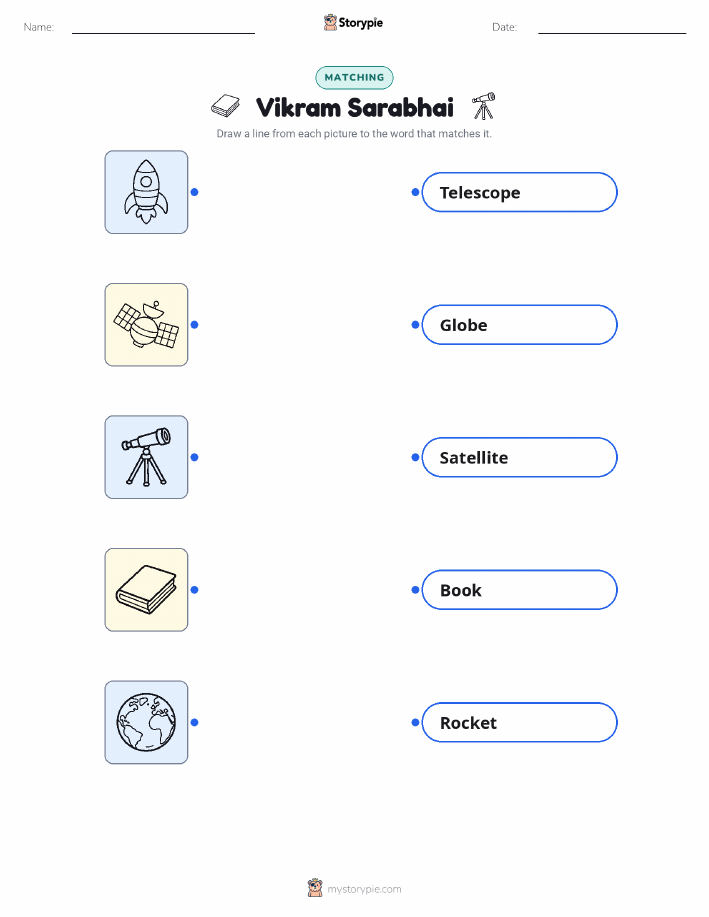
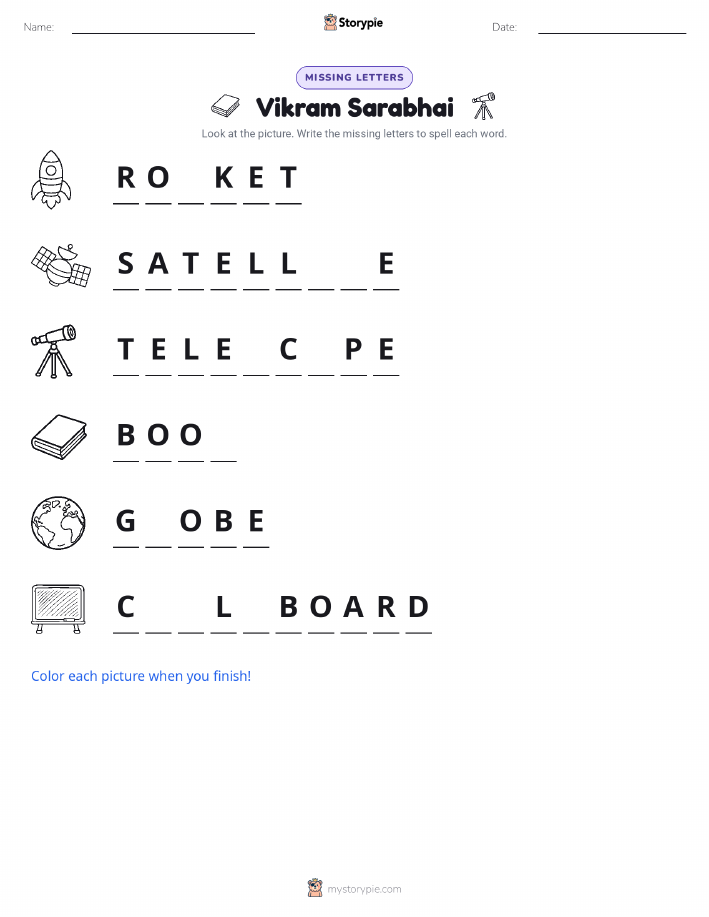
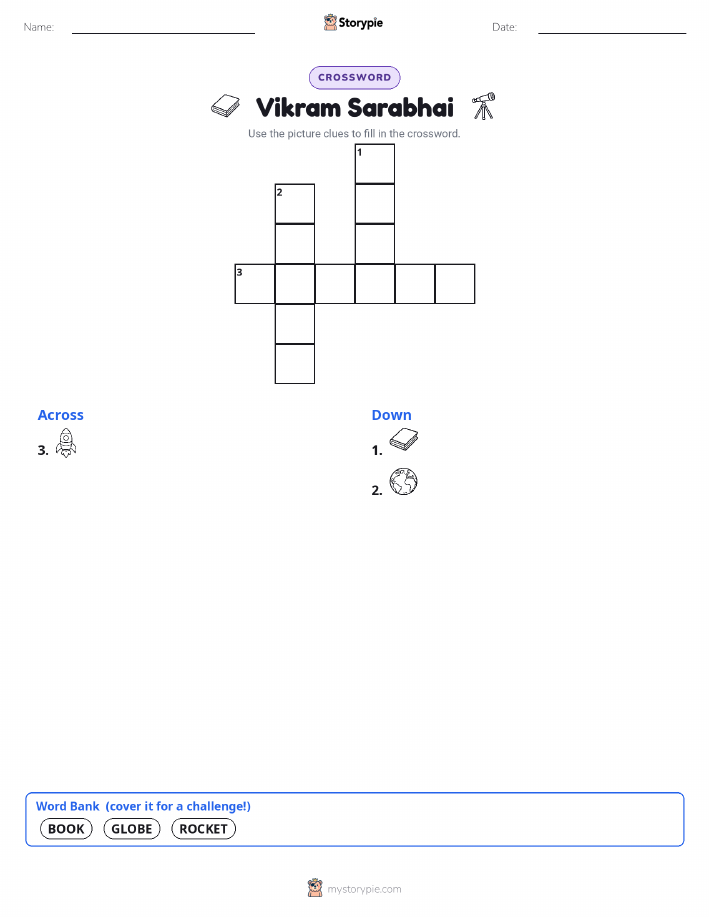
Print & create
Answer keys·No prep·Free with an account
28 worksheets · answer keys · full story · quiz · Ages 10-12 · CEFR B2
Plus adds 279,000+ more stories in 27 languages, audio for every one, and printables for all of them.
Just want Vikram Sarabhai?

Hello, my name is Vikram Sarabhai, and I am often called the father of India's space program. My story begins in a time of great change for my country. I was born on August 12th, 1919, in the city of Ahmedabad, India. My family was deeply involved in the movement for India's independence, and our home was often visited by great leaders like Mahatma Gandhi. My parents, Ambalal and Sarla Devi, believed that curiosity was the best teacher. Instead of sending my siblings and me to a traditional school, they started one right in our home. It was a place where we were encouraged to ask questions, explore our interests, and think for ourselves. This unique education ignited my passion for science and mathematics. From a young age, I was fascinated by how the world worked, and I knew I wanted to spend my life uncovering its secrets. This early encouragement to be curious and to serve our country shaped the entire course of my life.
My quest for knowledge took me far from home. In 1937, I traveled to England to study at the prestigious University of Cambridge. I was excited to learn from some of the world's greatest minds. However, my time there was interrupted by the start of World War II. It was no longer safe to stay in England, so I returned to India. But my studies did not stop. I began working at the Indian Institute of Science in Bangalore under the guidance of a brilliant scientist and Nobel laureate, Sir C. V. Raman. There, I began my research into cosmic rays, the mysterious high-energy particles that travel through space and hit the Earth. When the war ended, I went back to Cambridge to finish my studies. In 1947, I earned my PhD. That same year was incredibly important for another reason: it was the year India finally gained its independence. With my degree in hand and a heart full of hope for my newly free country, I knew I had to return and use my education to help build our nation.
Vikram Sarabhai: India's Visionary of Space
Hello, my name is Vikram Sarabhai, and I am often called the father of India's space program. My story begins in a time of great change for my country. I was born on August 12th, 1919, in the city of Ahmedabad, India. My family was deeply involved in the movement for India's independence, and our home was often visited by great leaders like Mahatma Gandhi. My parents, Ambalal and Sarla Devi, believed that curiosity was the best teacher. Instead of sending my siblings and me to a traditional school, they started one right in our home. It was a place where we were encouraged to ask questions, explore our interests, and think for ourselves. This unique education ignited my passion for science and mathematics. From a young age, I was fascinated by how the world worked, and I knew I wanted to spend my life uncovering its secrets. This early encouragement to be curious and to serve our country shaped the entire course of my life.
My quest for knowledge took me far from home. In 1937, I traveled to England to study at the prestigious University of Cambridge. I was excited to learn from some of the world's greatest minds. However, my time there was interrupted by the start of World War II. It was no longer safe to stay in England, so I returned to India. But my studies did not stop. I began working at the Indian Institute of Science in Bangalore under the guidance of a brilliant scientist and Nobel laureate, Sir C. V. Raman. There, I began my research into cosmic rays, the mysterious high-energy particles that travel through space and hit the Earth. When the war ended, I went back to Cambridge to finish my studies. In 1947, I earned my PhD. That same year was incredibly important for another reason: it was the year India finally gained its independence. With my degree in hand and a heart full of hope for my newly free country, I knew I had to return and use my education to help build our nation.
Returning to an independent India was a profound experience. I saw a country full of potential, ready to build its own future. I believed that science and technology were not luxuries, but essential tools for solving the problems faced by our people. My first major step was to create a center for scientific research. With the support of my family and friends, I founded the Physical Research Laboratory, or PRL, in Ahmedabad on November 11th, 1947. We started small, in just a few rooms, but our dreams were big. The PRL was dedicated to studying the sciences of the atmosphere and space. I wanted it to be a place where India's brightest minds could work on cutting-edge research without having to leave the country. But my vision went beyond just one laboratory. I knew that for India to grow, we needed skilled managers and leaders in all fields. This belief led me to help establish the Indian Institute of Management Ahmedabad in 1961, an institution that would train the next generation of leaders to guide our nation's industries and economy.
My greatest dream, however, was to take India to the stars. When other countries began exploring space in the mid-20th century, I saw an incredible opportunity. For me, a space program was not about competing in a race or showing off power. It was about using space technology to solve real-world problems for the people of India. I imagined satellites that could help farmers by predicting the weather, connect remote villages with communication, and educate children across the country. In 1962, I persuaded the government of this vision, and we formed the Indian National Committee for Space Research, or INCOSPAR. Our first major project was to find a place to launch rockets. We chose a small fishing village in Kerala called Thumba, because its location on the magnetic equator was perfect for atmospheric studies. On November 21st, 1963, we successfully launched our first sounding rocket from the Thumba Equatorial Rocket Launching Station. It was a humble beginning, but it was the start of India's journey into space. This organization that I founded would later grow, and in 1969, it was renamed the Indian Space Research Organisation, or ISRO.
My work expanded in 1966 when I was asked to become the Chairman of the Atomic Energy Commission after the tragic death of my friend and fellow scientist, Homi J. Bhabha. I took on this role with a deep sense of responsibility, continuing his work to develop nuclear energy for peaceful purposes. I lived to be 52 years old, and my time on Earth ended on December 30th, 1971. Although I was no longer there to see it, the vision I had for India continued to grow. In 1975, the team I had built launched India's first-ever satellite, Aryabhata, into space. Today, ISRO is one of the world's leading space agencies, sending missions to the Moon and Mars and improving the lives of millions. My hope is that my story shows you that with a clear vision and a desire to help others, you can reach for the stars and make a difference in the world.
Wow facts
About
Vikram Sarabhai was an Indian physicist and astronomer who is widely regarded as the father of India's space program. He founded the Indian National Committee for Space Research (INCOSPAR) in 1962, which was later renamed the Indian Space Research Organisation (ISRO) in 1969, and he was instrumental in developing nuclear power in India.
Take a Quiz
Question 1 of 5
What was Vikram Sarabhai's primary motivation for starting India's space program?
Explore next





Want to do even more?
Go beyond exploring. Unlock tools that turn every story into real learning.

Storypie Plus for families
Full stories, quizzes, and printables. Nights and car rides, sorted.
- Unlimited audio stories
- Create Mode: your child stars in the story
- Offline downloads
- Printable worksheets & coloring pages

Why Storypie for Schools
Students engaged. Prep in seconds. Evenings back to you.
- Worksheets & Quizzes
- Classroom Management
- Formative Assessment
- Custom Curriculum & Lesson Plans
- 27 Languages

Why Storypie for Homeschool
Curriculum done. They'll ask for more. Hours back in your day.
- Worksheet Generator
- First-Person Audio Stories
- Built-in Comprehension Quizzes
- Custom Curriculum & Lesson Plans
- Print & Go Activities