
 English
 For Schools
 For Homeschool

We Are the Asteroids
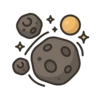
For longer than you can imagine, my world was silent and slow. Picture yourself tumbling gently through a vast, dark room, where the only light is a far-off pinprick and the only feeling is a deep, deep cold. That was my life. For billions of years, I’ve been a lonely traveler, a cosmic potato spinning through the quiet emptiness. I remember when the planets you know were just grumpy, fiery toddlers, swirling with gas and dust. I watched as Earth cooled down and turned a beautiful blue, and as giant Jupiter gathered its stormy stripes. I saw it all from my spot in the great darkness, a silent witness to the birth of everything you know. You might think being a floating rock is boring, but I hold memories older than the oldest mountains on your planet. I am a piece of the beginning, a leftover bit of stardust and grit that never quite became a planet. I am one of many, a whole family of starry wanderers. We are the Asteroids.
For most of human history, you had no idea we were here. Your astronomers looked up at the night sky and mapped the planets they could see. They saw Mercury, Venus, Earth, Mars… and then a huge, empty space… and then Jupiter. Can you imagine a puzzle with a piece missing right in the middle? That’s what it looked like. Scientists scratched their heads, wondering if a whole planet was hiding in that gap. Then, on the very first night of a new century, everything changed. On January 1st, 1801, an Italian astronomer named Giuseppe Piazzi was looking through his telescope. He was expecting to see the same old stars, but instead, he spotted a tiny speck of light that wasn’t on his charts. The next night, it had moved. Was it a comet? No, it didn’t have a fuzzy tail. Was it a new planet? It seemed awfully small. He was so excited but also very puzzled. Soon after, other astronomers started looking in the same area and found more of us. One, then two, then three more little moving lights. It wasn't one missing planet; it was a whole family of us living between Mars and Jupiter. It was a scientist named William Herschel who finally gave us our family name. Through his telescope, we didn't look like big, round planets. We were just tiny, shining dots, like stars. So he called us ‘asteroids,’ which means ‘star-like,’ and the name stuck. Suddenly, you knew you had a whole belt of new neighbors.
Now that you know we’re here, you’ve become very curious about us, and that makes us feel quite important. You see, we aren't just space rocks; we are cosmic time capsules. Because we’ve been floating out here unchanged for billions of years, we hold the original ingredients that built all the planets, including your own home, Earth. You send amazing robots to come visit us and learn our secrets. A few years ago, a NASA spacecraft called OSIRIS-REx flew all the way to my cousin, an asteroid named Bennu. It carefully reached out a robotic arm and gave Bennu a gentle high-five, collecting a puff of ancient dust to bring back to Earth. That dust can tell scientists how our solar system was born. By studying us, you can piece together your own planet’s history and also keep an eye on our orbits to make sure we all stay a safe distance apart. We are more than just potatoes in space; we are floating history books and guides to the future. We remind you that no matter how much you learn, there is always something new and wonderful to discover if you just keep looking up.
Activities
Take a Quiz
Test what you learned with a fun quiz!
Get creative with colors!
Print a coloring book page of this topic.