

 English

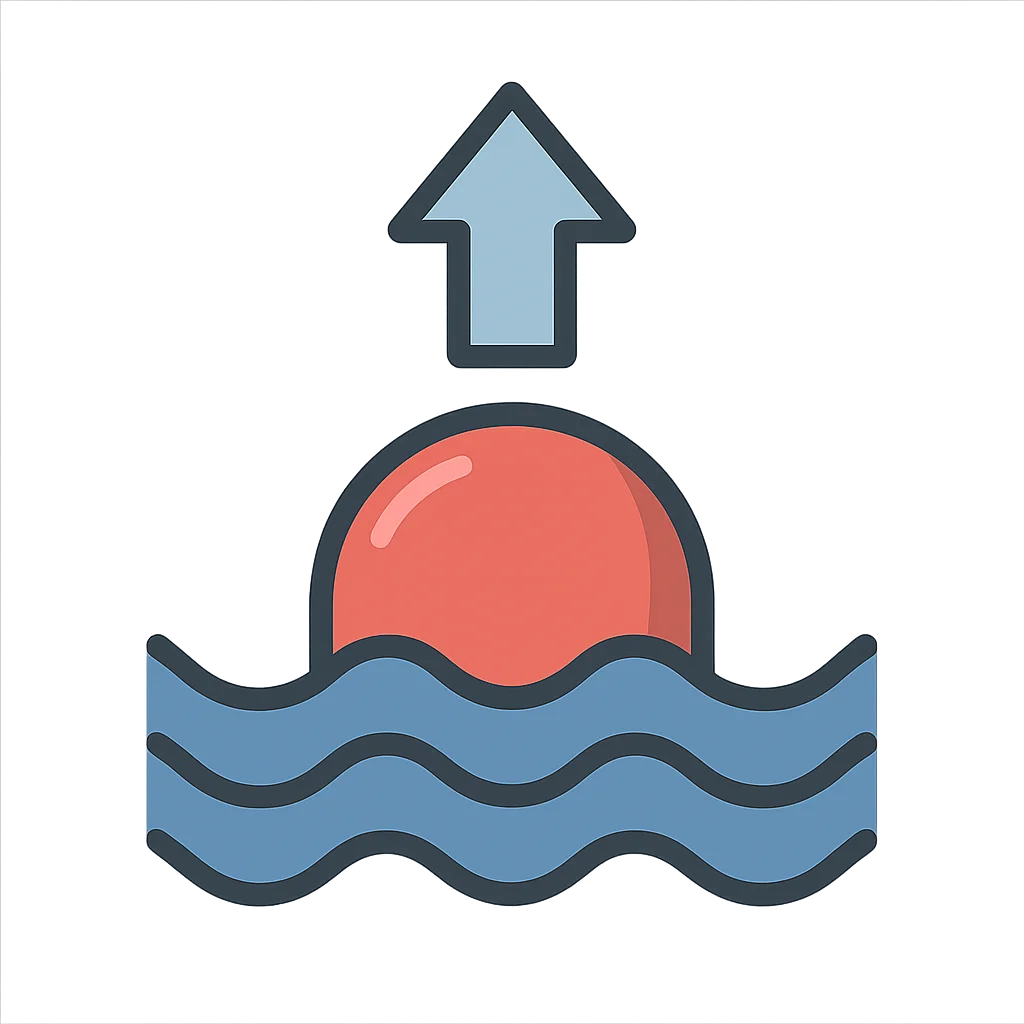
The Upward Push: A Story of Buoyancy
Have you ever felt it. That gentle, insistent push when you try to dunk a beach ball under the water at the pool. Or the amazing lightness you feel when you lie back and float, staring up at the clouds. That’s me. I’m the secret force that helps rubber ducks stay afloat in the bathtub and gigantic steel ships cruise across the ocean without sinking. For thousands of years, people felt my power, but they didn’t have a name for me. They saw logs floating down rivers and wondered how something so heavy could rest on water as if it were a solid bed. They built simple rafts and boats, learning through trial and error how to work with me, even without fully understanding my rules. I was a quiet, helpful mystery, a constant partner in their relationship with water. Before you had a name for gravity, you felt its pull. In the same way, you’ve always felt my lift. I am the reason a cork bobs back to the surface and why an iceberg, a mountain of ice, can drift through the sea. I am the upward hug that water and even air can give. My name is Buoyancy, and my story is about a famous bathtub, giant ships, and even journeys into the sky.
My big debut in human history happened in the 3rd century BCE, thanks to a very clever man named Archimedes who lived in Syracuse, a city on the island of Sicily. The story goes that the king, Hiero II, had a problem. He had given a goldsmith a chunk of gold to make a new crown, but he suspected the sneaky smith had mixed in some cheaper silver. The king was furious but needed proof. He asked Archimedes to figure out if the crown was pure gold without damaging it in any way. Archimedes puzzled over this for days, knowing that gold is denser than silver, meaning a pound of gold takes up less space than a pound of silver. The challenge was measuring the crown's volume precisely. Then, one afternoon around 250 BCE, as he lowered himself into a public bath filled to the brim, he noticed the water level rise and spill over the side. In that instant, he understood everything. He realized that the amount of water that spilled out was equal in volume to the space his body took up. And he realized that I was pushing up on him with a force equal to the weight of the water he had pushed aside. He was so excited that he supposedly leaped out of the bath and ran through the streets shouting 'Eureka.', which means 'I have found it.'. This became known as Archimedes' Principle, and it was the first time someone had written down the rules of how I work. He used this idea to solve the king's problem. By placing the crown in a full container of water and measuring the overflow, and then doing the same with a pure gold block of the same weight, he could compare their volumes. The crown displaced more water, proving it was less dense and therefore not pure gold. The goldsmith had cheated. This discovery wasn't just about catching a dishonest worker; it changed the world. Shipbuilders could now use my principle to design bigger, safer, and more efficient ships. They understood that a ship floats because its hull displaces a large amount of water, and as long as the weight of that displaced water is more than the weight of the ship, I can hold it up. From the mighty triremes of Ancient Greece to the explorers' caravels in the 15th and 16th centuries that sailed across the globe, understanding me was key to mastering the oceans.
But I don't just work in water. I work in any fluid, and that includes the air all around you. It took a while longer for people to realize this. In the 18th century, two French brothers, Joseph-Michel and Jacques-Étienne Montgolfier, noticed that smoke from a fire rose upwards. They figured that if they could capture that hot air in a big, lightweight bag, I might be able to lift it. On June 4th, 1783, they held their first public demonstration of a hot air balloon in Annonay, France. The air inside their balloon, when heated, became lighter and less dense than the cooler air outside. I saw that less dense air and gave it a powerful upward push, lifting the entire balloon into the sky. Suddenly, humanity could fly. My work isn't just about lifting things up; it's also about controlling movement within a fluid. Think about a submarine. It's a master of working with me. To dive, it fills special containers called ballast tanks with water, making it heavier and denser than the surrounding water, so it sinks. To rise, it pushes the water out with compressed air, making it lighter again so I can push it back to the surface. Fish do this naturally with an internal organ called a swim bladder. Today, I am everywhere. I am in the life vest that keeps you safe in a boat, the weather balloon that gathers information high in the atmosphere, and the cargo ships that connect our world by carrying goods across vast oceans. I am a fundamental force of physics, a silent partner in exploration and engineering. The next time you see a boat gliding on a lake or feel yourself become wonderfully light in a swimming pool, remember me. I am Buoyancy, and I am here to lift you up, to open up the world's oceans and skies, and to remind you that sometimes, the greatest discoveries begin with a simple splash.
Activities
Take a Quiz
Test what you learned with a fun quiz!
Get creative with colors!
Print a coloring book page of this topic.











 Free for Educators