

 English

The Point That Changed Everything
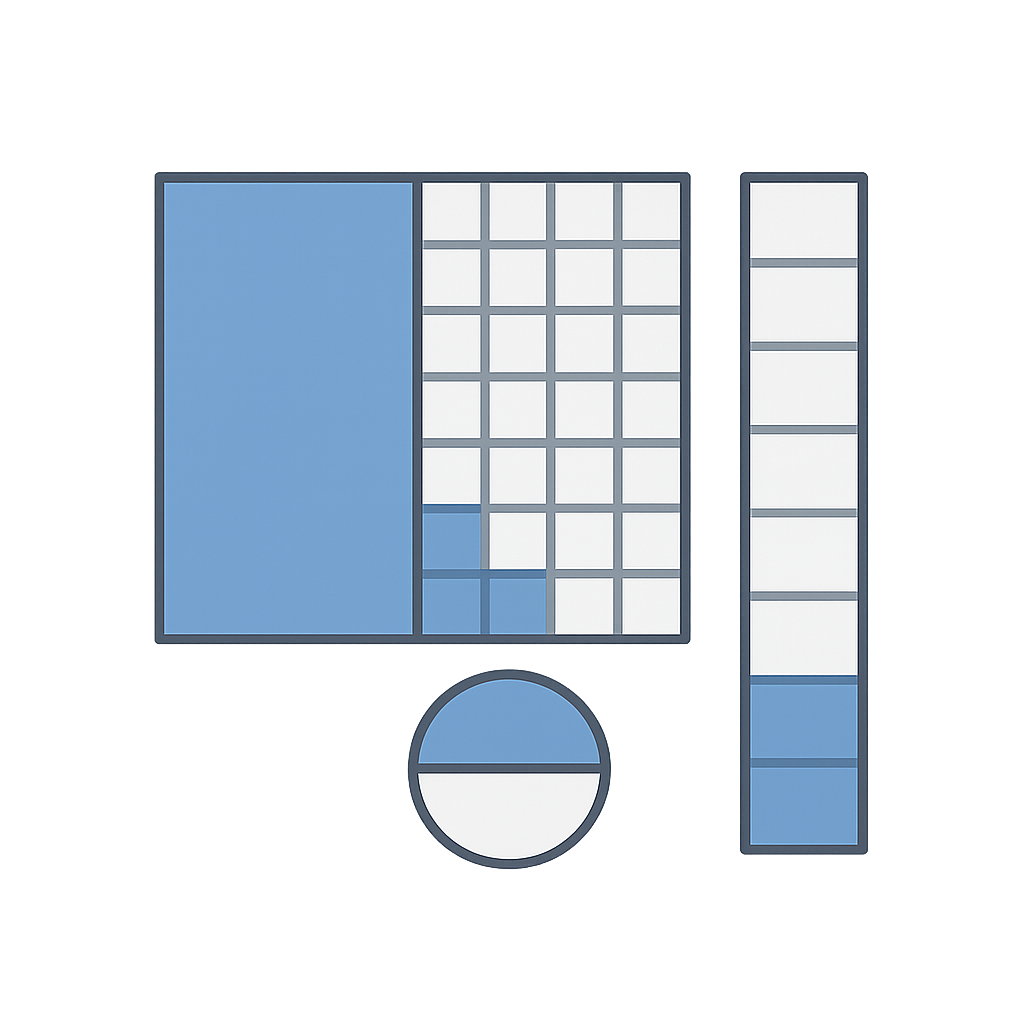
Hello. You might not notice me, but I am everywhere. Imagine a world with no in-between. A world where you could only have whole cookies, never half of one. A world where a race could only be won by a full second, never by a fraction of a moment. For thousands of years, that’s how people had to think. They had whole numbers, which were strong and reliable, but they left so many gaps. Trying to describe the parts of something was messy and complicated, a jumble of clumsy fractions that were difficult to work with. How much is one-third plus four-sevenths? It was a puzzle that could frustrate even the cleverest minds. People needed a simpler way to be precise, to be fair, to make sense of a world that wasn't just made of whole things. They needed a quiet hero to connect the whole to the part, to build a bridge across that gap. That hero is me. I am the small, humble dot that brings order to the pieces. I am the Decimal, and I’m here to tell you how I brought precision to the world.
For a long, long time, I was just an idea waiting for my moment. The brilliant mathematicians of ancient India had already built the perfect home for me: the base-ten number system, with its elegant digits from zero to nine. It was a system where each place value was ten times bigger than the one to its right. It was a beautiful, logical house, but the door to the smaller side, the fractional side, remained locked. People continued to wrestle with fractions, which were a real headache for anyone who needed accuracy. Think of a merchant trying to calculate the cost of a piece of fabric that wasn't a whole number of yards, or an astronomer trying to chart the subtle movements of the stars. Their calculations were tangled and took forever. I would pop up in the work of a few mathematicians here and there, but no one had truly introduced me to the world. That all changed in 1585. A clever and practical Flemish mathematician named Simon Stevin decided it was time everyone knew about me. He wrote a small but powerful book called 'De Thiende,' which means 'The Tenth.' In it, he laid out a clear system for working with tenths, hundredths, thousandths, and so on. He showed how I could make life easier for everyone—from surveyors measuring land to merchants counting money. He didn't use the simple dot you see today; his notation was a bit more complicated, with circles and numbers. But the revolutionary idea was there. A few decades later, a brilliant Scottish thinker named John Napier, who was busy inventing logarithms to make calculations even faster, helped streamline the whole process. He championed the use of a simple point—me!—to separate the whole number from its fractional part. At last, I was easy to use and understand. The door to the world of precision was finally unlocked for everyone.
Now, I am one of the busiest workers in your world. The moment you wake up, I am there. The alarm clock might read 6:30. The temperature outside might be 15.5 degrees Celsius. When you go to the store, you see me on every price tag, like $4.99 for a box of cereal or $1.25 for a drink. I am on the gas pump, measuring fuel to the thousandth of a gallon. I am the star of every sporting event, deciding the winner of a race by 0.01 seconds or giving a gymnast a score of 9.85. My work is critical in science and medicine. A doctor relies on me to measure the exact dosage of medicine, where 1.5 milliliters is very different from 2.0. An engineer uses me to design everything from a tiny microchip to a massive bridge, ensuring every measurement is perfect. When you listen to your favorite song on a digital device or play a video game, I am deep inside the computer's code, a silent, essential part of the binary language that makes it all possible. I may look like nothing more than a tiny speck of ink or a pixel on a screen, but I carry the weight of accuracy on my shoulders. I prove that the small, 'in-between' parts of the world are just as important as the whole things. So the next time you see me, give me a little nod. Remember my journey, and remember that even the smallest, most humble detail has the power to make a world of difference.
Activities
Take a Quiz
Test what you learned with a fun quiz!
Get creative with colors!
Print a coloring book page of this topic.















 Free for Educators