

 English

The Leader's Shadow
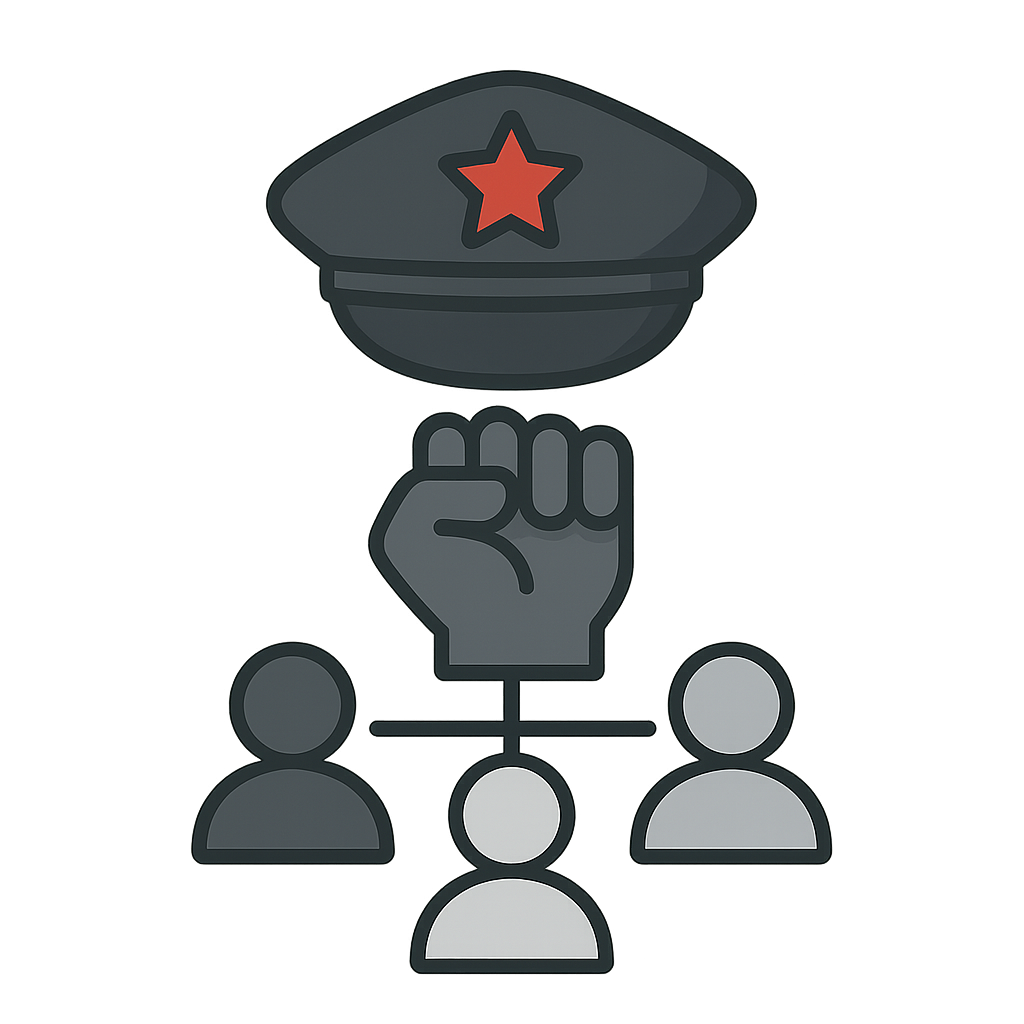
Imagine a world painted in just two colors: black and white. The streets are perfectly clean, and every day, thousands of people march in perfect, synchronized step, their faces turned toward posters of a single, smiling leader. On the radio, only one voice ever speaks, promising strength, order, and a glorious future. There are no arguments, no messy debates, and no difficult questions. Everything is simple. Everything is decided for you. It might sound peaceful, like a well-oiled machine. But in the quiet spaces between the marching boots and the booming radio announcements, you can feel something missing. The vibrant colors of new ideas have faded to grey. The music of many different voices has been silenced. Laughter feels rehearsed, and curiosity is a dangerous secret. This perfect order comes at a cost, a price paid with the freedom to think, to create, and to disagree. In this world of perfect control, I am the architect. I am the silence. I am Dictatorship.
My story, however, did not begin in shadow and silence. I was born from an idea in the ancient Roman Republic, more than two thousand years ago. The Romans were clever, and they knew that sometimes, during a great crisis like a war or a famine, decisions needed to be made quickly. They created a special, temporary role for a leader they called a 'dictator.' This person was given absolute power for a short time—usually six months—to solve the emergency, like a ship's captain taking complete control during a violent storm. Once the storm passed, the captain was expected to hand the wheel back to the crew. For centuries, it worked. Great men like Cincinnatus were called from their farms, saved Rome, and then returned to their fields without a second thought. But human nature is a tricky thing. Power can be alluring. Eventually, a man named Julius Caesar came along. In 44 B.C., after winning a long civil war, he had himself named 'dictator perpetuo'—dictator for life. The temporary solution for an emergency had become a permanent system of control. The very idea of me was twisted, and I was no longer a shield for the Republic, but a sword pointed at its heart.
Centuries passed, and I mostly slept, but I was reawakened in the 20th century with terrifying new strength. The world was reeling from a massive war, and people were scared, confused, and desperate for answers. This was the soil in which I could grow. And this time, I had powerful new tools. The invention of the radio meant a single leader's voice could now enter every home, repeating promises and lies until they felt like truth. Moving pictures in cinemas could show endless images of a strong, wise leader, creating what people called a 'cult of personality,' where the ruler was worshiped almost like a god. Leaders like Benito Mussolini in Italy, Joseph Stalin in the Soviet Union, and Adolf Hitler in Germany became masters of this new power. They offered simple solutions to complex problems, often by creating an enemy—a group of people to blame for everything that was wrong. They controlled the newspapers, burned books that contained challenging ideas, and made sure that any voice that spoke against them was silenced. They used fear as their greatest weapon, convincing people that the only way to be safe was to give up their freedom and follow one leader without question. My shadow stretched across nations, and my methods became more sophisticated than the Romans could have ever imagined.
But here is my secret, the truth I can never escape: my power is built on a fragile foundation. I can build walls, control radios, and fill libraries with my own stories, but I can never truly extinguish the light in the human spirit. People are born with a deep, unshakeable desire to be free, to speak their own thoughts, and to choose their own leaders. It takes immense courage, but history is filled with stories of ordinary people who dared to whisper, then to speak, and finally to shout for their rights. They stood up for the idea of democracy—the belief that power belongs to the many, not the few. My story is a dark one, but it is also a powerful lesson. By understanding how I work—how I use fear, silence, and simple promises to gain control—you learn how precious your own freedoms are. You learn the importance of listening to many different voices, especially the ones you disagree with. My existence reminds you to ask questions, to think for yourselves, and to work together to build a world where every voice matters and the future is not written by one person, but by everyone. That is a power I can never defeat.
Activities
Take a Quiz
Test what you learned with a fun quiz!
Get creative with colors!
Print a coloring book page of this topic.















 Free for Educators